


Premier Wu Den-yih (吳敦義) said yesterday that despite various tax cutting measures, the country’s tax revenue had increased this year, indicating that the domestic economy is improving and tax reductions benefited average citizens.
The government collected a total of NT$388.5 billion (US$12.29 billion) in taxes in the first four months of this year, representing a year-on-year growth of 15.4 percent, Wu said, quoting the latest Ministry of Finance figures.
“The growing tax revenue indicates that Taiwan’s economic climate has rebounded,” Wu said at a Cabinet meeting in which he heard reports from ministry officials on this year’s tax revenues.
The premier said reductions offered by the ministry on composite income tax, alcohol and tobacco tax, commodity tax and inheritance tax, helped achieve the government’s goal of taking better care of citizens by reducing their overall tax burden.
Meanwhile, Deputy Minister of Finance Chang Sheng-ford (張盛和) said that strong growth in revenues from the composite income tax, business tax and commodity tax over the past four months clearly indicated that the domestic economy “has been recovering briskly.”
He attributed the economic recovery in part to remittances from Taiwanese businesspeople operating in China that have helped fuel domestic investment.
Chang estimated that the ministry would collect more than NT$1.6 trillion in tax this year, with total revenues expected to increase by 5.6 percent, or NT$86.4 billion, from the previous year.
He attributed the increase in the first four months of the year mainly to a surge in land value increment tax revenues, which stood at NT$24.6 billion, a rise of NT$11.9 billion, or 93.6 percent, from the same period last year.
This marked the largest growth in history in terms of January-April land value increment tax revenues, Chang said, adding that the figure showed trading in the real estate market is far brisker than a year earlier.
Accumulated securities transaction tax revenues reached NT$34.2 billion in the four-month period, up NT$8.8 billion from the same period last year, according to the ministry’s statistics.
Chang said that salary earners contributed only about 55 percent of the country’s total revenue from composite income tax last year.
He added that nearly 71 percent of the country’s taxpayers pay less than 13 percent in income tax.

HSBC Holdings PLC is deepening its commitment to Taiwan as the economy emerges as one of the bank’s fastest-growing markets globally, driven by an artificial intelligence (AI) investment boom, expanding cross-border trade, and rising wealth creation. “The advantage that Taiwan has is a growth story linked to the semiconductor and broader AI industries, strong underlying corporate performance, and wealth creation,” said Surendra Rosha, HSBC’s co-chief executive for Asia and the Middle East, in an exclusive interview with the Taipei Times on June 2, during this year’s HSBC Taiwan Conference. That combination has helped HSBC cement its position as the most profitable international
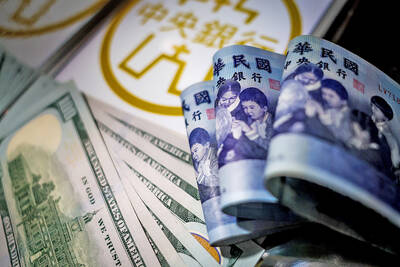
The New Taiwan dollar yesterday fell sharply against the US dollar to close at its lowest level since May 22 amid a massive outflow of funds from the country because of investors panicking over global equity markets. The NT dollar ended at NT$31.580 against the US dollar, slightly lower than its close of NT$31.568 on May 22, after moving between NT$31.5 and NT$31.648 on combined turnover of US$3.062 billion on the Taipei Foreign Exchange and the Cosmos Foreign Exchange. The NT dollar received a significant hit in the morning session, slumping as much as NT$0.173 at a time when other Asian currencies
Taiwan Semiconductor Manufacturing Co (TSMC, 台積電) is now ranked ninth among the world’s 100 most valuable companies after its market capitalization more than doubled over the past year, PricewaterhouseCoopers (PwC) Taiwan said in a report last month. TSMC’s market capitalization surged 101 percent year-on-year to US$1.427 trillion as of March 31, the accounting and consulting firm’s 2026 Global Top 100 Companies by Market Capitalization report said. The gain catapulted the world’s largest contract chipmaker from 12th place to ninth in the rankings, and it was the fastest-growing among the global top 10, it said. TSMC was the only Taiwanese company among the top
Taiwan Semiconductor Manufacturing Co (TSMC, 台積電) yesterday reported record revenue of NT$416.975 billion (US$13.17 billion) for last month, putting the world’s largest contract chipmaker on track to set a record for quarterly revenue. Last month’s figure surpassed March’s record NT$415.19 billion and represented increases of 1.5 percent from April and 30.1 percent from a year earlier. For the first five months of the year, TSMC generated NT$1.96 trillion in revenue, up 30 percent year-on-year, it said in a statement. TSMC has forecast second-quarter revenue of between US$39 billion and US$40.2 billion, representing sequential growth of about 10 percent and year-on-year growth of about


 RSS
RSS