

Once known as the “umbrella kingdom” and the “footwear kingdom,” Taiwan no longer reigns as a stronghold of labor-intensive industries.
The country has seen a major exodus of companies dependent on manual labor over the past two decades, and businesses that stayed behind are now concerned that they might be adversely affected if an economic cooperation framework agreement with China leads to an influx of cheap Chinese-made goods.
Some firms, however, have found ways to carve out a niche that should prove resistant to Chinese competition by repositioning themselves and the traditional manufacturing models from which they emerged.
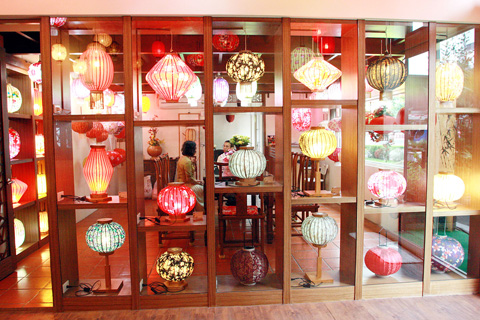
PHOTO: CNA
Ever Shine Enterprise Co (光遠企業), a lantern maker in Jhushan (祝山), Nantou County, has been around for more than 60 years, despite product upheavals and market realignments that nearly drove it out of business.
Its evolution — and success — provides a model that the government hopes can be emulated by other older small and medium-sized manufacturers.
The firm first demonstrated its survival skills in the early 1960s, less than two decades after its was founded in 1947 by Hsieh Yi-huang (謝亦熀), an immigrant from Fuzhou, to make Fuzhou-style paper umbrellas.
It’s market was undermined when umbrellas made of synthetic fabrics were introduced in 1963, but unwilling to shut-up shop, and with the help of a friend, Hsieh transformed his company into a producer of traditional lanterns.
But the labor-intensive business began sputtering in the late 1980s, when rising labor costs hurt its competitiveness. Rather than moving offshore, however, the Hsieh family stubbornly tried to make it at home.
Hsieh’s youngest son, Hsieh Chih-cheng (謝志成) decided to help his father keep his business afloat through innovation, without sacrificing the lanterns’ traditional charm. He improved the basic structure of the lantern frame to make it stronger, more flexible and more resilient. He also introduced new printing and sewing technologies to upgrade productivity and lower costs, as well as developing new lantern styles to stay competitive.
But the son insisted on keeping the bamboo frame, instead of an aluminum alloy or steel wires, to preserve the lanterns’ special feel.
“The bamboo lantern is a traditional Chinese handicraft that has enormous historical significance. For me, only a bamboo frame gives a lantern heart and soul,” he said.
Moreover, bamboo represents growth and its nodes symbolize moral integrity, he said.
“I believe using bamboo frames add culture and history to our lanterns,” he said.
This combination of the modern and traditional, and attention to detail shown in the lanterns, has helped the company survive against cheaper Chinese rivals.
An Industrial Development Bureau (IDB) official said his superiors at the Ministry of Economic Affairs sometimes received Chinese-made lanterns as souvenirs but often found their flimsy frames to be bent of warped.
Yet, more than innovation was needed when demand from Ever Shine’s main client base — temples — began shrinking at the beginning of the last decade. As temples started to purchase electric ornaments instead of lanterns, Hsieh Chih-cheng created new lantern styles to appeal to the household market.
Each of the company’s artistic lanterns, he says, has a unique character that embodies a delicate balance between fashion and functionality.
These new lanterns now account for 30 percent of the company’s NT$10 million (US$315,000) in annual sales, and Hsieh Chih-cheng hopes their share will reach 50 percent within three years.
Ever Shine has embraced a new business model, one that could help other conventional industries survive lower cost competition.
The new model integrates manufacturing, corporate history and tourism.
“We hope this strategy will help upgrade public awareness and recognition of our brand as well as charm more visitors into buying our lanterns to decorate their homes,” Hsieh Chih-chang said.
However, the factory has been open to tourists for only three months (tours must be arranged seven days in advance), so Hsieh is unsure how much of an impact this will have on overall sales, but he expects it will have intangible benefits to Ever Shine’s brand image and value.
“We have high expectations of this new line of business because it will help fulfill our ultimate goal of passing on the traditional craft of lantern making,” he said.
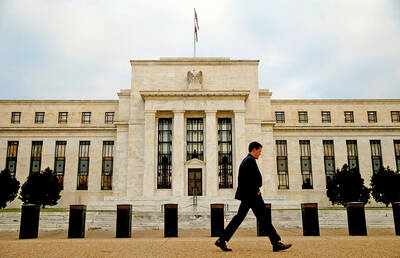
Federal Reserve Bank of Philadelphia President Anna Paulson on Thursday joined the chorus of policymakers saying additional interest-rate increases may be needed to ensure inflation returns to the central bank’s 2 percent goal. “Looking ahead, if conditions evolve as I expect, some modest further tightening may be warranted,” Paulson said on Thursday at an event in Philadelphia. Earlier on Thursday, New York Fed President John Williams said he and his colleagues “still have a lot of work to do” in dealing with lingering inflation risks. Several other officials have aired similar comments, in line with the signal given last week when policymakers voted
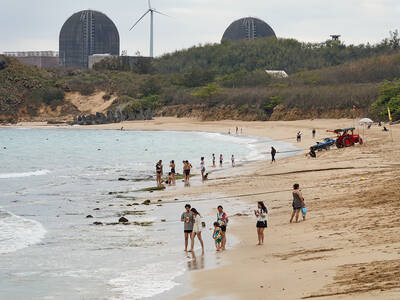
COURSE CHANGE: The shift comes amid pressure from chipmakers for stable, low-carbon electricity. Officials said Ma-anshan could be restarted as early as 2028 Taiwan has approved a preliminary plan to restart an idled atomic power plant, marking a reversal of the ruling party’s anti-nuclear stance as the nation pursues greater energy security. The Nuclear Safety Commission has cleared its review of an initial proposal to restart the Ma-anshan Nuclear Power Plant, it said in a statement on Thursday. Taiwan Power Co (台電) will still need to carry out follow-up work including safety inspections, before submitting another report on implementation for review, the commission said. The earliest the plant could resume operations is 2028, according to previous reports in local media, citing Minister of Economic Affairs
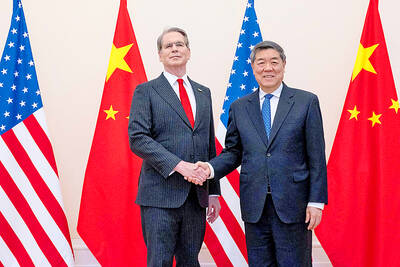
MINIMAL EXPECTATIONS: Analysts think that the two sides are likely to aim for ‘status quo’-level agreements, maintaining civility, without major trade breakthroughs US Secretary of the Treasury Scott Bessent and Chinese Vice Premier He Lifeng (何立峰) were set to meet yesterday to try to set up potential agreements on artificial intelligence (AI), tariffs and critical minerals for a summit in Washington this week between US President Donald Trump and Chinese President Xi Jinping (習近平). The meetings at JPMorgan Chase & Co’s headquarters in Manhattan, which included US Trade Representative Jamieson Greer, were due to start at about 10:30am on Sunday morning and were expected to run all day. Key topics would be the status of a US-China trade truce that is set to expire
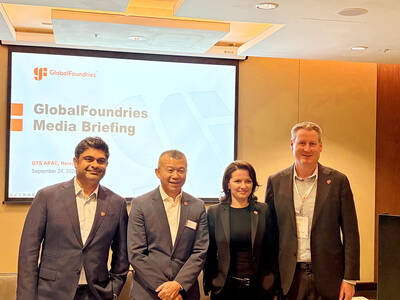
GlobalFoundries Inc yesterday said it plans to accelerate global capacity optimization and expansion to accommodate exponential growth in radio frequency (RF) and other chips driven by the artificial intelligence (AI) boom. Singapore will pay a vital role in the company’s capacity expansion, alongside production line optimizations across its manufacturing sites, GlobalFoundries Asia Pacific head Vincent Feng (范曾文) told a news conference in Hsinchu City. “Many might be surprised to hear that the RF market is thriving now. We are gearing up for a massive capacity expansion, and it is all being driven by AI,” Feng said. He declined to disclose details of the


 RSS
RSS