

Canada’s Research in Motion (RIM), maker of the Blackberry, replaced Motorola as one of the world’s top five mobile phone manufacturers in the first quarter of this year, industry tracker IDC said on Friday.
RIM appeared on the list of top five vendors for the first time on the basis of worldwide sales of 10.6 million units in the first three months of the year, placing it in a tie for fourth spot with Sony Ericsson, IDC said.
Motorola, which had been in the top five since 2004, got yet more bad news on Thursday when the US handset maker was also supplanted by Apple as the leading US manufacturer of mobile devices.
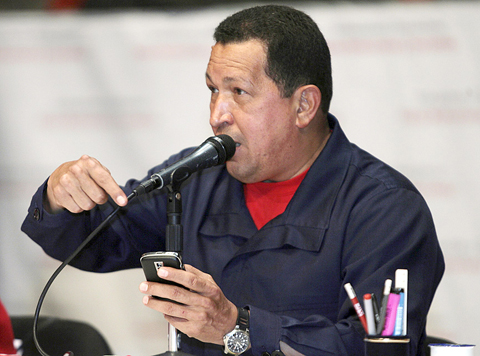
PHOTO: REUTERS
Apple last week reported iPhone sales of 8.75 million units in the first three months of the year, while Motorola on Thursday said it sold 8.5 million units in the corresponding period.
Finland’s Nokia remained in the top spot on the IDC list of leading mobile phone makers with first-quarter sales of 107.8 million units and a market share of 36.6 percent, down from 38.4 percent a year ago.
South Korea’s Samsung Electronics was next with sales of 64.3 million.
Samsung increased its market share to 21.8 percent from 18.9 percent a year ago.
Another South Korean company, LG Electronics, was third with sales of 27.1 million.
Its market share slipped 0.1 percent to 9.2 percent.
RIM’s sales of 10.6 million units gave it a market share of 3.6 percent, up from 3 percent a year ago.
Sony Ericsson sold 10.5 million units, but saw its market share slip from 6 percent a year ago to 3.6 percent.
Other handset makers accounted for total sales of 74.6 million units in the quarter, IDC said.
Overall, mobile phone sales rose 21.7 percent in the first quarter to 294.9 million units, fuelled by growth in demand for smartphones and the global economic recovery.
“The entrance of RIM into the top five underscores the sustained smartphone growth trend that is driving the global mobile phone market recovery,” IDC senior research analyst Kevin Restivo said in a statement. “This is also the first time a vendor has dropped out of the top five since the second quarter of 2005, when Sony Ericsson grabbed the No. 5 spot from BenQ Siemens.”
IDC forecast growth of 11 percent in mobile phone sales this year.

Bankers in Hong Kong skipped the summer break as an artificial intelligence (AI)-fueled rush for capital sent share sales to a record, defying a bruising selloff in the city’s stocks. Initial public offerings (IPOs), placements and block trades raised US$47.5 billion in July to last month, the biggest haul ever for the period, data compiled by Bloomberg showed. That pushed fundraising this year above US$92 billion and within reach of the US$112.5 billion record set in 2021. AI has been at the heart of Hong Kong’s deal revival, but this summer brought a new level of intensity. Chinese companies raised ever-larger sums

BOOMING BUSINESS: Memory supply constraints would be even more severe in 2027 and 2028, prompting customers to sign long-term supply agreements, Micron said Micron Memory Taiwan Co (台灣美光) yesterday said it is accelerating memorychip capacity expansion amid growing artificial intelligence (AI)-driven demand, with its accumulated investment in Taiwan reaching NT$1.6 trillion (US$50.2 billion) as of June. The company’s investment in Taiwan has surged over the past four years, with recent spending equaling the total invested over the past 25 years, Micron Taiwan chairman Donghui Lu (盧東暉) told a media briefing in Taipei. “The launch of ChatGPT and the outbreak of COVID triggered increasing demand for memory chips. Since then, demand has gathered pace rapidly, with only a brief pause in 2023 when a major downturn”
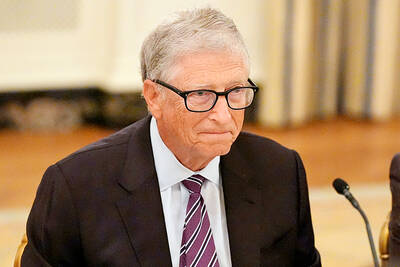
Artificial intelligence (AI) requires safeguards that go beyond self-regulation, Microsoft Corp cofounder Bill Gates said in an interview that aired on Sunday, calling for legislation to be passed in US Congress. “You need law enforcement and the politicians to get into the discussion about what safeguards and monitoring look like,” Gates said in a taped interview on NBC’s Meet the Press program. “And that has to be a required thing.” A sudden groundswell has risen in favor of federal intervention after OpenAI in July said that an autonomous AI agent went rogue during a security test and hacked into another company, subverting

Apple Inc is set to sell about 6 million units of the iPhone Duo this year, Counterpoint Research said, offering the first estimate for how the company’s inaugural foldable device would fare. The figure, more typical of the niche foldable segment than Apple’s usual smartphone sales, is contingent on how well the company ramps up production of the new hardware, Counterpoint senior analyst Ivan Lam (林科宇) said. Priced at US$1,999 and set for a release this month, the iPhone Duo sits atop the Apple lineup and carries industry wide hopes for stoking greater interest and sales of foldables. Market researcher IDC Corp


 RSS
RSS