

Chunghwa Telecom Co (中華電信), the nation’s biggest telecom operator, yesterday said the board approved a proposal for a 20 percent capital reduction program, allowing it to deliver extra cash dividends of NT$2 per common share and an 8 percent stock dividend, or 80 shares per 1,000 held.
The much-anticipated capital reduction will be the biggest ever launched by the cash-rich Chunghwa Telecom. The phone company planned to slash NT$19.4 billion (US$609.9 million) in capital, which will reduce the number of shares from 9.7 billion to 7.76 billion.
The phone company aims to “better manage its capital” and boost earnings per share to some extent, company financial executive Yeh Shu (葉疏) told an investor conference yesterday.
Canceling outstanding common stock to reduce capital would reduce the company’s cost of capital and improve return on equity, the company said in a statement.
The capital reduction plan will need shareholder approval in the annual general meeting scheduled for June 18.
As of the end of last year, Chunghwa Telecom held NT$73.26 billion, down 9.9 percent from NT$81.29 billion at the end of 2008, the company’s financial statement showed. The company is debt free.
This year, the company planned to boost capital spending by roughly 20 percent to more than NT$30 billion, which could touch its record high, from NT$25.48 billion budgeted for last year.
The expenditures will be used mostly on deploying a high-speed fiber optical network, a 3.5G network and undersea cable construction.
Chunghwa Telecom said net income slid 2.8 percent to NT$43.76 billion, or NT$4.51 per share, last year, compared to NT$45.01 billion, or NT$4.64 a share, as average revenue per user (ARPU) fell on bleak macroeconomic conditions and stiffening competition.
The blended ARPU of the company’s mobile business dropped 4.5 percent to NT$653 last year from NT$684 in 2008.
Chunghwa Telecom has 9.27 million mobile subscribers, seizing a bigger market share of 46.4 percent last year from 42.5 percent in 2008.
Overall revenues edged lower by 1.6 percent year-on-year to NT$198.36 billion with mobile business accounting for the biggest portion of 44 percent last year.
Company chairman Lu Shyue-ching (呂學錦) said he hoped the improving economy would help boost business and offset the adverse impact of rate cuts requested by the National Communications Commission.
Local mobile operators are required by the telecom regulator to lower tariffs by 5.87 percent annually over a three-year period, beginning next month.
Shares of Chunghwa Telecom rose 1.31 percent to NT$62.1 yesterday, beating the TAIEX’s 0.19 percent gain.
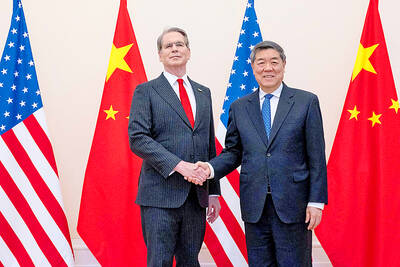
MINIMAL EXPECTATIONS: Analysts think that the two sides are likely to aim for ‘status quo’-level agreements, maintaining civility, without major trade breakthroughs US Secretary of the Treasury Scott Bessent and Chinese Vice Premier He Lifeng (何立峰) were set to meet yesterday to try to set up potential agreements on artificial intelligence (AI), tariffs and critical minerals for a summit in Washington this week between US President Donald Trump and Chinese President Xi Jinping (習近平). The meetings at JPMorgan Chase & Co’s headquarters in Manhattan, which included US Trade Representative Jamieson Greer, were due to start at about 10:30am on Sunday morning and were expected to run all day. Key topics would be the status of a US-China trade truce that is set to expire
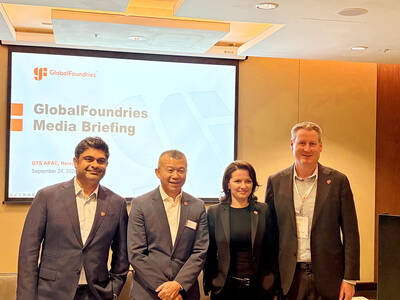
GlobalFoundries Inc yesterday said it plans to accelerate global capacity optimization and expansion to accommodate exponential growth in radio frequency (RF) and other chips driven by the artificial intelligence (AI) boom. Singapore will pay a vital role in the company’s capacity expansion, alongside production line optimizations across its manufacturing sites, GlobalFoundries Asia Pacific head Vincent Feng (范曾文) told a news conference in Hsinchu City. “Many might be surprised to hear that the RF market is thriving now. We are gearing up for a massive capacity expansion, and it is all being driven by AI,” Feng said. He declined to disclose details of the

MORE DATA CENTERS: Microsoft’s Taiwan-area general manager said the corporation is looking to add two more data centers in northern Taiwan over the next few years Microsoft Corp plans to double its data centers in Taiwan from two facilities to four, Microsoft Taiwan general manager Sean Pien (卞志祥) said yesterday. “Over the past two to three years, we have consistently seen demand outstrip supply, and we expect that situation to continue over the next two to three years,” Pien said on the sidelines of a news conference in Taipei. The data center sites would mainly be in northern Taiwan to meet customer demand and reduce the risk of operational disruptions caused by a single event, he said, without saying their exact locations. Microsoft enabled the first phase of
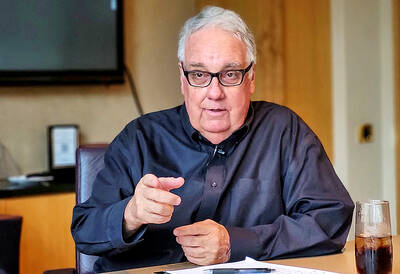
Berkshire Hathaway Inc has been synonymous with Warren Buffett. It falls to his oldest son, Howard Buffett, to keep the conglomerate’s “culture” alive. Friday’s announcement that Warren Buffett, 96, stepped down as chairman means the longtime investor would no longer have a management role at the company he took over in 1965, or be a regular sounding board for Greg Abel, who succeeded him as chief executive officer in January. Howard Buffett, 71, is assuming a different role as non-executive chairman, focused on preserving Berkshire’s culture and values. It is the latest move in a years-long leadership transition. “This one is really about


 RSS
RSS