


A UN think tank yesterday backed China’s controls on the yuan despite US and EU pressure, saying that exposing the Chinese currency to the money markets would pose greater global risks.
“Expecting that China will leave its exchange rate to the mercy of totally unreliable markets and risk a Japan-like appreciation shock ignores the importance of its domestic and external stability for the region and for the globe,” the UN Conference on Trade and Development (UNCTAD) said.
China has been under intense pressure from the US and the EU, to allow its currency to appreciate. Washington and Brussels claim that Beijing has intentionally kept the currency low to boost its exports, in a bid to exit from the global economic crisis.
UNCTAD, however, said that China has “done more than any other emerging economy to stimulate domestic demand” in order to mitigate the crisis.
As a result, domestic private consumption rose about 9 percent last year, said UNCTAD, “backed by salary increases in the two-digit range.”
Labor costs are therefore rising at a faster pace than elsewhere, “resulting in a continuous loss in competitive power even with a fixed exchange rate,” UNCTAD said.
It also warned that speculation has returned to the markets and that emerging economies could fall victim.
“The global casino, nearly empty a year ago, is crowded again, and many new bets are on the table,” it said.
“The effects of the new exuberance on financial markets are adverse for countries with once-fragile currencies, such as Brazil, Hungary and Turkey,” UNCTAD said.
It also backed Brazil’s move to tax equities and fixed income investment inflows by foreigners.
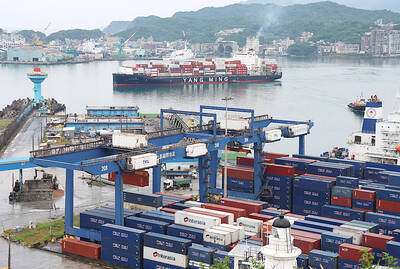
Taiwan’s exports soared 56 percent year-on-year to an all-time high of US$64.05 billion last month, propelled by surging global demand for artificial intelligence (AI), high-performance computing and cloud service infrastructure, the Ministry of Finance said yesterday. Department of Statistics Director-General Beatrice Tsai (蔡美娜) called the figure an unexpected upside surprise, citing a wave of technology orders from overseas customers alongside the usual year-end shopping season for technology products. Growth is likely to remain strong this month, she said, projecting a 40 percent to 45 percent expansion on an annual basis. The outperformance could prompt the Directorate-General of Budget, Accounting and

Two Chinese chipmakers are attracting strong retail investor demand, buoyed by industry peer Moore Threads Technology Co’s (摩爾線程) stellar debut. The retail portion of MetaX Integrated Circuits (Shanghai) Co’s (上海沐曦) upcoming initial public offering (IPO) was 2,986 times oversubscribed on Friday, according to a filing. Meanwhile, Beijing Onmicro Electronics Co (北京昂瑞微), which makes radio frequency chips, was 2,899 times oversubscribed on Friday, its filing showed. The bids coincided with Moore Threads’ trading debut, which surged 425 percent on Friday after raising 8 billion yuan (US$1.13 billion) on bets that the company could emerge as a viable local competitor to Nvidia
BARRIERS: Gudeng’s chairman said it was unlikely that the US could replicate Taiwan’s science parks in Arizona, given its strict immigration policies and cultural differences Gudeng Precision Industrial Co (家登), which supplies wafer pods to the world’s major semiconductor firms, yesterday said it is in no rush to set up production in the US due to high costs. The company supplies its customers through a warehouse in Arizona jointly operated by TSS Holdings Ltd (德鑫控股), a joint holding of Gudeng and 17 Taiwanese firms in the semiconductor supply chain, including specialty plastic compounds producer Nytex Composites Co (耐特) and automated material handling system supplier Symtek Automation Asia Co (迅得). While the company has long been exploring the feasibility of setting up production in the US to address

OPTION: Uber said it could provide higher pay for batch trips, if incentives for batching is not removed entirely, as the latter would force it to pass on the costs to consumers Uber Technologies Inc yesterday warned that proposed restrictions on batching orders and minimum wages could prompt a NT$20 delivery fee increase in Taiwan, as lower efficiency would drive up costs. Uber CEO Dara Khosrowshahi made the remarks yesterday during his visit to Taiwan. He is on a multileg trip to the region, which includes stops in South Korea and Japan. His visit coincided the release last month of the Ministry of Labor’s draft bill on the delivery sector, which aims to safeguard delivery workers’ rights and improve their welfare. The ministry set the minimum pay for local food delivery drivers at


 RSS
RSS