

Factory activity in Asia’s main economies expanded last month, with India and South Korea growing at their fastest pace in around two years although China showed some signs of weakening.
A pair of surveys of purchasing executives showed the pace of manufacturing growth in the world’s third-biggest economy eased slightly last month, but economists said the recovery trend remained intact.
“Policymakers are driving with low visibility on the Chinese activity data at the moment,” said Brian Jackson, a strategist with Royal Bank of Canada in Hong Kong, adding that the timing of the Lunar New Year holidays complicated interpretation of data.
“So it would be premature to conclude that today’s fall in the headline PMI [Purchasing Managers’ Index] numbers show a broader easing in the momentum of China’s recovery,” he said.
The PMI derived from a survey conducted by the China Federation of Logistics and Purchasing for the National Bureau of Statistics (NBS) fell to 52 last month, well below the median forecast of 55.45 in a Reuters poll and from 55.8 in January.
The Australian dollar dipped and copper prices pared their gains after the data, which markets took as a sign Chinese demand for metals and other commodities might be softening. Shanghai stocks, however, rose step with other Asian markets.
A separate survey conducted by research firm Markit for HSBC showed the PMI dipping to 55.8 from a record high of 57.4 in January.
PMIs for the eurozone and the US were due to be released later yesterday. Russia’s PMI eased a touch to 50.2 last month, but the index continued to show expansion for the second straight month.
India’s PMI rose to 58.5 last month, its strongest reading since June 2008, from 57.7 in January, boosted by expanding output and new orders.
“At 58.5, the headline index is consistent with ongoing double-digit gains in industrial production which in turn is likely to mean that spare capacity is being eaten into rapidly,” said Robert Prior-Wandesforde, senior Asian economist at HSBC.
Signs of supply-side constraints in labor and product markets were also emerging, which backed the case for further monetary tightening next month.
“In our view, it is time to start unwinding the monetary stimulus and we would be very surprised if the RBI were not to raise policy rates at the 20 April meeting,” Prior-Wandesforde said.
Price pressures were also building in South Korea, which saw its headline PMI rise to the highest level since December 2007. Input prices rose for the third straight month while output price index inched up to 51.8.
“HSBC’s Korea PMI suggests that price pressures are growing, something that official price series have not yet picked up,” the report said.
Bank of Korea Governor Lee Seong-tae said last month that interest rates needed to be raised soon to head off inflationary pressures.
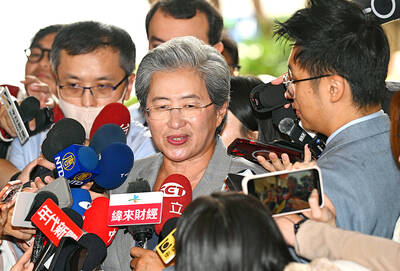
SILICON ISLAND: When asked about geopolitical tensions, Lisa Su said that ‘Taiwan is absolutely critical to the semiconductor supply chain, and very, very critical for AMD’ Advanced Micro Devices Inc (AMD) CEO Lisa Su (蘇姿丰) yesterday said the company plans to “substantially” increase manufacturing capacity next year through its Taiwanese supply chain, particularly with Taiwan Semiconductor Manufacturing Co (TSMC, 台積電), as surging demand for artificial intelligence (AI)-related processors continues to outstrip supply. “It is a very exciting time right now for all kinds of compute, and especially on the CPU [central processing unit] side,” Su said during a visit to Taiwan. “The overall market has increased a lot in 2026, and so we have also increased our own supply and capacity in 2026, but I can

INFRINGEMENT: The investigation comes after a complaint from Vicor Corp, with the company seeking a limited exclusion order as well as cease-and-desist orders, the ITA said The US International Trade Commission (USITC) has launched a Section 337 investigation naming Taiwanese technology companies, including Hon Hai Precision Industry Co (鴻海), Delta Electronics Inc (台達電) and Quanta Computer Inc (廣達), as respondents. The Ministry of Economic Affairs (MOEA) pledged assistance if needed. The USITC said on Friday in a statement that it had voted to institute an investigation under Section 337 of the US Tariff Act of 1930 into certain vertical power delivery systems, related components and computing devices incorporating such systems. The investigation covers 20 companies from Taiwan, China, Germany and the US, the commission said, adding that it
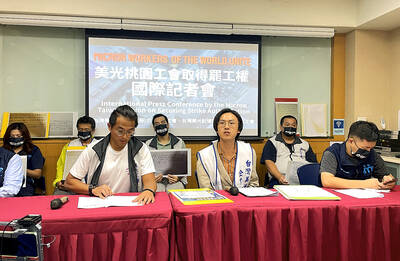
INDUSTRY STANDARD: Most global semiconductor companies have tied employee bonuses directly to corporate profits, the union said, urging Micron to do the same Micron Memory Taiwan Co’s (台灣美光) Taoyuan union secured strike authorization yesterday after a six-day vote, ramping up pressure on management to build a reasonable profit-sharing mechanism. Before the strike, the Taoyuan union “encourages” members to join a protest in Taipei on Oct. 19, union chairman Jerry Lin (林哲瑞) told a news conference in Taipei. The union did not rule out staging a snap strike, Lin said. The union has 2,258 registered members, with 88.3 percent backing the strike, he said. The vote comes as Micron’s board of directors is meeting today and tomorrow in the US. The union expects the board to respond

Elon Musk said his business empire would build and operate Terafab independently, quashing speculation about industry leader Taiwan Semiconductor Manufacturing Co (TSMC, 台積電) swooping in to run his ambitious chipmaking venture. Based in Texas, the Terafab project is Musk’s effort to break into the business of fabricating chips, in service of his companies Tesla Inc and SpaceXAI. While Musk had said that he was in discussions with TSMC, the trillionaire clarified in an X post yesterday that the only matter under consideration is for TSMC potentially leasing some part of the planned site and would not involve any operational role. “Maybe TSMC


 RSS
RSS