

Formosa Plastics plans plant
Formosa Plastics Group (台塑集團), one of Taiwan’s largest industrial conglomerates, said yesterday it plans a stainless steel plant in Vietnam, with local media citing a budget of over US$3 billion.
The plant will be part of a steel mill complex that the conglomerate intends to build in the central province of Ha Tinh, a group official said.
The official said a timetable of the construction of the stainless steel plant had not been finalized, and declined to disclose further details.
The Taipei-based Economic Daily News reported yesterday the plant will cost the group NT$100 billion (US$3.1 billion).
The newspaper said the planned stainless steel plant is expected to roll out 2 million tonnes a year.
HK firms hit by big tax bills
Taiwan’s tax authorities have ordered four Hong Kong clothes brands to pay millions of US dollars in fines for alleged tax evasion, officials said yesterday.
The National Tax Bureau has fined HangTen, Giordano, Bossini and BaLeNo around NT$530 million (US$17 million) collectively for alleged tax evasion over a four-year period ending in 2002.
HangTen was fined NT$293 million alone.
The four firms, which have hundreds of stores in Taiwan, rejected the charges and previously sought to present their case in the court system, but they lost the legal battle, a HangTen official said.
HTC phone scoops prize
HTC Hero smartphone was announced last week as the best mobile handset of the year at the Mobile World Congress in Barcelona, beating Samsung Star, Samsung Omnia HD, Nokia N97 mini and BlackBerry Bold 9700, the company said.
That was the first time that HTC Corp (宏達電), the leading maker of smartphones running on both Android and Windows Mobile platforms, made it into the shortlist for the category.
HTC Hero is a 3.2-inch touch screen model that runs on the Android operating system.
TSMC purchases equipment
Taiwan Semiconductor Manufacturing Co (台積電), the world’s largest custom-chip maker, bought NT$696 million (US$21.6 million) of equipment from Dainippon Screen Manufacturing Co, the Hsinchu-based company said in an exchange filing yesterday.
Meanwhile, Advanced Semiconductor Engineering Inc (日月光半導體), the world’s largest chip packaging and testing company, said in an exchange filing it bought NT$1.08 billion of equipment from Kulicke and Soffa Global Holding Corp.
“The purchase shows that they have a lot of orders for the rest of the year and investors are optimistic about this company,” said Rubens Lai, a trader at Taiwan International Securities Corp (金鼎證券).
S Korea set for record offerings
South Korea will “easily” absorb initial share offerings that will probably surge to a record this year amid abundant liquidity and optimism shares will hold their value, Daewoo Securities Co said.
Companies may raise as much as 12 trillion won (US$10.4 billion) from initial public offerings this year, said Gabriel Jung, 47, head of the investment banking group at Daewoo Securities, the No. 1 IPO underwriter in South Korea over the past five years. That would be more than threefold the 3.4 trillion won raised last year.
“There’s ample liquidity, confidence in the stock market has recovered quickly from the global credit crunch and there are signals for positive corporate earnings,” Jung said in a telephone interview yesterday.

Taiwan Semiconductor Manufacturing Co (TSMC, 台積電) yesterday dismissed concerns about a deeper correction of the artificial intelligence (AI) market, saying that soaring global demand AI applications continues to outstrip its supply of advanced chips. The world’s largest contract chipmaker said in a statement that it continues to observe challenges facing the consumer and price-sensitive end-market segments posed by rising component prices and economic uncertainties, TSMC chairman and chief executive officer C.C. Wei’s (魏哲家) remarks during an earnings conference on Oct. 15. “Global demand for AI continues to grow, with its long-term outlook remaining upbeat,” TSMC said in the statement. “Demand
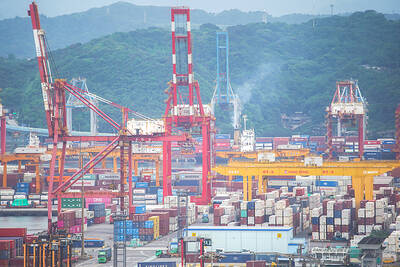
BOOM DRIVEN: The third-quarter current account surplus was the second-highest on record, well up from last year, and lagging only behind last year’s fourth quarter Taiwan’s current account surplus in the third quarter of this year reached its second-highest level on record, as exports hit new highs on the back of robust global demand for artificial intelligence (AI)-related applications, the central bank said on Friday. The surplus rose by US$22.04 billion from a year earlier to US$68.79 billion in the third quarter, second only to the US$69.69 billion recorded in the fourth quarter of last year, the bank said. The current account mainly measures a country’s transactions in goods and services, as well as primary and secondary income flows with the rest of the world. Taiwan’s merchandise trade

CHINA LEANING? The US has greenlit the sale of less-than-cutting-edge Nvidia chips to China, amidst national security and technology control concerns US Secretary of the Treasury Scott Bessent said on Friday that no more restrictions on the sale of older Nvidia Corp chips to China were needed following US President Donald Trump administration’s move earlier last week to block China’s remote access to the latest semiconductors. The ability of Chinese tech firms to access Nvidia’s technology came under scrutiny after CEO Jensen Huang (黃仁勳) stepped down amid allegations of his affair with an executive at Megaspeed International Pte Ltd, a Singapore-based company that uses advanced chips to generate computing power that Chinese firms access remotely. “The proper chip restrictions are in place,” Bessent

China’s Z.AI Co (智譜) has fallen behind schedule on its next flagship artificial intelligence (AI) model, while rival Moonshot AI Technology Co (月之暗面) expects the interval between major releases could double from six months to a year or longer if it loses access to overseas computing power, people familiar with the matter said. The previously unreported details show how efforts by US AI companies OpenAI and Anthropic PBC to prevent distillation, a technique in which developers train models using answers generated by more capable ones, have slowed Chinese AI development. Washington’s latest chip restrictions threaten further delays. The measures jeopardize a key


 RSS