


United Microelectronics Corp (UMC, 聯電), the world’s second-largest contract chipmaker, said yesterday it planned to ramp up its capital spending to between US$1.2 billion and US$1.5 billion this year, up from US$551 million last year, to meet strong consumer demand for capacity and advanced technologies.
UMC chief executive officer Sun Shih-wei (孫世偉) said this year’s capital spending was mainly aimed at establishing capacity using 40/45-nanometer process technologies and introducing facilities for developing 28-nanometer technologies at its Fab12A in South Taiwan Science Park (南部科學工業園區) in Tainan.
The company will also expand capacity using 65/55-nanometer process technologies at its Fab12i in Singapore, he said.
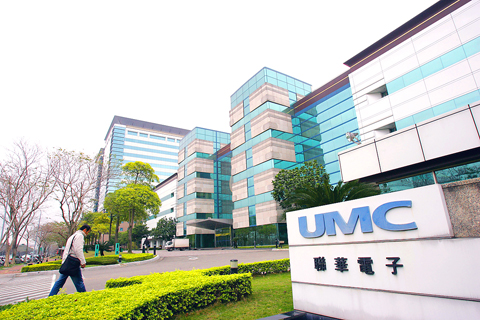
PHOTO: MAURICE TSAI, BLOOMBERG
UMC’s increased capital spending this year reflects the company’s improved financial results over the past year. The Hsinchu-based company yesterday reported a net income of NT$4.39 billion (US$136.93 million), or NT$0.35 per share, for last quarter, compared with a record loss of NT$23.51 billion during the same period a year earlier.
“Our company not only managed to go through a year of drastic economic fluctuations, but also took the lead in recovering rapidly from the financial tsunami,” Sun told investors. “Last year’s revenue saw the smallest contraction, 4.2 percent, among other competitors.”
Revenue totaled NT$88.62 billion last year, down from NT$92.53 billion in 2008. However, fourth-quarter revenue rose 1.2 percent to NT$27.75 billion from the previous quarter, the company said yesterday in a statement.
Asked if the substantial increase in capital spending might mean the semiconductor industry could face excess capacity in the next two years, Sun said that UMC would not enter into “an arms race” with its competitors, adding that the amount of capital spending for this year was at a low risk because it only accounted for 25 percent of the company’s revenues in the last three to four years.
“It [the amount of capex] is still in a reasonable range,” Sun said. “About 94 percent of capital expenditures would be used on 12-inch fabs and 6 percent on 8-inch ones.”
UMC’s 12-inch wafer fabs have been fully loaded and have experienced supply constraint. Although 8-inch fabs have yet to be fully utilized, their capacity utilization rate has continued to rise, he said.
“The entire capacity utilization rate is expected to reach between 86 percent and 89 percent in the first quarter of this year,” Sun said.
The capacity utilization rate was 86 percent in the fourth quarter.
Gross margin will likely be between 20 percent and 30 percent, compared with 25.9 percent in the fourth quarter.
Shares of UMC rose to NT$16.65 on the Taiwan Stock Exchange yesterday after the company’s board approved a plan on Tuesday to buy back NT$300 million of its own shares on the open market until April 2.
UMC chief financial officer Liu Chi-tung (劉啟東) said that the repurchased shares would either transfer to employees or be cancelled to help improve shareholder equity returns.
“If there’s still enough cash, UMC will continue to buy back shares on the open market in an aggressive manner,” he said.
Looking ahead, UMC said its wafer shipments would match fourth-quarter levels, when it delivered around 990,000 8-inch-equivalent wafers to its customers.
Average selling prices are likely to fall by less than 3 percent in the first quarter from the previous quarter, while the appreciation of the New Taiwan dollar is likely to cut revenue by between 1 and 2 percent, UMC said.

Cairo’s new monorail slices across the city skyline, running above the familiar chaos of blaring horns and aging buses’ exhaust fumes that mark rush hour below. The US$4.5 billion monorail, opened this month, is among Egypt’s most prominent new transport projects, part of a debt-funded infrastructure drive criticized for sapping state finances while bringing limited benefits to most of the country’s 109 million people. “It feels like you’re in a different country,” said Ramy Sayed, a restaurant manager, aboard a driverless Innovia 300 train. “No noise, no traffic, we’re not used to this.” The eastern line runs 56km from the bustling middle-class

Taiwanese firms have increased investment in the Philippines in recent years as Manila’s ties with Washington deepen and global supply chains continue to shift away from China, an expert at the Chung-Hua Institution for Economic Research (CIER, 中華經濟研究院) said yesterday. The Philippines had not been among Taiwanese investors’ top choices in Southeast Asia, CIER Taiwan ASEAN Studies Center director Kristy Hsu (徐遵慈) said at a seminar in Taipei. However, Taiwan’s investment in the country has grown significantly since the COVID-19 pandemic, reaching US $257 million last year, a high in recent years, she said. Although Taiwan’s total investment in the Philippines still lags

Intel Corp regards Taiwan Semiconductor Manufacturing Co (TSMC, 台積電) as a longstanding partner, as the US chipmaker would continue outsourcing production of advanced chips to TSMC, Intel chief executive officer Lip-Bu Tan (陳立武) said yesterday. “I don’t look at people as competitors. I look at the collaboration... Nvidia is also, you know, a good friend,” Tan told a news conference following his keynote speech at the Computex trade show in Taipei. “It’s a very trusted partnership for us... We are a big, top customer for them, and we’re going to continue doing that,” he said, referring to TSMC, the world’s largest foundry

Artificial intelligence (AI) agents would supplant smartphones as the center of people’s digital lives, fundamentally reshaping personal devices and driving a major computing upgrade cycle, Qualcomm Inc CEO Cristiano Amon said yesterday. In his keynote speech for this year’s Computex trade show in Taipei, Amon said that the rise of "agentic AI" — AI systems capable of reasoning, planning and carrying out tasks autonomously — would transform how people interact with technology across phones, PCs, vehicles and wearable devices. Describing the technology as the next major evolution in computing, Amon said that "2026 is the year of agents.” For decades, smartphones have sat


 RSS
RSS