


Many of the photographers at Taiwan’s largest auto show are aiming their cameras not just at models of concept cars but also at the showgirls who survived a stringent selection process that began months ago to allow them to strut their stuff at the show.
Ann Chen, who is working for Suzuki during the Dec. 26 to Jan. 3 Taipei International Auto Show, said that unlike other types of show, clients exhibiting at the auto show started looking for models and showgirls much earlier.
This year, the process started as early as April.
Chen, who is also a model agent, said that the size of the new cars on show is one of the key factors in selecting models.
“Companies that plan to display large cars prefer tall girls, while those with small ones choose shorter ones,” she said on Monday.
The preparation process for the auto show is also longer than for other shows, Chen added.
The screening process requested by clients started in July or August this year, compared with two weeks to two months of preparation for computer and other shows, she said.
Every screening interview is a “ruthless” process for the candidates, she said.
“After the screening, you have to learn how to cheer yourself up and go for the next one if you fail to make the list,” she said.
At the auto show, the 18th of its kind, the models do not just stand there and smile.
They have to handle a variety of tasks.
“Some need to know how to dance, some serve as emcees for activities, while others give away small gifts at the reception desks,” Chen said.
Chen, who wears a red wig and dresses up as a car-race girl along with seven colleagues, has to put on a 20-minute performance five times a day during weekdays and six times on the weekend.
Models at the auto show often outshine their peers at other shows, Chen said, explaining that “the car companies focus very much on the looks and temperament of the models.”
Another key element in the presentation of models and showgirls is their costumes, which are tailor-made to go with the cars on display.
“Attention has to be paid to every little detail of the costumes. For example, the car logo must always be seen and visible in photos, no matter how the girls pose,” said Coraline Lin (林乃卉), the publicist for the event.
It costs NT$6,000 (US$186) to NT$15,000 on average to hire a model for a day in Taiwan, Lin said.
Nevertheless, not every car company uses models or showgirls as the principal means to help promote their products.
Companies such as Audi and Porsche prefer to appeal to visitors by focusing less on dancing showgirls and more on setting up VIP rooms where visitors can have a seat and enjoy a complimentary dessert.
This tactic might work on Jean-Francois Fort, a French car fan who was surprised to see so many people pointing their cameras at the girls rather than at the cars, and the long line of people waiting to have their photo taken with the girls.
“They should at least take some photos of the cars,” he said.

Taiwanese firms have increased investment in the Philippines in recent years as Manila’s ties with Washington deepen and global supply chains continue to shift away from China, an expert at the Chung-Hua Institution for Economic Research (CIER, 中華經濟研究院) said yesterday. The Philippines had not been among Taiwanese investors’ top choices in Southeast Asia, CIER Taiwan ASEAN Studies Center director Kristy Hsu (徐遵慈) said at a seminar in Taipei. However, Taiwan’s investment in the country has grown significantly since the COVID-19 pandemic, reaching US $257 million last year, a high in recent years, she said. Although Taiwan’s total investment in the Philippines still lags
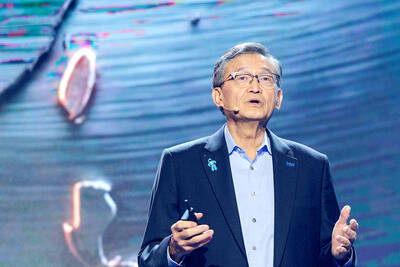
Intel Corp regards Taiwan Semiconductor Manufacturing Co (TSMC, 台積電) as a longstanding partner, as the US chipmaker would continue outsourcing production of advanced chips to TSMC, Intel chief executive officer Lip-Bu Tan (陳立武) said yesterday. “I don’t look at people as competitors. I look at the collaboration... Nvidia is also, you know, a good friend,” Tan told a news conference following his keynote speech at the Computex trade show in Taipei. “It’s a very trusted partnership for us... We are a big, top customer for them, and we’re going to continue doing that,” he said, referring to TSMC, the world’s largest foundry

Artificial intelligence (AI) agents would supplant smartphones as the center of people’s digital lives, fundamentally reshaping personal devices and driving a major computing upgrade cycle, Qualcomm Inc CEO Cristiano Amon said yesterday. In his keynote speech for this year’s Computex trade show in Taipei, Amon said that the rise of "agentic AI" — AI systems capable of reasoning, planning and carrying out tasks autonomously — would transform how people interact with technology across phones, PCs, vehicles and wearable devices. Describing the technology as the next major evolution in computing, Amon said that "2026 is the year of agents.” For decades, smartphones have sat
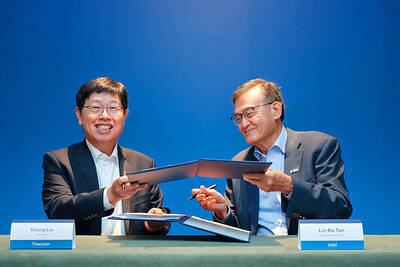
Hon Hai Precision Industry Co (鴻海精密) yesterday said it would work with US chipmaker Intel Corp to jointly develop and deploy next-generation artificial intelligence (AI) infrastructure and intelligent computing platforms in a move to capture booming demand for AI computing systems. Hon Hai, also known as Foxconn Technology Group (富士康), said in a statement that the partnership would combine its global manufacturing scale, system integration expertise and AI data center deployment capabilities with Intel’s strengths in processor architecture, silicon technologies and software ecosystem. The companies said they plan to work on equipment used in AI data centers, including server racks powered by


 RSS
RSS