


The residential property market has fully emerged from its slump, with the monthly indicator flashing a “green” light this month after showing a “yellow-blue” light for nine months, the Chinese-language Housing Monthly reported yesterday.
“The green light flashed for the first time since May last year, which represents a market rebound in December back to a healthier level last seen around the presidential inauguration,” Nii Tzu-jung (倪子仁), an executive at the magazine, said by telephone yesterday.
The indicator’s score climbed 4 points month-on-month to 43 this month, the same as in May last year, Nii said.
Unless the score jumps to 53 or 63 points, which would indicate a “yellow-red” light or “red” light respectively, there are no signs that the market is overheating, he said.
The market began its downward decline in May last year and hit bottom in January, the report showed. Among the indicator’s six components, the supply of new homes reached 3,211 units nationwide this month, 62.5 percent up from last month’s 1,976 units, the report said.
The supply of new homes in Taipei County and Taoyuan County saw the biggest growth at 51.5 percent and 75 percent respectively to 1,306 and 1,370 units, which could trigger selling pressure to fuel price fluctuations, the report said.
An upswing in buying activity and competition has also cut down discounts for customers to average at 12 percent this month, down from 21 percent in the previous month, the report found.
The volume of new property projects also declined 9 percent month-on-month to a total value of NT$35.3 billion (US$1.09 billion) this month after local elections on Dec. 5 interrupted sales.
Meanwhile, the rental of Grade A offices in Taipei also reversed its decline to register a meager growth of 0.4 percent in the fourth quarter, averaging at a rental of NT$2,309 per ping (3.3m²), Savills Taiwan (第一太平戴維斯) said in a press release on Tuesday.
The rental of Grade A offices in the Xinyi district saw the biggest jump at 1.85 percent quarter-on-quarter to average at NT$2,710 per ping, although the vacancy rate in the district jumped to a high of 16.48 percent for the same period amid newly released office space.
The realtor said the rental of Grade A offices in Xinyi could continue to rise and top other areas in the next three years.
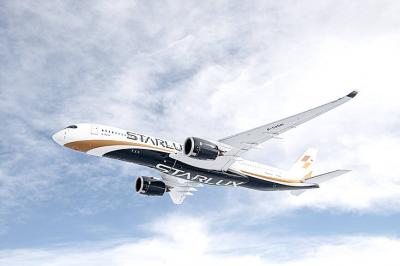
Starlux Airlines Co (星宇航空) today unveiled a long-haul network expansion plan at a shareholders’ meeting in Taipei, including direct flights to Barcelona, Spain, and Zurich, Switzerland, as well as a service connecting Taipei, Sydney and New Zealand. Starlux is to become the first Taiwanese carrier to offer non-stop services to the two European cities, while the inaugural oceanic route is expected to expand transit opportunities within the Australia-New Zealand market, Starlux said. Flight services to Chicago, Dallas, Washington and New York are under evaluation, the airline added. Prior to the shareholders’ meeting, the airline earlier this year announced that it would be

Netherlands-based semiconductor equipment supplier ASML Holding NV yesterday said that it is planning to hire an additional 1,000 people in Taiwan this year in response to growing demand from clients. ASML had previously planned to recruit 600 people this year, but that the plan has been adjusted upward, ASML vice president and ASML Taiwan general manager Grace Wang (汪佳慧) told reporters. ASML has a workforce of more than 4,500 in Taiwan, accounting for about 10 percent of its global total, Wang said. This year’s recruitment campaign would focus on adding people in the customer support, manufacturing and supply chain domains to assist ASML

UNDER MICROSCOPE: Taiwan detained three people who allegedly conspired to buy servers in Taiwan and export them using fraudulent documentation, prosecutors said Nvidia Corp chief executive officer Jensen Huang (黃仁勳) on Saturday urged Super Micro Computer Inc to tighten up on compliance after Taiwan detained three people this week for allegedly making fraudulent declarations about artificial intelligence (AI) servers made by its US partner. The development marked the nation’s first crackdown on semiconductor smuggling, which grew after the US slapped restrictions on exports of high-end chips such as Nvidia AI accelerators to China. Nvidia is “rigorous” in explaining regulations to all of its partners, Huang told reporters after arriving in Taipei. “Ultimately Super Micro has to run their own company,” he said in response to

Nvidia Corp yesterday announced that CEO Jensen Huang (黃仁勳) would attend an employee meeting in Taipei tomorrow to celebrate the launch of the company’s Taiwan headquarters project. Huang would attend a gathering at the site of Nvidia’s planned headquarters in Beitou Shilin Technology Park (北投士林科技園區), the company said in a statement. After arriving in Taiwan on Saturday last week, Huang told reporters that he plans to meet with Quanta Computer Inc (廣達) chairman Barry Lam (林百里) and Taiwan Semiconductor Manufacturing Co (TSMC, 台積電) chairman C.C. Wei (魏哲家), and would attend the groundbreaking ceremony for Nvidia’s Taiwan headquarters tomorrow. Nvidia has not yet applied


 RSS
RSS