


The government may seek to attract private investors or financial institutions to inject funds into DRAM makers if the legislature vetoes an industry revitalization plan in the third reading, a minister said yesterday.
“If the National Development Fund doesn’t inject capital into the companies, private sector investment is one alternative,” Minister of Economic Affairs Shih Yen-shiang (施顏祥) told a press conference.
Another option is to follow Japan’s lead and allow financial institutions to invest in companies filing for restructuring or bankruptcy, he said.
But this would require the government to formulate regulations first, he said.
“DRAM players have borrowed as much as NT$300 billion [US$9.1 billion] from banks,” Shih said.
These manufacturers should consider integrations to create a foundation strong enough to weather economic downturns, he said.
On Nov. 11, lawmakers passed a resolution to ax the government’s plan to revitalize the DRAM industry, which has been hit hard by the financial crisis, saying that the right time to inject capital had passed and the government should not waste taxpayers’ money.
Among the three companies that applied for the capital funding — Taiwan Memory Co (TMC, 台灣創新記憶體公司), Powerchip Semiconductor Corp (力晶半導體) and Kaohsiung-based Taiwan Creative Lab (台灣創造力實驗室) — TMC was approved for an initial capital injection of NT$4.9 billion.
Meanwhile, the ministry said computer, retail and wholesale services would make up the services category of an early harvest list for a proposed economic cooperation framework agreement (ECFA) with China.
There are two major categories of trade — merchandise and services — on the list.
Merchandise would include tariff reductions on approximately 500 items. The services category would comprise computer, retail and wholesale services.
The ministry hopes that China will lower restrictions — including on capital and outlet numbers — for Taiwanese companies competing in the services market across the Strait.
Whether other service sectors — such as telecoms and finances — will be included on the list will depend on evaluations and recommendations from certain government agencies, Shih said.
Taipei is set to formally begin ECFA negotiations with Beijing next month and the pact is expected to be inked at the fifth round of cross-strait talks in the middle of next year.
In related news, the minister said he couldn’t reveal details concerning the potential lifting of a ban on panel, semiconductor and petrochemical companies expanding their investment in China.
“[Talking about this] would affect share prices of listed companies,” Shih said, adding that the matter was still being discussed between ministries and the ban would only be lifted if the legislature agreed.
Shih told the Chinese-language Apple Daily on Dec. 19 that panel makers would be allowed to invest in China by the first quarter at the earliest and semiconductor makers by the second quarter at the earliest.
All applications would be reviewed on a case by case basis. The change would stipulate that advanced technology must be based in Taiwan and investment in China must not exceed investment at home, he was quoted as saying.
Also See: Government to target PRC, Indian, Indonesian markets

SECOND-RATE: Models distilled from US products do not perform the same as the original and undo measures that ensure the systems are neutral, the US’ cable said The US Department of State has ordered a global push to bring attention to what it said are widespread efforts by Chinese companies, including artificial intelligence (AI) start-up DeepSeek (深度求索), to steal intellectual property from US AI labs, according to a diplomatic cable. The cable, dated Friday and sent to diplomatic and consular posts around the world, instructs diplomatic staff to speak to their foreign counterparts about “concerns over adversaries’ extraction and distillation of US AI models.” Distillation is the process of training smaller AI models using output from larger, more expensive ones to lower the costs of training a powerful new
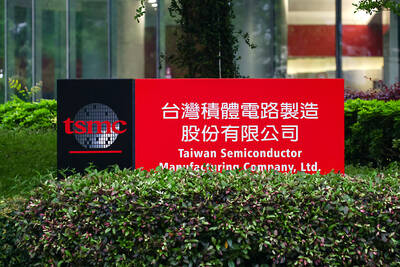
Shares of Taiwan Semiconductor Manufacturing Co (TSMC, 台積電) have repeatedly hit new highs, but an equity analyst said the stock’s valuation remains within a reasonable range and any pullback would likely be technical. The contract chipmaker’s historical price-to-earnings (P/E) ratio has ranged between 20 and 30, Cathay Futures Consultant Co (國泰證期) analyst Tsai Ming-han (蔡明翰) told Central News Agency. With market consensus projecting that TSMC would post earnings per share of about NT$100 (US$3.17) this year, supported by strong global demand for artificial intelligence (AI) applications, and the stock currently trading at a P/E ratio of below 25, Tsai said the valuation
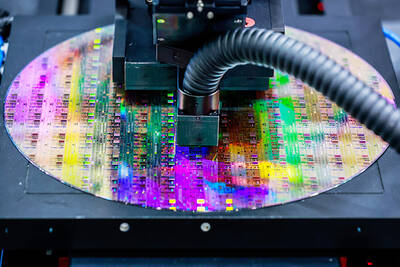
The artificial intelligence (AI) boom has triggered a seismic reshuffling of global equity markets, with Taiwan and South Korea muscling past European nations one by one. With its stock market now valued at nearly US$4.3 trillion, Taiwan surpassed the UK, Europe’s biggest market, earlier this month, data compiled by Bloomberg showed. South Korea is about US$140 billion away from doing the same. The tech-heavy Asian markets have shot past Germany and France in the past seven months. The shift is largely down to massive gains in shares of three companies that provide essential hardware for AI: Taiwan Semiconductor Manufacturing Co (TSMC, 台積電),
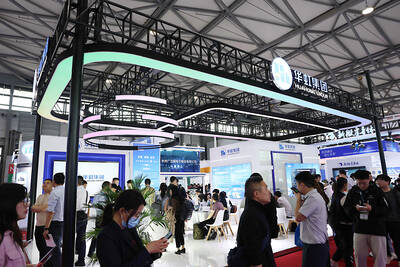
The US Department of Commerce last week ordered multiple chip equipment companies to halt shipments of certain tools to China’s second-largest chipmaker, Hua Hong Semiconductor Ltd (華虹半導體), its latest action to slow the country’s development of advanced chips, two people familiar with the matter said. The department sent letters to at least a handful of companies informing them of restrictions on tools and other materials destined for two Hua Hong facilities US officials believe make China’s most sophisticated chips, the people said. Top US chip equipment companies Lam Research Corp, Applied Materials Inc and KLA Corp, each of which has significant


 RSS
RSS