


France’s Safran SA said it won a US$5 billion contract to supply engines for China’s first narrowbody aircraft and will consider building a “final assembly line” in the country with its partner General Electric Co.
The deal, which was to be signed yesterday, may be worth three times that amount over 30 years including maintenance contracts, Safran chief executive officer Jean-Paul Herteman told reporters in Beijing yesterday.
Commercial Aircraft Corp of China (Comac, 中國商飛) is planning the single-aisle C919, about the same size as a Boeing Co 737 or Airbus SAS A320, to enter service in 2016. CFM International, the GE and Safran venture, will supply its Leap-X engine for the project, said the people, who declined to be identified.
“The outlook for the C919 remains uncertain and the headwinds it faces are great, but the market just within China is potentially large,” said Douglas Runte, a managing director at Piper Jaffray & Co in New York.
Safran shares rose as much as 0.31 euros (US$0.45), or 3.4 percent, to 13.35 euros, changing hands up 2.3 percent at 13.2 euros as of 9:24am in Paris.
China plans to complete the construction of an assembly plant to make C919 planes in Shanghai by 2012, part of plans to create an aircraft manufacturing industry in the nation’s financial center.
China is developing passenger aircraft to compete with Airbus and Boeing, aiming to gain from the growth in the world’s second-largest aviation market.
China needs to add 3,796 passenger planes in the 20 years through 2028, said a forecast by Aviation Industry Corp of China, the nation’s largest aerospace company.
The Leap-X is designed to reduce fuel consumption by 16 percent from the current model, which powers the two Airbus SAS and Boeing Co planes.
Narrowbody jetliners comprise more than 60 percent of all commercial aircraft. Manufacturers have estimated the market for new engines as replacements or on newly designed single-aisle aircraft at US$30 billion to US$50 billion. CFM’s win comes as Airbus and Boeing consider offering the more efficient engines on existing narrowbody aircraft and push plans for new planes beyond 2020.
As of September, Boeing and Airbus combined had delivered more than 9,000 narrowbody planes since the first Boeing 737 hit the market in 1967, with some 4,500 orders still pending.

HSBC Holdings PLC is deepening its commitment to Taiwan as the economy emerges as one of the bank’s fastest-growing markets globally, driven by an artificial intelligence (AI) investment boom, expanding cross-border trade, and rising wealth creation. “The advantage that Taiwan has is a growth story linked to the semiconductor and broader AI industries, strong underlying corporate performance, and wealth creation,” said Surendra Rosha, HSBC’s co-chief executive for Asia and the Middle East, in an exclusive interview with the Taipei Times on June 2, during this year’s HSBC Taiwan Conference. That combination has helped HSBC cement its position as the most profitable international
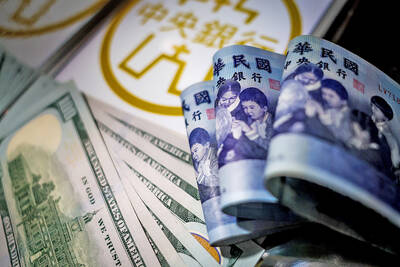
The New Taiwan dollar yesterday fell sharply against the US dollar to close at its lowest level since May 22 amid a massive outflow of funds from the country because of investors panicking over global equity markets. The NT dollar ended at NT$31.580 against the US dollar, slightly lower than its close of NT$31.568 on May 22, after moving between NT$31.5 and NT$31.648 on combined turnover of US$3.062 billion on the Taipei Foreign Exchange and the Cosmos Foreign Exchange. The NT dollar received a significant hit in the morning session, slumping as much as NT$0.173 at a time when other Asian currencies
Taiwan Semiconductor Manufacturing Co (TSMC, 台積電) is now ranked ninth among the world’s 100 most valuable companies after its market capitalization more than doubled over the past year, PricewaterhouseCoopers (PwC) Taiwan said in a report last month. TSMC’s market capitalization surged 101 percent year-on-year to US$1.427 trillion as of March 31, the accounting and consulting firm’s 2026 Global Top 100 Companies by Market Capitalization report said. The gain catapulted the world’s largest contract chipmaker from 12th place to ninth in the rankings, and it was the fastest-growing among the global top 10, it said. TSMC was the only Taiwanese company among the top
Taiwan Semiconductor Manufacturing Co (TSMC, 台積電) yesterday reported record revenue of NT$416.975 billion (US$13.17 billion) for last month, putting the world’s largest contract chipmaker on track to set a record for quarterly revenue. Last month’s figure surpassed March’s record NT$415.19 billion and represented increases of 1.5 percent from April and 30.1 percent from a year earlier. For the first five months of the year, TSMC generated NT$1.96 trillion in revenue, up 30 percent year-on-year, it said in a statement. TSMC has forecast second-quarter revenue of between US$39 billion and US$40.2 billion, representing sequential growth of about 10 percent and year-on-year growth of about


 RSS
RSS