


Despite the financial tsunami that has swept over enterprises in most sectors, the brand values of the top 20 Taiwanese companies with a global presence experienced relatively small declines this year, a survey showed yesterday.
The top 20 Taiwanese firms saw their total brand values decline 5.1 percent to US$8.67 billion this year from last year, showing these brands could withstand trying times and continue to conquer markets outside of Taiwan, Taiwan External Trade Development Council (TAITRA) chairman Wang Chih-kang (王志剛) said.
“This signifies that Taiwanese firms have strong competitiveness even amid the economic downturn,” Wang said at TAITRA’s Top 20 Taiwanese Global Brands Awards Ceremony yesterday.
Now in its seventh year, the survey was organized by TAITRA, sponsored by the Ministry of Economic Affairs and co-organized by the Chinese-language BusinessNext magazine and Interbrand Consulting.
The ranking uses the methodology employed by Interbrand, which also helps rank the annual 100 Best Global Brands for BusinessWeek.
Deputy Minister of Economic Affairs Lin Sheng-chung (林聖忠) said the government’s aim was to increase the brand values of Taiwan’s top 20 to US$10 billion in 2012, with at least five individual companies seeing brand values of US$1 billion each.
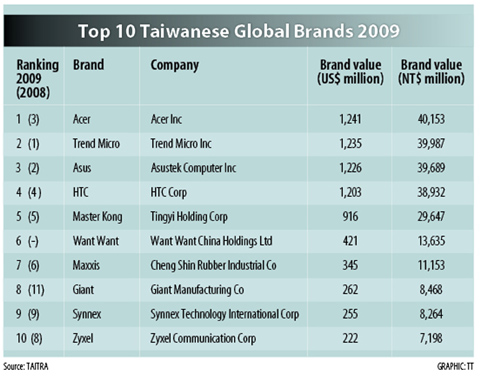
The list saw Acer Inc (宏碁) jump from No. 3 last year to the top spot this year. Trend Micro Inc (趨勢科技), famous for its PC-cillin and antivirus solutions, and Asustek Computer Inc (華碩電腦) were each down one spot to No. 2 and No. 3, respectively.
Fourth place went to HTC Corp (宏達電), which produces smartphones running on Microsoft Corp’s Windows Mobile and Google Inc’s Android platforms. Fifth was Tingyi Holding Corp (頂益控股), whose Master Kong-brand instant noodles have taken the China market by storm.
Two companies made it onto the Top 20 list for the first time this year: Want Want China Holdings Ltd (旺旺中國控股) and CyberLink Corp (訊連科技), which were ranked No. 6 and No. 17 respectively.
“We are honored to make the Top 20 list for the first time. It shows our products have gained awareness among global consumers,” said Manal Ma (馬慧嫻), CyberLink’s vice president of marketing and consumer service department.
The company’s investments this year in research and development, as well as manpower, are similar to last year’s budget, despite the financial crisis, she said.
Giant Manufacturing Co (巨大機械), which rose from No. 11 last year to No. 8 this year, also underscored the importance of investing in brand building.
“There’s no point in just trying to see how many bicycles we can sell. At the end of the day, what matters is striving for better brand recognition and raising our average selling prices,” Giant spokesman Jeffrey Sheu (許立忠) said.
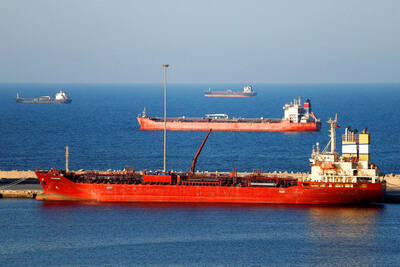
HORMUZ ISSUE: The US president said he expected crude prices to drop at the end of the war, which he called a ‘minor excursion’ that could continue ‘for a little while’ The United Arab Emirates (UAE) and Kuwait started reducing oil production, as the near-closure of the crucial Strait of Hormuz ripples through energy markets and affects global supply. Abu Dhabi National Oil Co (ADNOC) is “managing offshore production levels to address storage requirements,” the company said in a statement, without giving details. Kuwait Petroleum Corp said it was lowering production at its oil fields and refineries after “Iranian threats against safe passage of ships through the Strait of Hormuz.” The war in the Middle East has all but closed Hormuz, the narrow waterway linking the Persian Gulf to the open seas,
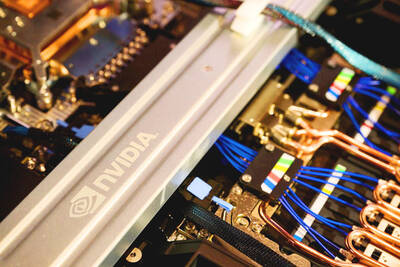
RATIONING: The proposal would give the Trump administration ample leverage to negotiate investments in the US as it decides how many chips to give each country US officials are debating a new regulatory framework for exporting artificial intelligence (AI) chips and are considering requiring foreign nations to invest in US AI data centers or security guarantees as a condition for granting exports of 200,000 chips or more, according to a document seen by Reuters. The rules are not yet final and could change. They would be the first attempt to regulate the flow of AI chips to US allies and partners since US President Donald Trump’s administration said it rescinded its predecessor’s so-called AI diffusion rules. Those rules sought to keep a significant amount of AI

Apple Inc increased iPhone production in India by about 53 percent last year and now makes a quarter of its marquee devices there, reflecting the US company’s efforts to avoid tariffs on China. The company assembled about 55 million iPhones in India last year, up from 36 million a year earlier, people familiar with the matter said, asking not to be named because the numbers aren’t public. Apple makes about 220 million to 230 million iPhones a year globally, with India’s share of the total increasing rapidly. Apple has accelerated its expansion in the world’s most populous country in recent years, bolstered
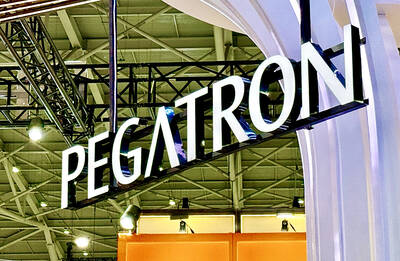
HEADWINDS: The company said it expects its computer business, as well as consumer electronics and communications segments to see revenue declines due to seasonality Pegatron Corp (和碩) yesterday said it aims to grow its artificial intelligence (AI) server revenue more than 10-fold this year from last year, driven by orders from neocloud solutions clients and large cloud service providers. The electronics manufacturing service provider said AI server revenue growth would be driven primarily by the Nvidia Corp GB300 server platform. Server shipments are expected to increase each quarter this year, with the second half likely to outperform the first half, it said. The AI server market is expected to broaden this year as more inference applications emerge, which would drive demand for system-on-chip, application-specific integrated circuits


 RSS
RSS