

Australia’s economy will likely perform under capacity and unemployment will rise, despite the country’s resilience in the face of the global downturn, Treasurer Wayne Swan said yesterday.
Swan said the government’s A$70 billion (US$63.2 billion) emergency stimulus package had helped keep Australia out of a recession — the only major Western country to do so — but that uncertainties remained.
“We still expect the economy will operate below capacity for a while yet and for the unemployment rate to continue to rise,” he told economists at a lunch in Sydney.
“The full effects of the fall in Australia’s terms of trade are also still being felt and this will continue to weigh on domestic incomes. Private business investment and company profitability are still expected to decline,” he said.
Australia posted growth of 0.6 percent in the three months to June — the best in the developed world — while the country’s unemployment rate fell unexpectedly for the first time in five months last month to 5.7 percent.
But Swan, who did not put a figure on future unemployment, said without the government’s fiscal stimulus the economy would have contracted by 1.3 percent over the year to June.
The treasurer said one year after the global financial crisis rattled markets around the world, a sustained global recovery was “no sure thing.”
“Substantial uncertainties remain and Australians’ jobs are still at risk as a consequence,” he said.
And yet, “it is possible the economy could continue to surprise on the upside,” he said.

INFRINGEMENT: The investigation comes after a complaint from Vicor Corp, with the company seeking a limited exclusion order as well as cease-and-desist orders, the ITA said The US International Trade Commission (USITC) has launched a Section 337 investigation naming Taiwanese technology companies, including Hon Hai Precision Industry Co (鴻海), Delta Electronics Inc (台達電) and Quanta Computer Inc (廣達), as respondents. The Ministry of Economic Affairs (MOEA) pledged assistance if needed. The USITC said on Friday in a statement that it had voted to institute an investigation under Section 337 of the US Tariff Act of 1930 into certain vertical power delivery systems, related components and computing devices incorporating such systems. The investigation covers 20 companies from Taiwan, China, Germany and the US, the commission said, adding that it
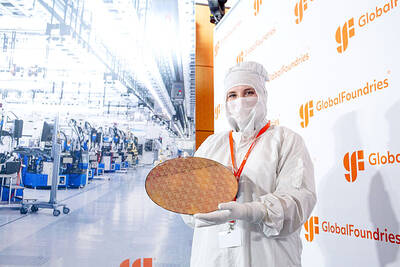
PACKAGING PUSH: The chipmaker said that it would begin ramping up silicon interposer production in New York in the first half of 2028 to support AI systems GlobalFoundries Inc shares gained as much as 7 percent after the chip manufacturer announced a five-year, US$2 billion deal to provide US production capacity to Taiwan Semiconductor Manufacturing Co (TSMC, 台積電). Under the agreement, announced on Thursday, GlobalFoundries is to help supply components known as silicon interposers. The US company is to rely on manufacturing at its facility in Malta, New York, and said it has the option to expand capacity “as customer demand grows.” An interposer is a small layer of silicon that sits between a chip and its packaging. It is home to the wires that carry electronic signals and
A man charged along with Super Micro Computer Inc co-founder Yih-Shyan “Wally” Liaw (廖益賢) of conspiring to send cutting-edge chips to China in violation of US export controls pleaded guilty, court documents said. Ting-Wei “Willy” Sun (孫廷瑋), a former outside contractor described by US authorities as a “fixer” who allegedly aided in the sales, pleaded guilty on Thursday at a hearing in federal court in New York as part of an agreement with prosecutors, court filings showed. Prosecutors claimed the men were part of a scheme to send Nvidia Corp-powered servers to an unnamed Southeast Asian company and then divert them to
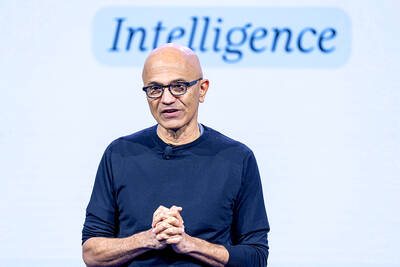
Microsoft Corp chief executive officer Satya Nadella said companies should treat powerful artificial intelligence (AI) models as potential insider threats, assume they could be compromised and create an “emergency brake” system to prevent agentic models from going rogue. Nadella said that those deploying advanced AI should not rely on assurances from model makers. “We must assume a model is compromised and contain it from the start,” Nadella wrote on Saturday in a post on X. “Think of it like an emergency brake. An authorized person should always be able to pause or shut down a model mid-task.” The statement comes as Anthropic PBC


 RSS
RSS