

Stanford University is trying to sell US$1 billion of its US$12.6 billion portfolio of assets, including investments in venture capital, its head of investments said on Friday.
The top-tier university nestled in the heart of Silicon Valley is selling at a time when the value of its endowment has dropped nearly 30 percent. Investment bank Cogent Partners is coordinating a sale of private equity, venture capital, timber, oil and gas and real estate assets with bids due at month’s end.
RIGHT PRICE
John Powers, chief executive officer of Stanford Management Co, said the university would sell only if the price is right.
“We are not a distressed seller so we’re quite willing to not do it if we don’t get terms we are comfortable with,” Powers said.
“We had very deliberately chosen to wait until the markets had recovered somewhat to explore if this made sense,” he said, adding that Stanford has US$800 million of borrowed money, stored in short-term holdings, that it has yet to tap into.
“If in fact we get a level of interest that we think merits a response, I would expect [the sale] to move relatively briskly,” he said.
He said it could be completed by December or January.
The story was initially reported by the Stanford Daily, which also interviewed Powers.
One potential buyer in the secondary market said that, although the assets will be sold below their purchase price, the university expected a good price.
“It is not hard pressed on pricing and the university may be aggressive on what it tries to get as a price,” said one person in the secondary market, who has held talks with Stanford over the sale.
He spoke on condition of anonymity because the talks were private.
Powers said the goal was to raise the liquidity of the university’s holding in order to rebalance its portfolio.
However, the university was finding not all assets had equal appeal.
“There doesn’t appear to be a lot of interest in private real estate assets,” he said.
Stanford, which counts Google founders Larry Page and Sergey Brin and other technology titans among its graduates, is cutting 500 jobs and scaling back budgets this year because of an estimated 30 percent drop in the value of its endowment.
The endowment had dropped in value 27 percent to US$12.6 billion as of Aug. 31, compared with a year ago, hurt by volatile markets.
LITTLE ACTION
Kate Mitchell, managing director of venture capital investors Scale Venture Partners, said that although there had been rumors of many such secondary sales, there had been little action because buyers and sellers could never agree on price.
“There has been a narrowing of the spread between the buyers and sellers,” she said. “They couldn’t come to terms in January. As I’m hearing it, people are actually closing a lot of deals now.”
Sales were now being facilitated because the public market was up, increasing prices and sellers were being “more realistic” about what prices they might expect to obtain, she said.

EQUAL SHARE: A row over Micron’s payouts coincides with a global debate about who deserves a cut of the sudden wealth generated by the artificial intelligence boom Micron Technology Inc is to provide its engineers in Taiwan a cash bonus of NT$1 million (US$31,600) plus equity rewards, as the company’s local unions are demanding an additional payout to reflect their contribution to the chipmaker’s blowout profits. The Idaho-based chipmaker said in a statement yesterday that its entry-level, Taiwan-based engineers’ average compensation would reach NT$3.4 million for the past fiscal year after the cash and equities awards. All employees in Taiwan would receive equities as part of the annual merit grants, the company added. Before the announcement, Micron’s unions asked for a one-time cash payout equal to about seven years
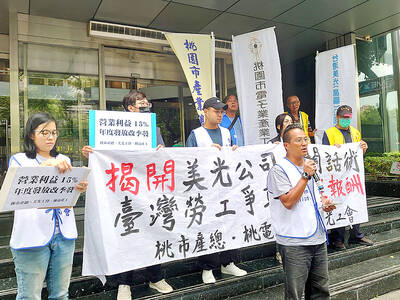
UNION DETERMINATION: Rejecting an offer for a one-time payout as an attempt to influence opinion, the union said a strike at the memory chip manufacturer is possible The Micron Taiwan workers’ union yesterday rejected a one-time payout unveiled by US-based Micron Technology Inc last week, saying it wants a long-term mechanism under which employees would share 15 percent of the company’s operating profits. While the union and the company are still in talks over the dispute, the reward package was proposed unilaterally by the employer without reaching an agreement with the union, union head Jerry Lin (林哲瑞) told reporters. Lin said he suspected the company was seeking to influence public opinion with the move. On Friday last week, Micron announced a reward package under which employees in Taiwan would receive
SOME CUSHION: Taiwan’s GDP is forecast to grow more than 11 percent this year, so the economy should be able to absorb the impact of a rate hike, an expert said With domestic inflation topping the 2 percent alert level for a fourth consecutive month last month and several major central banks around the world raising their key interest rates, Taiwan’s central bank is facing growing pressure to raise rates at its quarterly policymaking meeting on Thursday, economists said. At its June meeting, the central bank left interest rates unchanged for the ninth consecutive quarter, with the discount rate at 2 percent. Central Bank Governor Yang Chin-long (楊金龍) had said that the bank maintained a somewhat hawkish stance, with two board directors voicing support for a rate hike at the meeting. Cathay United
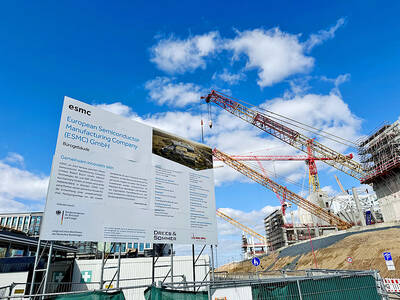
BUILDER’s RITES: The topping out ceremony is held when a project being built has its highest point laid out, a sure sign that TSMC’s European project is making solid progress A “topping out” ceremony was held on Monday at a plant under construction in Germany by Taiwan Semiconductor Manufacturing Co (TSMC, 台積電), indicating that the fab is progressing as planned and within budget, the head of a joint-venture company in charge of the project said. A topping out ceremony is the construction milestone of laying the final beam or structural piece at the highest point of a building, and it honors the construction crew, architects and engineers. European Semiconductor Manufacturing Co (ESMC) president Christian Koitzsch said that about 2,000 workers from 106 countries are working around the clock at the site in


 RSS
RSS