


Nearly 90 percent of people in Taiwan believe they do not have enough non-life insurance policy coverage, yet 60 percent of non-life policyholders do not keep tabs on their protection, a survey found.
“The demand for non-life insurance policies is greatly underestimated in Taiwan,” Jennifer Wang (王儷玲), dean of risk management department at National Chengchi University, told a media briefing organized by MSIG Mingtai Insurance Co (明台產險) yesterday.
Non-life policy penetration in Taiwan is 0.87 percent, for a density of NT$4,677 per head.
This lags far behind the 15.55 percent penetration rate for life polices, or NT$83,294 each, Wang said, citing statistics provided by the Financial Supervisory Commission.
The survey also showed that some 57 percent of 1,020 polled respondents said they did not seek consultations on non-life policies after assessing the risk to their properties such as houses, cars and motorbikes on their own.
Another 73 percent said they only take up compulsory liability policies such as mandatory automobile liability insurance, the survey found.
Wang said more than 70 percent of the survey’s respondents would welcome tailor-made face-to-face professional consultations to examine the “breadth” of their protection and how reasonable their policy premiums were.
Under such a backdrop, Mingtai yesterday launched its risk consultation services and hotline, hoping to promote the awareness of liability risk among potential policyholders.
The insurer’s 1,400 in-house staff including 700 agents and 1,700 contracted agents will respond to calls for risk assessments and insurance planning as requested by prospective policyholders, company president Steven Chang (張立義) said at the sideline of yesterday’s media briefing.
He said that in the past three years the insurer has invested more than NT$100 million (US$3.1 million) in staff training to better its services and enhance its expertise.
Mingtai believes the local market presents ample business opportunities as the nation’s non-life insurance coverage remains low, Chang said.

Cairo’s new monorail slices across the city skyline, running above the familiar chaos of blaring horns and aging buses’ exhaust fumes that mark rush hour below. The US$4.5 billion monorail, opened this month, is among Egypt’s most prominent new transport projects, part of a debt-funded infrastructure drive criticized for sapping state finances while bringing limited benefits to most of the country’s 109 million people. “It feels like you’re in a different country,” said Ramy Sayed, a restaurant manager, aboard a driverless Innovia 300 train. “No noise, no traffic, we’re not used to this.” The eastern line runs 56km from the bustling middle-class
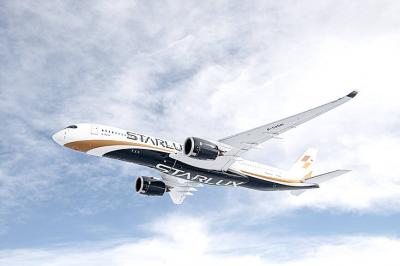
Starlux Airlines Co (星宇航空) today unveiled a long-haul network expansion plan at a shareholders’ meeting in Taipei, including direct flights to Barcelona, Spain, and Zurich, Switzerland, as well as a service connecting Taipei, Sydney and New Zealand. Starlux is to become the first Taiwanese carrier to offer non-stop services to the two European cities, while the inaugural oceanic route is expected to expand transit opportunities within the Australia-New Zealand market, Starlux said. Flight services to Chicago, Dallas, Washington and New York are under evaluation, the airline added. Prior to the shareholders’ meeting, the airline earlier this year announced that it would be

Taiwanese firms have increased investment in the Philippines in recent years as Manila’s ties with Washington deepen and global supply chains continue to shift away from China, an expert at the Chung-Hua Institution for Economic Research (CIER, 中華經濟研究院) said yesterday. The Philippines had not been among Taiwanese investors’ top choices in Southeast Asia, CIER Taiwan ASEAN Studies Center director Kristy Hsu (徐遵慈) said at a seminar in Taipei. However, Taiwan’s investment in the country has grown significantly since the COVID-19 pandemic, reaching US $257 million last year, a high in recent years, she said. Although Taiwan’s total investment in the Philippines still lags

Taiwanese prosecutors suspect that three people successfully smuggled at least one shipment of Nvidia Corp artificial intelligence (AI) chips to China after first exporting them to Japan, people familiar with the matter said. The trio was detained last week by the Keelung District Prosecutors’ Office for allegedly falsifying documents related to exports of Super Micro Computer Inc servers containing advanced Nvidia chips, which the US has barred from sale to China without a license from Washington. The move marked Taiwan’s first public crackdown on AI chip diversion after years of pressure from the US to take a more active role in curtailing


 RSS
RSS