


Bidders for AIG’s Taiwanese life insurance unit may offer less than the US insurer’s US$2 billion target, three people with knowledge of the matter said.
A group led by Primus Financial Holdings Ltd could bid between US$1.2 billion and US$1.4 billion for AIG’s Taipei-based Nan Shan Life Insurance Co (南山人壽), one of the people said, declining to be identified. Fubon Financial Holding Co (富邦金控) plans a US$1 billion offer, said another. Cathay Financial Holding Co (國泰金控) may bid at least US$1.5 billion, a third said.
Nan Shan, Taiwan’s second-largest life insurer, is burdened with unprofitable guaranteed-return policies it sold in the 1990s when interest rates were higher, raising concerns that a buyer may need to inject more capital, said Fitch Ratings analyst Joyce Huang (黃佳琪). AIG is selling assets to help repay US$182.5 billion of debt stemming from a US government bailout.
“It’s going to be challenging in the next two years because the negative spread issue will persist for a while,” said Huang, who has a “negative” ratings outlook for Taiwan’s insurance industry.
Nan Shan, Morgan Stanley and Blackstone Group LP, which are advising AIG on the sale, declined to comment.
AIG was rescued last year after wrong-way bets on securities tied to US subprime mortgages brought it to the brink of collapse.
Cathay Financial is bidding on its own.
Carlyle Group partnered with Fubon Financial, Taiwan’s second-largest publicly traded financial-services company. Primus Financial, co-founded by former Citigroup Inc Asia investment banking chief Robert Morse, is teaming up with China Strategic Holdings Ltd, a Hong Kong-traded battery manufacturer and trader.
By acquiring Nan Shan, Cathay Financial would dominate Taiwan’s life insurance market. It controls 25 percent of premiums and Nan Shan has an 11 percent share, said Andy Chang (張書評), a director at Taiwan Ratings, the local partner of Standard & Poor’s.
Nan Shan raised US$1.45 billion in a rights offer last year to avoid slipping below a regulatory capital requirement. AIG, which owns 97.57 percent of the unit, contributed most of the money.
AIG told potential buyers in February that Nan Shan had an embedded value of about NT$55.5 billion (US$1.7 billion). That figure was revised to about US$3 billion as of May to reflect increased investment returns of Nan Shan’s stock holdings, the people said.
Yesterday, Chinatrust Financial Holding Co (中信金), the nation’s third-largest financial company by market value, also said its board had decided to bid for Nan Shan in a filing to the Taiwan stock exchange.
Chinatrust Financial also said it plans to raise up to NT$2.5 billion by issuing common shares via a private placement.

Cairo’s new monorail slices across the city skyline, running above the familiar chaos of blaring horns and aging buses’ exhaust fumes that mark rush hour below. The US$4.5 billion monorail, opened this month, is among Egypt’s most prominent new transport projects, part of a debt-funded infrastructure drive criticized for sapping state finances while bringing limited benefits to most of the country’s 109 million people. “It feels like you’re in a different country,” said Ramy Sayed, a restaurant manager, aboard a driverless Innovia 300 train. “No noise, no traffic, we’re not used to this.” The eastern line runs 56km from the bustling middle-class
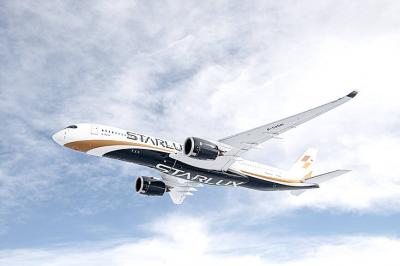
Starlux Airlines Co (星宇航空) today unveiled a long-haul network expansion plan at a shareholders’ meeting in Taipei, including direct flights to Barcelona, Spain, and Zurich, Switzerland, as well as a service connecting Taipei, Sydney and New Zealand. Starlux is to become the first Taiwanese carrier to offer non-stop services to the two European cities, while the inaugural oceanic route is expected to expand transit opportunities within the Australia-New Zealand market, Starlux said. Flight services to Chicago, Dallas, Washington and New York are under evaluation, the airline added. Prior to the shareholders’ meeting, the airline earlier this year announced that it would be

Taiwanese firms have increased investment in the Philippines in recent years as Manila’s ties with Washington deepen and global supply chains continue to shift away from China, an expert at the Chung-Hua Institution for Economic Research (CIER, 中華經濟研究院) said yesterday. The Philippines had not been among Taiwanese investors’ top choices in Southeast Asia, CIER Taiwan ASEAN Studies Center director Kristy Hsu (徐遵慈) said at a seminar in Taipei. However, Taiwan’s investment in the country has grown significantly since the COVID-19 pandemic, reaching US $257 million last year, a high in recent years, she said. Although Taiwan’s total investment in the Philippines still lags

Taiwanese prosecutors suspect that three people successfully smuggled at least one shipment of Nvidia Corp artificial intelligence (AI) chips to China after first exporting them to Japan, people familiar with the matter said. The trio was detained last week by the Keelung District Prosecutors’ Office for allegedly falsifying documents related to exports of Super Micro Computer Inc servers containing advanced Nvidia chips, which the US has barred from sale to China without a license from Washington. The move marked Taiwan’s first public crackdown on AI chip diversion after years of pressure from the US to take a more active role in curtailing


 RSS
RSS