


China can finance the US economy because its workforce is large relative to children and old people, a new analysis suggests in an attempt to solve a mystery why Beijing is a major net creditor rather than a borrower as emerging economies usually are.
This strong ratio of workers to dependents is set to last for at least 15 years, the study says, although the net benefit for China will decline as the burden of old people creeps up while the cost of children remains steady.
The personal research by economists writing in a publication of the Basel-based Bank for International Settlements also implies that the workforce is skewed, with young people who have left a child-bulge bracket up to the age of 15 now boosting the workforce.
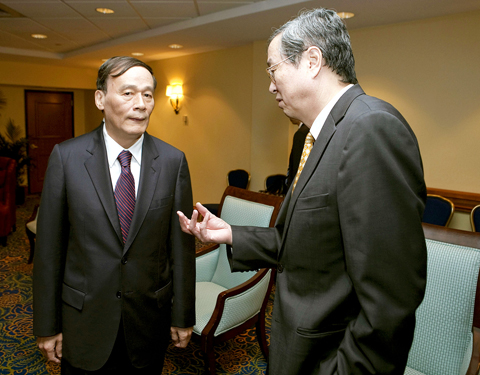
PHOTO: BLOOMBERG
And they are saving money substantially.
Economists Ma Guonan (馬國南) and Zhou Haiwen (周海文) argue that China’s savings glut can in part be explained by its low “youth dependency ratio,” that is, the ratio of those below the age of 15 to the working age population.
A country’s “old-age dependency ratio,” by contrast, compares the percentage of pensioners over 65 to the work force.
“One striking feature of China’s demographic transition during 1985-2007 is that its youth dependency ratio fell by half while its old-age dependency increased only slightly, leaving the overall dependence unchanged,” the report said.
The suggestion that demographics are a hidden key to why China is able to buy assets around the world while holding huge amounts of US government debt casts surprising light on an issue at the heart of long-standing tension between the US and China.
It also gives a new perspective to the view long held by many economists that so-called global imbalances, principally the US trade deficit with China matched by import earnings for China, would be a factor leading to a crisis of the kind the world is now experiencing.
The conventional view is that the massive Chinese investment abroad is a way of “sterilizing” the country’s huge earnings from exports or preventing them from causing inflation and driving up the yuan. The export surpluses are an undisputed fact; however, the new research suggests that they are not the only big source of surplus funding available to China.
For the US, struggling to spark a recovery, the stakes are high, a point apparently driven home by senior US officials during talks in Washington last week with Chinese Vice Premier Wang Qishan (王岐山).
US Treasury Secretary Timothy Geithner urged China to shift its economy away from exports and toward domestic demand to strengthen the ailing global economy. He was in essence asking the Chinese to save less and import more.
The research by Ma and Zhou offers insights into why China has funds to invest abroad and points to a high ratio of personal savings and a reduction of government borrowing as important factors.
These, they say, are driven by demographics and enable the emerging Chinese powerhouse to export capital instead of importing it, thereby defying classical economic theory.
FREED
With a relatively low percentage of the population under 15, the Chinese government is freed from having to spend vast sums on child-related services and can go abroad in search of securities and companies to buy, according to this analysis.
The BIS, known as the central bankers’ central bank, circulated the report last week, adding that the arguments developed by the authors do not necessarily reflect those of the bank.
A net debtor in 1999, China has since become a major net creditor and is likely to remain so until 2025, according to the study.
The country’s “net foreign asset position” (NFA) — the difference between its overseas assets and liabilities — came to 30 percent of its GDP in 2007 and amounted to more than US$1 trillion.
In absolute terms, China’s NFA status was second only to that of Japan.
The authors of the study describe the turnaround in China’s external financial situation as “puzzling,” given its relatively low per capita income level (US$2,500) and its sizzling growth of recent years.
“A faster growing economy tends to attract more capital inflows,” the report noted, adding that “by conventional wisdom China should ... be a significant importer of foreign savings.”
ZEALOUS SAVERS
But that is not what has happened, the report contends, largely because the Chinese are zealous savers rather than consumers of foreign goods.
And those savings are increasingly being invested abroad, notably in the US, where Chinese holdings in US Treasury bonds now amount to more than US$800 billion.
“Given China’s growing role in the global financial system, the stakes are high, not only for China but for the rest of the world,” the authors contend.
In 1985, according to the study, for every 100 people in work, just over 45 children aged under 15 were dependent on them.
By 2005, 100 workers were supporting slightly fewer than 15 youngsters.
A reduced obligation to meet youth-related needs, the report said, should boost overall savings and drive net capital outflow.
“This is because a lower youth dependency could lead to reduced investment in housing, schools and hospitals,” the report says.
China’s overall dependency ratio, expressed as all children under 15 plus pensioners over 65 divided by all workers in between, is also falling.
The labor force in China has, in effect, been growing faster than the population that depends on it, further strengthening savings.
The study found that China’s overall dependency fell from 55 percent in 1985 to 38 percent in 2007.
A declining dependency ratio tends to lift household savings rates while increasing the labor supply, thereby acting as a constraint on wage rises.
Government savings are also enhanced as less money is spent on health care and pensions.
DEBT
The report also pointed to a reduction of Chinese government debt, which hit a peak of 30 percent of output in 2002. It noted that, conversely, a rise in official debt would tend to reduce domestic savings and increase foreign borrowing.
While Beijing is on course to remain a net creditor until 2025, youth dependency is unlikely to fall further and so “may thus cease to be a main driver” of China’s external financial position.
But the old-age dependency ratio is also forecast to double to 20 percent in the next 15 years, cutting spare funds for investment abroad.
China’s foreign asset position “is expected to adjust gradually, facilitated by continued strong economic growth and a more flexible renminbi.”
And “this should assist an orderly global rebalancing without creating excess stress on the rest of the world during the transition.”

Among the rows of vibrators, rubber torsos and leather harnesses at a Chinese sex toys exhibition in Shanghai this weekend, the beginnings of an artificial intelligence (AI)-driven shift in the industry quietly pulsed. China manufactures about 70 percent of the world’s sex toys, most of it the “hardware” on display at the fair — whether that be technicolor tentacled dildos or hyper-realistic personalized silicone dolls. Yet smart toys have been rising in popularity for some time. Many major European and US brands already offer tech-enhanced products that can enable long-distance love, monitor well-being and even bring people one step closer to

TRANSFORMATION: Taiwan is now home to the largest Google hardware research and development center outside of the US, thanks to the nation’s economic policies President Tsai Ing-wen (蔡英文) yesterday attended an event marking the opening of Google’s second hardware research and development (R&D) office in Taiwan, which was held at New Taipei City’s Banciao District (板橋). This signals Taiwan’s transformation into the world’s largest Google hardware research and development center outside of the US, validating the nation’s economic policy in the past eight years, she said. The “five plus two” innovative industries policy, “six core strategic industries” initiative and infrastructure projects have grown the national industry and established resilient supply chains that withstood the COVID-19 pandemic, Tsai said. Taiwan has improved investment conditions of the domestic economy

Malaysia’s leader yesterday announced plans to build a massive semiconductor design park, aiming to boost the Southeast Asian nation’s role in the global chip industry. A prominent player in the semiconductor industry for decades, Malaysia accounts for an estimated 13 percent of global back-end manufacturing, according to German tech giant Bosch. Now it wants to go beyond production and emerge as a chip design powerhouse too, Malaysian Prime Minister Anwar Ibrahim said. “I am pleased to announce the largest IC (integrated circuit) Design Park in Southeast Asia, that will house world-class anchor tenants and collaborate with global companies such as Arm [Holdings PLC],”

MAJOR BENEFICIARY: The company benefits from TSMC’s advanced packaging scarcity, given robust demand for Nvidia AI chips, analysts said ASE Technology Holding Co (ASE, 日月光投控), the world’s biggest chip packaging and testing service provider, yesterday said it is raising its equipment capital expenditure budget by 10 percent this year to expand leading-edge and advanced packing and testing capacity amid strong artificial intelligence (AI) and high-performance computing chip demand. This is on top of the 40 to 50 percent annual increase in its capital spending budget to more than the US$1.7 billion to announced in February. About half of the equipment capital expenditure would be spent on leading-edge and advanced packaging and testing technology, the company said. ASE is considered by analysts


 RSS
RSS