

Steve Jobs, the chief executive officer of Apple Inc, who has been on medical leave since January to take care of an undisclosed medical condition, has received a liver transplant in Tennessee, the Wall Street Journal reported yesterday.
The newspaper said the transplant took place about two months ago, and Jobs has been recovering well and was expected to return to work on schedule later this month. However, the Apple CEO may initially work part-time.
“Steve continues to look forward to returning at the end of June, and there’s nothing further to say,” Apple spokeswoman Katie Cotton is quoted by the report as saying.
When he returns, Jobs may be encouraged by his physicians to initially “work part-time for a month or two,” said the Journal, citing an unnamed person familiar with the situation at Apple.
That may lead Tim Cook, Apple’s chief operating officer, to take “a more encompassing role,” the paper said, citing the same source. The person added that Cook may be appointed to Apple’s board in the not-too-distant future, the paper said.
Apple has previously drawn criticism from some shareholders over what they have called limited disclosure of Jobs’s health problems, the report said. In this case, it is unclear whether the surgery changes anything because Jobs was already on leave, the paper said.
Apple shares have climbed 63 percent since Jobs went on medical leave, signaling investors are confident the maker of the iPhone can succeed without its co-founder at the helm.
Jobs, who in January turned over day-to-day operations to Cook, should hand over the CEO job permanently when he returns later this month, said Michael Obuchowski, chief investment officer at First Empire Asset Management Inc in Hauppauge, New York.
“For investors, it would be better if Steve doesn’t return to be as hands-on as he was,” Obuchowski said. “He has created a good team and investors would be comfortable with that team and having Steve in more of an advisory role.”
Jobs, a cancer survivor, could take a new position, possibly as Apple’s chairman, letting him guide the company with less scrutiny of his health, Obuchowski said.
Jobs said on Jan. 5 that he was suffering from a hormone imbalance and announced nine days later that his health issues were more complex than he thought. Cook and a team of product and marketing executives have raised their profiles in Jobs’ absence, unveiling updated Macintosh computers and iPod media players.
The company is also releasing a new iPhone, generating buzz even though Jobs, 54, did not introduce the device.
During Jobs’ leave, Apple shares have outpaced the Standard & Poor’s 500 index by almost sevenfold. The stock rose US$3.60 to US$139.48 on Friday in NASDAQ Stock Market trading.
Cook filled in when Jobs took a month-long medical leave in August 2004 to recover from surgery to remove an islet cell neuroendocrine tumor. Apple said in January that it has a succession plan should Jobs decide to leave for any reason. The plan is confidential, the company said.
“Transparency in this area is critical,” said Charles Elson, director of the John L. Weinberg Center for Corporate Governance at the University of Delaware. “The transparency issues throughout his illnesses have raised concerns among investors.”
Jobs co-founded Apple in 1976 with Steve Wozniak. He was fired by the board after a management dispute in 1985 and then returned to lead the company in 1997. Under Jobs’ tenure, Apple’s sales have surged to more than US$30 billion a year. The stock has risen from US$3.42 in July 1997.
Cook was first mentioned as a possible heir in 2004 when he ran the company during Jobs’s leave. His position as second-in-command was cemented in October 2005, when he was promoted to operating chief.
“If you had an arrangement where Steve focused on Apple’s strategic products and Tim took care of all the other stuff, I would say it wouldn’t really change the complexion of Apple,” said Charlie Wolf, an analyst at Needham & Co in New York. “It’s just a question of title.”

INFRINGEMENT: The investigation comes after a complaint from Vicor Corp, with the company seeking a limited exclusion order as well as cease-and-desist orders, the ITA said The US International Trade Commission (USITC) has launched a Section 337 investigation naming Taiwanese technology companies, including Hon Hai Precision Industry Co (鴻海), Delta Electronics Inc (台達電) and Quanta Computer Inc (廣達), as respondents. The Ministry of Economic Affairs (MOEA) pledged assistance if needed. The USITC said on Friday in a statement that it had voted to institute an investigation under Section 337 of the US Tariff Act of 1930 into certain vertical power delivery systems, related components and computing devices incorporating such systems. The investigation covers 20 companies from Taiwan, China, Germany and the US, the commission said, adding that it

IN GOOD FAITH: Lai said he appreciates Micron’s commitment to Taiwan and that it would continue expanding its investment in the country, while also working with labor President William Lai (賴清德) yesterday called for US memory maker Micron Technology Inc and its workers to negotiate “sincerely” ahead of a possible strike by the company’s union in Taiwan. Last week, a Taiwanese union representing workers at Micron said it had secured authorization from its members to strike over a dispute concerning the company’s bonus scheme, escalating a labor conflict at the chipmaker’s largest manufacturing hub. Micron employs about 15,000 people in Taiwan and has said it invested more than NT$1.6 trillion (US$49.6 billion) in the country. Speaking in Taichung at the opening of a new Micron advanced assembly and testing facility,

A man charged along with Super Micro Computer Inc co-founder Yih-Shyan “Wally” Liaw (廖益賢) of conspiring to send cutting-edge chips to China in violation of US export controls pleaded guilty, court documents said. Ting-Wei “Willy” Sun (孫廷瑋), a former outside contractor described by US authorities as a “fixer” who allegedly aided in the sales, pleaded guilty on Thursday at a hearing in federal court in New York as part of an agreement with prosecutors, court filings showed. Prosecutors claimed the men were part of a scheme to send Nvidia Corp-powered servers to an unnamed Southeast Asian company and then divert them to
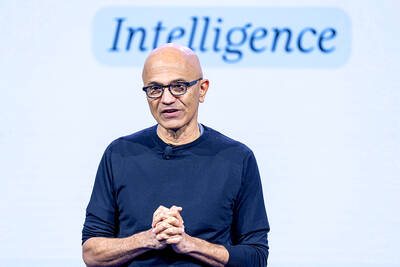
Microsoft Corp chief executive officer Satya Nadella said companies should treat powerful artificial intelligence (AI) models as potential insider threats, assume they could be compromised and create an “emergency brake” system to prevent agentic models from going rogue. Nadella said that those deploying advanced AI should not rely on assurances from model makers. “We must assume a model is compromised and contain it from the start,” Nadella wrote on Saturday in a post on X. “Think of it like an emergency brake. An authorized person should always be able to pause or shut down a model mid-task.” The statement comes as Anthropic PBC


 RSS
RSS