


Government inefficiency once again topped the American Chamber of Commerce in Taipei’s (AmCham) list of concerns in its annual Taiwan White Paper released yesterday, after several of its industry committees reported frustration dealing with regulatory bodies.
“Taiwan has been losing ground recently, mainly because competing economies are improving so rapidly,” AmCham chairman Alan Eusden told a media briefing yesterday.
“The area where Taiwan consistently has been weakest is in government inefficiency [sic],” said Eusden, who is also the president of Corning Display Technologies Taiwan.
TRAINING
The chamber called on the Taiwanese government to train civil servants and reinforce the focus on service, he said.
It complained that little opportunity was given in conducting two-way dialogue between the telecom/media sector and National Communications Commission (NCC) officials.
The chamber urged the NCC to set a clear policy agenda for the coming year while proactively fostering new technologies and telecom services, the white paper said.
REIMBURSEMENTS
In the pharmaceutical sector, the chamber said that the Bureau of National Health Insurance had lowered reimbursements for new drugs as a result of a tightened budget, which had a negative impact on innovation.
Taiwan now has the lowest reimbursement prices for new drugs among 10 benchmark advanced countries, including the US, Australia and Japan, Eli Lilly and Co in Taiwan (台灣禮來) general manager Shao Wei-li (邵維立) told the briefing.
The chamber also restated its opposition to the legislature’s planned cut on the statutory 20 percent interest rate cap on credit and cash cards’ revolving credit.
‘LOSE, LOSE, LOSE’
The move, which violates free-market principles, would trigger a “lose, lose, lose” situation among card issuers, socially disadvantaged consumers and the nation’s economy as a whole, said Morris Li (利明獻), country officer of Citi Taiwan (花旗), said at the briefing.
The chamber, however, lauded the government’s achievements last year, including direct cross-strait flights and the nation’s accession to the Government Procurement Agreement under the WTO, adding that 29 of its 101 priority issues covered in last year’s white paper had been addressed.
AmCham said it welcomed the government’s negotiation of a trade agreement with China, which it regards as an economic necessity that should not be politicized.
Before launching its annual Doorknock visit to Washington scheduled for the middle of this month, Eusden yesterday vowed to help cement trade ties between Taiwan and the US by lobbying for the scheduling of the next round of Trade and Investment Framework Agreement talks and the initiation of formal negotiations on a Bilateral Investment Agreement between the two countries.

Among the rows of vibrators, rubber torsos and leather harnesses at a Chinese sex toys exhibition in Shanghai this weekend, the beginnings of an artificial intelligence (AI)-driven shift in the industry quietly pulsed. China manufactures about 70 percent of the world’s sex toys, most of it the “hardware” on display at the fair — whether that be technicolor tentacled dildos or hyper-realistic personalized silicone dolls. Yet smart toys have been rising in popularity for some time. Many major European and US brands already offer tech-enhanced products that can enable long-distance love, monitor well-being and even bring people one step closer to

Malaysia’s leader yesterday announced plans to build a massive semiconductor design park, aiming to boost the Southeast Asian nation’s role in the global chip industry. A prominent player in the semiconductor industry for decades, Malaysia accounts for an estimated 13 percent of global back-end manufacturing, according to German tech giant Bosch. Now it wants to go beyond production and emerge as a chip design powerhouse too, Malaysian Prime Minister Anwar Ibrahim said. “I am pleased to announce the largest IC (integrated circuit) Design Park in Southeast Asia, that will house world-class anchor tenants and collaborate with global companies such as Arm [Holdings PLC],”

Sales in the retail, and food and beverage sectors last month continued to rise, increasing 0.7 percent and 13.6 percent respectively from a year earlier, setting record highs for the month of March, the Ministry of Economic Affairs said yesterday. Sales in the wholesale sector also grew last month by 4.6 annually, mainly due to the business opportunities for emerging applications related to artificial intelligence (AI) and high-performance computing technologies, the ministry said in a report. The ministry forecast that retail, and food and beverage sales this month would retain their growth momentum as the former would benefit from Tomb Sweeping Day
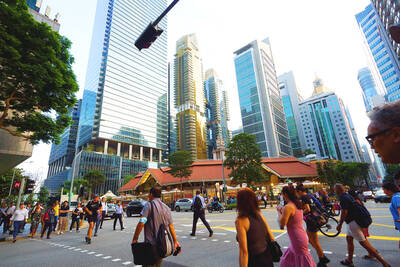
Thousands of parents in Singapore are furious after a Cordlife Group Ltd (康盛人生集團), a major operator of cord blood banks in Asia, irreparably damaged their children’s samples through improper handling, with some now pursuing legal action. The ongoing case, one of the worst to hit the largely untested industry, has renewed concerns over companies marketing themselves to anxious parents with mostly unproven assurances. This has implications across the region, given Cordlife’s operations in Hong Kong, Macau, Indonesia, the Philippines and India. The parents paid for years to have their infants’ cord blood stored, with the understanding that the stem cells they contained


 RSS
RSS