


The Ministry of Economic Affairs yesterday announced a plan to establish four business start-up service centers across the country, hoping to create 800 innovative small and medium enterprises (SMEs) by 2011 and encouraging more people to start their own businesses amid the economic downturn.
The ministry announced the plan yesterday at Taipei’s Nangang Software Park, where the ministry’s “talent incubation centers” set up booths to attract investments and provide start-up consultation.
SMEs played an important role in the nation’s economic development and helped stabilize domestic employment, the ministry’s Small and Medium Enterprise Administration (SMEA) said in a press release yesterday.
However, the recent economic downturn has resulted in a decline of new SMEs, it said.
The SMEA said only between 30 percent and 40 percent of those who start their own businesses in Taiwan eventually become successful, underscoring the difficulty of starting a business.
To create a healthy start-up environment and build the nation into an entrepreneur-friendly economy, the SMEA said it would invest more than NT$100 million (US$2.96 million) by 2011 to help local SMEs transform and upgrade their operations.
The administration said local SMEs, which are particularly vulnerable to the global financial crisis, were in urgent need of transformation and upgrade, and the key to successful transformation was creativity, innovation and entrepreneurship.
“There are five new industries we want to nurture — wireless broadband, digital content, green energy, cultural and creative, and health care,” SMEA director-general Lai Sun-quae (賴杉桂) was quoted as saying by the Broadcasting Corporation of China.

Apple Inc increased iPhone production in India by about 53 percent last year and now makes a quarter of its marquee devices there, reflecting the US company’s efforts to avoid tariffs on China. The company assembled about 55 million iPhones in India last year, up from 36 million a year earlier, people familiar with the matter said, asking not to be named because the numbers aren’t public. Apple makes about 220 million to 230 million iPhones a year globally, with India’s share of the total increasing rapidly. Apple has accelerated its expansion in the world’s most populous country in recent years, bolstered

DAMAGE REPORT: Global central banks are assessing war-driven inflation risks as the law of unintended consequences careens around the world, spiking oil prices Central banks from Washington to London and from Jakarta to Taipei are about to make their first assessments of economic damage after more than two weeks of conflict between the US and Iran. Decisions this week encompassing every member of the G7 and eight of the world’s 10 most-traded currency jurisdictions are likely to confirm to investors that the specter of a new inflation shock is already worrying enough to prompt heightened caution. The US Federal Reserve is widely expected to do exactly what everyone anticipated weeks ahead of its March 17-18 policy gathering: hold rates steady. The narrative surrounding that
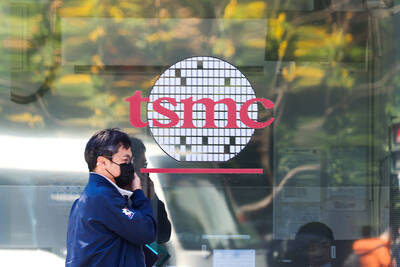
Taiwan Semiconductor Manufacturing Co’s (TSMC, 台積電) share of the global foundry market rose to almost 70 percent last year amid booming demand for artificial intelligence (AI), market information advisory firm TrendForce Corp (集邦科技) said on Thursday. The contract chipmaker posted US$122.54 billion in revenue, up 36.1 percent from a year earlier, accounting for 69.9 percent of the global market, TrendForce said. Its share was up from 64.4 percent in 2024, it said. TSMC’s closest rival, Samsung Electronics, was a distant second, posting US$12.63 billion in sales, down 3.9 percent from a year earlier, for a 7.2 percent share of the global market. In the

HEADWINDS: The company said it expects its computer business, as well as consumer electronics and communications segments to see revenue declines due to seasonality Pegatron Corp (和碩) yesterday said it aims to grow its artificial intelligence (AI) server revenue more than 10-fold this year from last year, driven by orders from neocloud solutions clients and large cloud service providers. The electronics manufacturing service provider said AI server revenue growth would be driven primarily by the Nvidia Corp GB300 server platform. Server shipments are expected to increase each quarter this year, with the second half likely to outperform the first half, it said. The AI server market is expected to broaden this year as more inference applications emerge, which would drive demand for system-on-chip, application-specific integrated circuits


 RSS
RSS