


Chrysler won a round of concessions from its Canadian union on Friday, while General Motors Corp (GM) soaked up US$2 billion more in US government aid and Ford Motor Co posted a narrower-than-expected loss that sent its shares soaring.
The developments underscored the diverging fortunes of Ford and Chrysler and GM, both of which are operating under US government oversight and increasing pressure to win cost-saving agreements to avoid bankruptcy.
Chrysler and the Canadian Auto Workers’ (CAW) tentative agreement on a new labor contract is intended to cut costs and keep the automaker from bankruptcy.
Under the agreement, the No. 3 US automaker would leave hourly base pay intact but cut a range of benefits, including an annual Christmas bonus, and add flexibility to work rules that would make it easier for Chrysler to hire temporary workers.
Chrysler would also cut the third production shift at its Windsor, Ontario minivan plant.
Taken together, the contract changes would save Chrysler an estimated C$240 million (US$198 million) in annual labor costs, CAW president Ken Lewenza said.
The leadership of the Canadian union also agreed to work with Chrysler to create a trust fund to pay for retiree health care modeled on a similar fund that the United Auto Workers union approved for Chrysler’s US workers in 2007.
The tentative deal, which will be put to CAW-represented workers for ratification this weekend, is one of several agreements that Chrysler needs to reach by next week to win new US government aid and avoid liquidation.
The Thursday deadline for Chrysler partly eclipsed GM’s struggle. The administration of US President Barack Obama has rejected a GM restructuring plan, ousted its chief executive and told the automaker to cut deeper and move faster if it wanted to continue to receive government support.
GM has been operating under US$13.4 billion of emergency loans from the US government. The US$2 billion draw adds working capital for the automaker. The US Treasury could lend another US$3 billion to GM.
The struggles of Chrysler and GM overshadowed Ford’s results on Friday. Ford, which has not sought emergency government loans, posted a US$1.4 billion loss that was less than analysts had expected and said it was on track to at least break even in 2011.
Chief financial officer Lewis Booth called the results encouraging and said the automaker expected the first quarter to have the worst cash burn of the year.
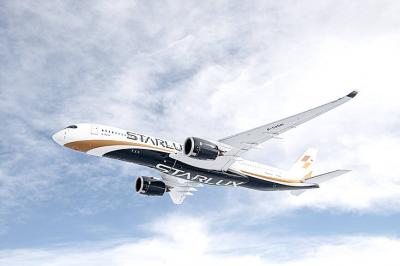
Starlux Airlines Co (星宇航空) today unveiled a long-haul network expansion plan at a shareholders’ meeting in Taipei, including direct flights to Barcelona, Spain, and Zurich, Switzerland, as well as a service connecting Taipei, Sydney and New Zealand. Starlux is to become the first Taiwanese carrier to offer non-stop services to the two European cities, while the inaugural oceanic route is expected to expand transit opportunities within the Australia-New Zealand market, Starlux said. Flight services to Chicago, Dallas, Washington and New York are under evaluation, the airline added. Prior to the shareholders’ meeting, the airline earlier this year announced that it would be

Netherlands-based semiconductor equipment supplier ASML Holding NV yesterday said that it is planning to hire an additional 1,000 people in Taiwan this year in response to growing demand from clients. ASML had previously planned to recruit 600 people this year, but that the plan has been adjusted upward, ASML vice president and ASML Taiwan general manager Grace Wang (汪佳慧) told reporters. ASML has a workforce of more than 4,500 in Taiwan, accounting for about 10 percent of its global total, Wang said. This year’s recruitment campaign would focus on adding people in the customer support, manufacturing and supply chain domains to assist ASML

UNDER MICROSCOPE: Taiwan detained three people who allegedly conspired to buy servers in Taiwan and export them using fraudulent documentation, prosecutors said Nvidia Corp chief executive officer Jensen Huang (黃仁勳) on Saturday urged Super Micro Computer Inc to tighten up on compliance after Taiwan detained three people this week for allegedly making fraudulent declarations about artificial intelligence (AI) servers made by its US partner. The development marked the nation’s first crackdown on semiconductor smuggling, which grew after the US slapped restrictions on exports of high-end chips such as Nvidia AI accelerators to China. Nvidia is “rigorous” in explaining regulations to all of its partners, Huang told reporters after arriving in Taipei. “Ultimately Super Micro has to run their own company,” he said in response to
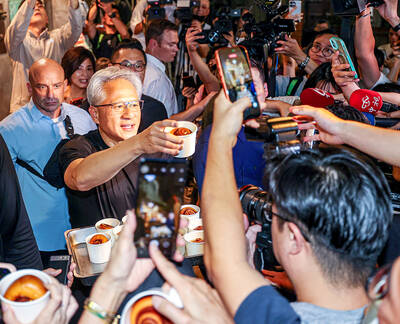
Nvidia Corp yesterday announced that CEO Jensen Huang (黃仁勳) would attend an employee meeting in Taipei tomorrow to celebrate the launch of the company’s Taiwan headquarters project. Huang would attend a gathering at the site of Nvidia’s planned headquarters in Beitou Shilin Technology Park (北投士林科技園區), the company said in a statement. After arriving in Taiwan on Saturday last week, Huang told reporters that he plans to meet with Quanta Computer Inc (廣達) chairman Barry Lam (林百里) and Taiwan Semiconductor Manufacturing Co (TSMC, 台積電) chairman C.C. Wei (魏哲家), and would attend the groundbreaking ceremony for Nvidia’s Taiwan headquarters tomorrow. Nvidia has not yet applied


 RSS
RSS