


Canon Inc, the world’s largest digital camera manufacturer, saw sales in Taiwan grow 15 percent year on year to NT$3 billion (US$85.3 billion) last year, the company said yesterday.
“We hope to overcome challenging economic times this year by targeting yet another 15 percent annual revenue growth for Taiwan [and] reach NT$3.3 billion for 2009,” Canon Taiwan chairman and CEO Satoshi Yahata told a media briefing yesterday.
Last year, digital cameras accounted for 70 percent of its business, followed by enterprise imaging with 20 percent and printers with 10 percent.
This year, Canon said it would focus on innovating its product lines, improving after-sales services and continue building its global brand image.
“Other than market share, Canon hopes to be the No. 1 in mind share as well,” Jesse Su (蘇惠璋), director and general manager of consumer image and information at Canon Taiwan, said at the same meeting.
Mind share refers to consumer awareness or the popularity of a certain product or brand name.
Last year, Canon Taiwan secured its first-place spot in the digital single lens reflex category by grabbing 40 percent of the domestic market, with sales rising 70 percent from the previous year.
Digital still cameras (DSC) took up 20 percent of the domestic market. Combined camera sales grew 13 percent year-over-year last year.
Sales of Canon printers in Taiwan also rose 25 percent last year and are projected to grow 20 percent this year with a focus on mid to high-level printer models and all-in-one machines for businesses, Su said.
Canon Taiwan yesterday unveiled its three IXUS DSC series aimed at amateur photographers. Unlike the usual conventional stark professional appearance, the IXUS models come in 14 vibrant colors and are priced from NT$8,990 to NT$11,990.
Featuring “smart auto” technology, these DSCs have 18 shooting modes and are equipped with features such as motion detection and face detection.

Cairo’s new monorail slices across the city skyline, running above the familiar chaos of blaring horns and aging buses’ exhaust fumes that mark rush hour below. The US$4.5 billion monorail, opened this month, is among Egypt’s most prominent new transport projects, part of a debt-funded infrastructure drive criticized for sapping state finances while bringing limited benefits to most of the country’s 109 million people. “It feels like you’re in a different country,” said Ramy Sayed, a restaurant manager, aboard a driverless Innovia 300 train. “No noise, no traffic, we’re not used to this.” The eastern line runs 56km from the bustling middle-class
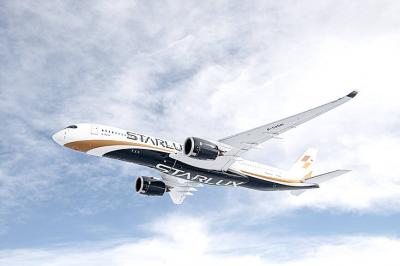
Starlux Airlines Co (星宇航空) today unveiled a long-haul network expansion plan at a shareholders’ meeting in Taipei, including direct flights to Barcelona, Spain, and Zurich, Switzerland, as well as a service connecting Taipei, Sydney and New Zealand. Starlux is to become the first Taiwanese carrier to offer non-stop services to the two European cities, while the inaugural oceanic route is expected to expand transit opportunities within the Australia-New Zealand market, Starlux said. Flight services to Chicago, Dallas, Washington and New York are under evaluation, the airline added. Prior to the shareholders’ meeting, the airline earlier this year announced that it would be

Taiwanese firms have increased investment in the Philippines in recent years as Manila’s ties with Washington deepen and global supply chains continue to shift away from China, an expert at the Chung-Hua Institution for Economic Research (CIER, 中華經濟研究院) said yesterday. The Philippines had not been among Taiwanese investors’ top choices in Southeast Asia, CIER Taiwan ASEAN Studies Center director Kristy Hsu (徐遵慈) said at a seminar in Taipei. However, Taiwan’s investment in the country has grown significantly since the COVID-19 pandemic, reaching US $257 million last year, a high in recent years, she said. Although Taiwan’s total investment in the Philippines still lags

Taiwanese prosecutors suspect that three people successfully smuggled at least one shipment of Nvidia Corp artificial intelligence (AI) chips to China after first exporting them to Japan, people familiar with the matter said. The trio was detained last week by the Keelung District Prosecutors’ Office for allegedly falsifying documents related to exports of Super Micro Computer Inc servers containing advanced Nvidia chips, which the US has barred from sale to China without a license from Washington. The move marked Taiwan’s first public crackdown on AI chip diversion after years of pressure from the US to take a more active role in curtailing


 RSS
RSS