


Who says print is dead? A Chicago-based start up is hoping to both revitalize and revolutionize the newspaper by reprinting blogs in hyper-localized free papers that offer business the same kind of targeted — and cheap — ads found online.
The Printed Blog hits the streets of Chicago and San Francisco tomorrow and will be launched in New York within the next month.
“What we’re trying to do is apply some of the principals that have worked online in aggregators to the newspaper industry and see if it works,” said founder Joshua Karp, who has a background in management consulting.
Print runs of just 1,000 issues will allow the paper to be tailored to specific neighborhoods — which Karp envisions could one day result in as many as 50 to 100 different editions in large cities — and users will be able to vote on what type of content they want.
The paper will be focused on “your physical social network as opposed to your online social network,” Karp said. “It’s a different idea than the one size fits all you get with the [free daily] Red Eye or Chicago Tribune.”
The venture comes at a time when daily newspapers across the US are slashing staff and budgets and struggling to compete with the online advertising market.
The respected Christian Science Monitor was forced to abandon print distribution and has become an online-only publication and the Minneapolis Star Tribune last week joined the Tribune company — which owns the LA Times and Chicago Tribune among other titles — in seeking bankruptcy protection.
“I really hope the print newspaper doesn’t go away,” Karp said. “I for one appreciate the physical nature of it — you shuffle it on the train and ink rubs off on your fingers. It’s not the same experience as a screen.”
The Printed Blog has a significant advantage over traditional newspapers in terms of cost structure: the content is provided in exchange for a share of advertising revenue as opposed to a journalist’s salary or the kinds of fees paid to professional freelancers.
There will be no editing, and Karp is hoping to automate layout and distribute the paper through local franchisees who publish the editions on an US$8,000 printer in their homes.
Ads will cost just US$15 to US$25 and the small, localized print runs will allow local businesses like clothing boutiques and restaurants reach a specific target audience.
“This will be the first time we’ve advertised in an offline media in any shape or form,” said John McCaw, who runs Directory of Schools, a Web site which helps users access online education and degrees.
‘The audience in the area where the Printed Blog is being distributed tends to be a good fit for the type of demographic that uses our service,” he said.
Karp hopes to soon publish the blog twice a day to reach commuters on their way to and from work. He’s had no trouble finding the content to fill the three double-sided pages.
“There is a phenomenal amount of remarkably well written blogs out there,” Karp said.

HSBC Holdings PLC is deepening its commitment to Taiwan as the economy emerges as one of the bank’s fastest-growing markets globally, driven by an artificial intelligence (AI) investment boom, expanding cross-border trade, and rising wealth creation. “The advantage that Taiwan has is a growth story linked to the semiconductor and broader AI industries, strong underlying corporate performance, and wealth creation,” said Surendra Rosha, HSBC’s co-chief executive for Asia and the Middle East, in an exclusive interview with the Taipei Times on June 2, during this year’s HSBC Taiwan Conference. That combination has helped HSBC cement its position as the most profitable international
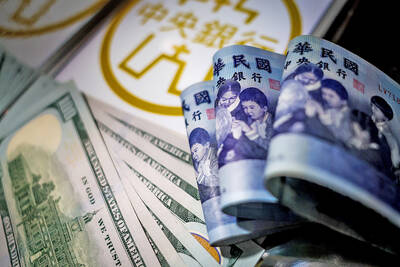
The New Taiwan dollar yesterday fell sharply against the US dollar to close at its lowest level since May 22 amid a massive outflow of funds from the country because of investors panicking over global equity markets. The NT dollar ended at NT$31.580 against the US dollar, slightly lower than its close of NT$31.568 on May 22, after moving between NT$31.5 and NT$31.648 on combined turnover of US$3.062 billion on the Taipei Foreign Exchange and the Cosmos Foreign Exchange. The NT dollar received a significant hit in the morning session, slumping as much as NT$0.173 at a time when other Asian currencies
Taiwan Semiconductor Manufacturing Co (TSMC, 台積電) is now ranked ninth among the world’s 100 most valuable companies after its market capitalization more than doubled over the past year, PricewaterhouseCoopers (PwC) Taiwan said in a report last month. TSMC’s market capitalization surged 101 percent year-on-year to US$1.427 trillion as of March 31, the accounting and consulting firm’s 2026 Global Top 100 Companies by Market Capitalization report said. The gain catapulted the world’s largest contract chipmaker from 12th place to ninth in the rankings, and it was the fastest-growing among the global top 10, it said. TSMC was the only Taiwanese company among the top
Taiwan Semiconductor Manufacturing Co (TSMC, 台積電) yesterday reported record revenue of NT$416.975 billion (US$13.17 billion) for last month, putting the world’s largest contract chipmaker on track to set a record for quarterly revenue. Last month’s figure surpassed March’s record NT$415.19 billion and represented increases of 1.5 percent from April and 30.1 percent from a year earlier. For the first five months of the year, TSMC generated NT$1.96 trillion in revenue, up 30 percent year-on-year, it said in a statement. TSMC has forecast second-quarter revenue of between US$39 billion and US$40.2 billion, representing sequential growth of about 10 percent and year-on-year growth of about


 RSS
RSS