


Economists yesterday forecast that interest rates would further trend down to 1 percent as early as March, but warned of a “liquidity trap” if the central bank continued its aggressive rate cuts.
“Cutting the rate to lower levels may backfire, forcing people to hold more cash,” Chen Miao (陳淼), a researcher at Taiwan Institute of Economic Research (台經院), said by telephone yesterday.
Keynesian economics warns that lowering interest rates to close to or equal to zero to avoid a recession may boost liquidity but not necessarily stimulate the economy. Borrowers may choose to keep assets in short-term cash bank accounts rather than making long-term investments, creating a liquidity trap. This may make a recession even more severe and can contribute to deflation.
Chen said the main problems facing the local economy were consumers drastically cutting back on spending, companies hesitating to take out loans for investment and banks refusing to extend credit.
A poll released by Global Views Survey Research Center (遠見民調) yesterday found that as many as 62 percent of respondents said they would spend the NT$3,600 vouchers that the government would start distributing to qualified individuals next Sunday on daily necessities and would refrain from over-spending, dealing a blow to the government’s goal of boosting consumption.
Wang Lee-rong (王儷容), director of the Chung-Hua Institution for Economic Research’s (中華經濟研究院) economic forecast center, also cast doubt on the wisdom of further cutting rates as the central bank had already lowered rates by 212.5 basis points in four months.
“The rate cut policy didn’t seem to help a lot,” she said.
Rate cuts have usually been followed by a rise in the stock market. However, the central bank’s rate cut on Wednesday failed to assure investors, who, spooked by the slump in the nation’s exports last month, drove the TAIEX down 5.3 percent to close at 4,535.79 points yesterday.
Wang said she did not foresee interest rates dropping below 1 percent as other pundits had suggested. She expects another 0.5 percentage-point cut in March amid worsening exports in the first quarter.
“An interest rate lower than 1 percent will cause panic — as if it’s the end of the world,” she said.
Agreeing that the nation’s rate will go down to 1 percent,
Arjuna Mahendran, head of HSBC private banking’s investment strategy in Asia, said interest rates could go down to 1 percent, but whether the central bank should cut rates even more aggressively would depend on the nation’s inflation outlook.
The banker said the consumer price index could fall into negative territory this year, which will leave the central bank no choice but to tackle deflation and “cut more to below 1 percent.” He did not give a timeframe for the expected rate cut.
Standard Chartered Bank said in a report yesterday that the central bank could slash its benchmark rate by another 0.25 percentage points in March and again in June and maintain it at 1 percent through the end of the year.
UBS AG predicted in an investment note yesterday that central bank would cut rates by 0.5 percentage points in March and another quarter point in June and leave it intact at 0.75 for the rest of the year.
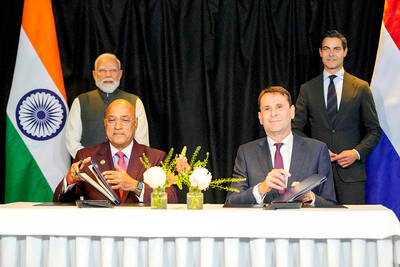
NEW MARKET: The partnership opens up India to the Dutch company, which already has a strong hold in the semiconductor market of South Korea, Taiwan and China ASML Holding NV entered into a partnership agreement with Tata Electronics Pvt Ltd aimed at ramping up India’s goal to develop domestic chip-manufacturing capabilities. The Dutch company’s technology would help power Tata Electronics’ planned 300 millimeter (mm) semiconductor foundry in Gujarat, according to a joint statement from the two companies on Saturday. The signing of a memorandum of understanding coincides with a visit by Indian Prime Minister Narendra Modi to the Netherlands, which is looking to deepen bilateral relations with New Delhi. ASML, whose top customers include Taiwan Semiconductor Manufacturing Co (台積電) and Samsung Electronics Co, makes lithography machines that can print

TECH RELIANCE: Growth is increasingly reflecting an unequal K-shaped distribution, where technology sectors outperform and other industries struggle, an expert said Standard Chartered Bank has significantly raised its forecast for Taiwan’s economic growth to 9.5 percent this year, up from 7.6 percent previously, citing surging artificial intelligence (AI) demand driving exports, semiconductor production and investment. The upgrade reflects a sustained AI supercycle that continues to fuel demand for advanced chips and technology infrastructure, which form the backbone of Taiwan’s exports, the bank said in a report this week. “We raise our 2026 growth forecast to reflect a much stronger-than-expected first-quarter GDP figure,” Standard Chartered senior economist for greater China and Asia Tommy Wu (胡東安) said in the report. Driven largely by a 35.3 percent
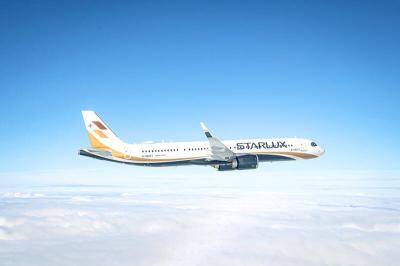
Two of Taiwan’s international carriers, Starlux Airlines Co (星宇航空) and EVA Airways Corp (長榮航空), have retained the five-star airline rating awarded by international airline review organization Skytrax. Starlux was awarded the distinction for a second consecutive year, while EVA Air received it for the 11th straight year, Skytrax said in statements released yesterday and on Thursday last week, respectively. The five-star rating is considered one of the airline industry's highest honors and is awarded following professional audits of airline product and frontline service standards, Skytrax said. The ratings are based on in-depth assessments using unified global quality standards rather than customer review scores

Tokyo Electron's Taiwan unit today said in a written response that it respects the judicial process, takes the court ruling seriously and would not appeal in the Taiwan Semiconductor Manufacturing Co (TSMC, 台積電) trade secrets case. Last month, a court fined the Taiwan unit of Japan's Tokyo Electron NT$150 million (US$4.74 million) in a case involving trade secrets related to TSMC's sensitive chip technology.


 RSS
RSS