


Market researcher International Data Corp (IDC) lowered its forecast of notebook shipments next year to 177.7 million units, saying deepening economic woes could delay consumer and corporate purchases.
That represents a drop of 3.8 percent from IDC’s previous estimate of 184.7 million units made in April as buyers tightened spending amid a global economic slump.
IDC, however, sharply raised its projection for global shipments of netbooks, or low-cost laptops, to 11.4 million units for this year and 21.5 million next year.
These figures represent a quadruple rise from its April estimate of 3.5 million for this year and 5.5 million units for next year because of fast consumer uptake in Western Europe, the researcher said. The figure may increase to 42.1 million in 2012, it added.
The markets for notebooks, monitors and TVs in Western Europe and the US are roughly similar in size, but in the case of mininotes, “it is about eight to one, Western Europe versus the US, which is extremely surprising,” IDC analyst Bob O’Donnell told a press briefing in Taipei.
Taiwanese computer companies Acer Inc (宏碁) and Asustek Computer Inc (華碩) may have relatively low brand awareness in the US, but both enjoy robust sales in Europe, where they have strong brand recognition, O’Donnell said.
Telecom operators in Europe and Japan have also begun to offer netbooks at a sharp discount or for free in exchange for two-year service contracts, which have helped boost the popularity of netbooks, he said.
The economy will likely only have an indirect impact on netbook sales, he said. Buyers in emerging markets could be enticed by netbooks’ lower price, while those in developed markets could put off upgrading their notebooks and opt for a netbook.
IDC also slashed its overall PC shipment forecast for next year by 6 percent to 324 million units.
“A worsening economy also has a ripple effect on LCD [liquid crystal display] TV sales and weakening demand,” said Eric Haruki, who tracks TV markets and technologies for IDC.
Haruki cut his forecast for global LCD TV sales this year by 4 percent to 95 million units, although Black Friday sales in the US looked good.
As IDC’s survey shows continuing strong interest in flat-panel TVs, Haruki was optimistic that “there’s gonna be robust demand next year.”
Shipments of LCD TVs may grow 24 percent to 118 million units next year, he said.
But the volume growth would be at the expense of margins and revenues, as consumers are expecting deeper discounts, Haruki said.
Japan’s Sony Corp and South Korea’s Samsung Electronics Co initiated a price war in the US early this year, allowing them to gain market share while forcing the smaller brands to exit the market, he said.
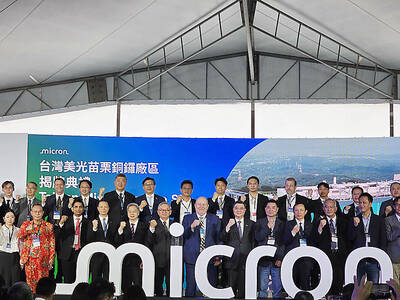
UNPRECEDENTED PACE: Micron Technology has announced plans to expand manufacturing capabilities with the acquisition of a new chip plant in Miaoli Micron Technology Inc unveiled a newly acquired chip plant in Miaoli County yesterday, as the company expands capacity to meet growing demand for advanced DRAM chips, including high-bandwidth memory chips amid the artificial intelligence boom. The plant in Miaoli County’s Tongluo Township (銅鑼), which Micron acquired from Powerchip Semiconductor Manufacturing Corp (力積電) for US$1.8 billion, is expected to make a sizeable capacity contribution to the company from fiscal 2028, the company said in a statement. It would be an extended production site of Micron’s large-scale manufacturing hub in Taichung, the company said. As the global semiconductor industry is racing to reach US$1 trillion

Singapore-based ride-hailing and delivery giant Grab Holdings Ltd has applied for regulatory approval to acquire the Taiwan operations of Germany-based Delivery Hero SE's Foodpanda in a deal valued at about US$600 million. Grab submitted the filing to the Fair Trade Commission on Friday last week, with the transaction subject to regulatory review and approval, the company said in a statement yesterday. Its independent governance structure would help foster a healthy and competitive market in Taiwan if the deal is approved, Grab said. Grab, which is listed on the NASDAQ, said in the filing that US-based Uber Technologies Inc holds about 13 percent of

Taiwan’s food delivery market could undergo a major shift if Singapore-based Grab Holdings Ltd completes its planned acquisition of Delivery Hero SE’s Foodpanda business in Taiwan, industry experts said. Grab on Monday last week announced it would acquire Foodpanda’s Taiwan operations for US$600 million. The deal is expected to be finalized in the second half of this year, with Grab aiming to complete user migration to its platform by the first half of next year. A duopoly between Uber Eats and Foodpanda dominates Taiwan’s delivery market, a structure that has remained intact since the Fair Trade Commission (FTC) blocked Uber Technologies Inc’s

Memory chip stocks extended their losses yesterday after Alphabet Inc’s Google publicized research that could allow more efficient use of the storage needed for artificial intelligence (AI) development. SK Hynix Inc and Samsung Electronics Co, South Korean leaders in the market, fell more than 6 percent and about 5 percent respectively in Seoul. In the US, Micron Technology Inc, Western Digital Corp and Sandisk Corp slid more than 2 percent in pre-market trading, after they all closed lower on Wednesday. Memory companies have been on a tear in recent months as the rapid development of AI infrastructure triggered a spike in chip


 RSS
RSS