


With the advantage of relatively cheap office rental rates, the third phase of the Nangang Software Park (南港軟體工業園區) has attracted many large international and domestic companies, developers said yesterday.
Apart from Microsoft Corp, which has already moved into the building, it has been confirmed that Taiwan High Speed Rail Corp (THSRC, 台灣高鐵) and International Business Machines Corp (IBM) will be leasing three floors each, Hoyt Tillman, director of international marketing division at Century Development Corp (世正開發), told reporters yesterday on the sidelines of an inauguration ceremony for the building.
Century Development is in charge of the planning, development and management of the building.
The building currently has an occupancy rate of 50 percent, and is expected to reach full occupancy by year’s end, Century Development chairman Theodore Huang (黃茂雄), said yesterday.
“The monthly rental rate of the new building should fall between NT$1,200 and NT$1,500 per ping, which is cheaper than A-class office spaces in Taipei by half,” Michael Wang (王維宏), supervisor at Sinyi Commercial (信義商仲), said by telephone yesterday.
Tillman said there is one foreign high-tech company that plans to lease a total of nine floors that is scheduled to move into the building in January next year, but declined to reveal the name.
The third phase of the Nangang Software Park is estimated to help bring in 60 companies with around 4,000 employees.

HORMUZ ISSUE: The US president said he expected crude prices to drop at the end of the war, which he called a ‘minor excursion’ that could continue ‘for a little while’ The United Arab Emirates (UAE) and Kuwait started reducing oil production, as the near-closure of the crucial Strait of Hormuz ripples through energy markets and affects global supply. Abu Dhabi National Oil Co (ADNOC) is “managing offshore production levels to address storage requirements,” the company said in a statement, without giving details. Kuwait Petroleum Corp said it was lowering production at its oil fields and refineries after “Iranian threats against safe passage of ships through the Strait of Hormuz.” The war in the Middle East has all but closed Hormuz, the narrow waterway linking the Persian Gulf to the open seas,
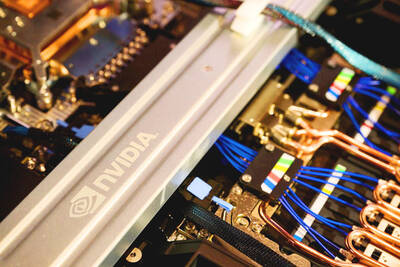
RATIONING: The proposal would give the Trump administration ample leverage to negotiate investments in the US as it decides how many chips to give each country US officials are debating a new regulatory framework for exporting artificial intelligence (AI) chips and are considering requiring foreign nations to invest in US AI data centers or security guarantees as a condition for granting exports of 200,000 chips or more, according to a document seen by Reuters. The rules are not yet final and could change. They would be the first attempt to regulate the flow of AI chips to US allies and partners since US President Donald Trump’s administration said it rescinded its predecessor’s so-called AI diffusion rules. Those rules sought to keep a significant amount of AI

Apple Inc increased iPhone production in India by about 53 percent last year and now makes a quarter of its marquee devices there, reflecting the US company’s efforts to avoid tariffs on China. The company assembled about 55 million iPhones in India last year, up from 36 million a year earlier, people familiar with the matter said, asking not to be named because the numbers aren’t public. Apple makes about 220 million to 230 million iPhones a year globally, with India’s share of the total increasing rapidly. Apple has accelerated its expansion in the world’s most populous country in recent years, bolstered

HEADWINDS: The company said it expects its computer business, as well as consumer electronics and communications segments to see revenue declines due to seasonality Pegatron Corp (和碩) yesterday said it aims to grow its artificial intelligence (AI) server revenue more than 10-fold this year from last year, driven by orders from neocloud solutions clients and large cloud service providers. The electronics manufacturing service provider said AI server revenue growth would be driven primarily by the Nvidia Corp GB300 server platform. Server shipments are expected to increase each quarter this year, with the second half likely to outperform the first half, it said. The AI server market is expected to broaden this year as more inference applications emerge, which would drive demand for system-on-chip, application-specific integrated circuits


 RSS
RSS