

The investment environment in China deteriorated while investment risks increased for the first time this year, and nearly 10 percent of Taiwanese manufacturers in China expressed a willingness to return if the government would provide sufficient incentives, a report released yesterday said.
The report by the Taiwan Electrical and Electronic Manufacturers’ Association (TEEMA, 台灣電子電機公會) said it was time for Taiwanese makers based in China to upgrade their production technology and management skills to stay competitive in the arena.
“For the first time in nine years, we found investment conditions in China showed unfavorable signs while investment risks worsened,” said Leu Horng-der (呂鴻德), business administration professor at Chuang Yuan Christian University.
Leu, commissioned to carry out the study, said the severest challenge lay with a stronger yuan that significantly dented profit margins this year. He added that the US subprime crisis and global slowdown also weakened results.
But Leu said personal safety ranked as the second-highest risk facing Taiwanese businesspeople in China, citing the semi-official Straits Exchange Foundation’s (SEF) figures showing a total of 1,463 personal safety cases involving Taiwanese businesspeople between 1991 and this year.
Also, labor and land costs are on the rise while investment incentives are declining, Leu said, adding that the trend prompted 9.88 percent of Taiwanese manufacturers in China to express a desire to move their business back home. The figure stood at 1.83 percent last year and 1.97 percent in 2006, the report said.
Chang Pao-cheng (張寶誠), president of the China Productivity Center, said Taiwanese manufacturers in China should engage in radical reform or risk being forced out of the market.
Chang said that the bulk of Taiwanese firms across the Strait are run by family members and leave ample room for improvement in product innovation and management.
Cheng Fu-hsiong (鄭富雄), vice chairman of the manufacturers’ association, said the government could lend a helping hand by facilitating the enactment of rules governing cross-strait commerce to protect Taiwanese firms and help boost their business.
But SEF Secretary-General Kao Koong-lian (高孔廉), who also attended the event, said the issue was not on his agency’s agenda this year.
The SEF is expected to meet with its Chinese counterpart, the Association for Relations Across the Taiwan Strait, in October for talks on cross-strait transport links.
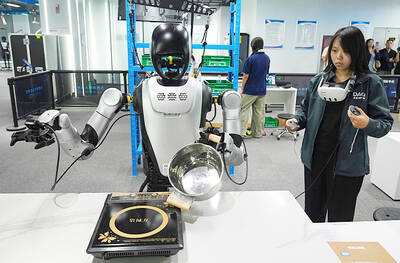
Taiwan and other technology democracies have a "golden but narrowing" three-to-five-year window to lay the foundations for an advanced robotics supply chain outside China, particularly for humanoid robots, a Taiwan-based researcher said yesterday. A report released on Monday by the Research Institute for Democracy, Society and Emerging Technology (DSET) examines China-West competition in physical artificial intelligence (AI) and Taiwan’s potential role in developing alternatives to Chinese robot supply chains. Humanoid robots remain unproven, meaning China’s lead in shipments currently has a limited impact on the real economy, Nathanael Cheng (鄭秉信), a policy analyst in the DSET Economic Security Program, said in a
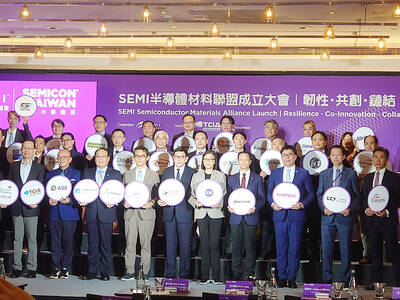
SPECIALTY SUPPLIES: Taiwan is ushering in a major shift in industrial upgrades and a local alliance will reinforce supply chain resilience, SEMI president Terry Tsao said SEMI Taiwan launched a semiconductor materials alliance yesterday to fortify industry resilience, capitalizing on surging domestic demand fueled by advanced nodes and next-generation packaging. Taiwan has been the world’s largest semiconductor materials consumer for 16 years in a row, the industry association said. Taiwan purchased about US$21.7 billion of semiconductor materials last year, driven by artificial intelligence (AI)-related demand, SEMI data showed. The spending accounted for 30 percent of global semiconductor materials consumption, totaling US$73.2 billion, the data showed. “Demand for specialty gases, chemicals and key raw materials are rising in Taiwan, fueled by the technology advancements to 2-nanometer and advanced packaging technologies,” SEMI

YouTube is offering millions of dollars to popular channels if they upload their videos to the site exclusively for a certain period of time, in an effort to halt Netflix Inc’s pursuit of its biggest stars, people familiar with the conversations said. The payment would come in a couple of different forms. YouTube has discussed directly financing some programs, and it has also offered to allot a portion of major brand deals to creators. Although YouTube has not finalized deals with any creators, it is close an agreement with several partners, said the people, who declined to be identified because
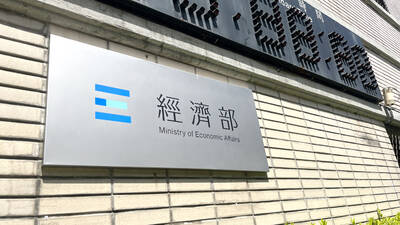
Outbound investments approved by Taiwan’s government surged more than 200 percent from the year before during the January to July period largely due to Taiwan Semiconductor Manufacturing Co (TSMC, 台積電) spending heavily overseas, the Ministry of Economic Affairs reported on Monday. The Department of Investment Review approved US$61.26 billion of outbound investment in 395 applications during the first seven months of this year, up 208.43 percent from a year earlier, the ministry said in a statement. Significant growth came after TSMC, the world’s largest contract chipmaker, secured approval to raise capital investments by US$20 billion in its US subsidiary TSMC Arizona Corp,


 RSS
RSS