


The launch of regular direct flights between China and Taiwan has been hailed as a symbol of progress and a boon to tourism, but industry workers are not all convinced.
Around 700 Chinese tourists arrived on the island to much ceremony over the weekend after taking the charter route, seen as ushering in a new start and the most visible sign yet in the thawing of cross-strait relations.
Tourism officials hope the visitors, besides promoting cordial exchanges, will bring in NT$60 billion (US$1.97 billion) annually, a big boost to local trade.
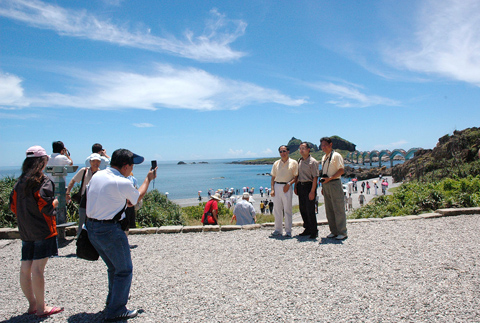
PHOTO: CNA
But some tour operators are skeptical.
“The agreements might look good on paper but I dare not think how much I can profit from that with a slow economy, rising inflation and high fuel prices,” said Wu Shih-chih, who rents yachts to tourists.
“I will not consider buying a new yacht or other equipment unless I can see a steady increase in business within six months,” said Wu, who has four boats taking visitors around Sun Moon Lake.
Others are concerned that Chinese tourists, sometimes seen as loud and ill mannered, could drive away other international travelers.
“We have fewer Japanese visitors since the government opened up to more mainlanders,” lamented a bus driver who works for a leading travel agency in Taipei.
“I am not thrilled at receiving the mainlanders because they can be proud and impolite, they think China is so important in the world,” said the driver, who asked not to be named.
Jack Lee, manager of a Taipei travel agency, said he often gets complaints from restaurants or shops that Chinese tour groups are too noisy or pay no attention to no-smoking signs.
“Some waiters also complained that Chinese customers throw bones or leftovers on the floor instead of leaving them on the plates or let cigarette ash fall everywhere,” Lee said, although most were willing to oblige when told.
Restaurateur Liu Ming-sung was blatant in expressing his dislike for Chinese tourists, putting up a sign reading “refusing Chinese communists” at his establishment in Kaohsiung City.
“I think President Ma [Ying-jeou (馬英九)] is wrong to see opening up to mainland investments and tourists as an elixir for Taiwan’s economy,” Liu said. “Let’s not forget that China is targeting Taiwan with thousands of missiles and they are still our enemies. Taiwan might be at risk under such rash moves.”
His sentiments mirror those of former president Chen Shui-bian (陳水扁), whose pro-independence rhetoric had angered Beijing.
There will be 36 round-trip flights across the Taiwan Strait weekly, operating from Friday to Monday between six Taiwanese airports and five in China.
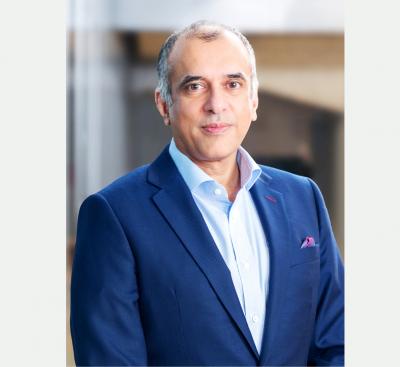
HSBC Holdings PLC is deepening its commitment to Taiwan as the economy emerges as one of the bank’s fastest-growing markets globally, driven by an artificial intelligence (AI) investment boom, expanding cross-border trade, and rising wealth creation. “The advantage that Taiwan has is a growth story linked to the semiconductor and broader AI industries, strong underlying corporate performance, and wealth creation,” said Surendra Rosha, HSBC’s co-chief executive for Asia and the Middle East, in an exclusive interview with the Taipei Times on June 2, during this year’s HSBC Taiwan Conference. That combination has helped HSBC cement its position as the most profitable international
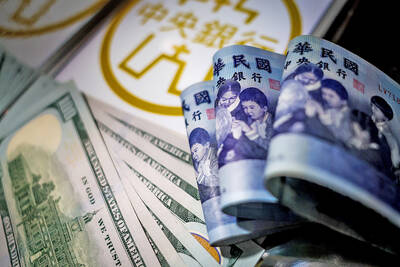
The New Taiwan dollar yesterday fell sharply against the US dollar to close at its lowest level since May 22 amid a massive outflow of funds from the country because of investors panicking over global equity markets. The NT dollar ended at NT$31.580 against the US dollar, slightly lower than its close of NT$31.568 on May 22, after moving between NT$31.5 and NT$31.648 on combined turnover of US$3.062 billion on the Taipei Foreign Exchange and the Cosmos Foreign Exchange. The NT dollar received a significant hit in the morning session, slumping as much as NT$0.173 at a time when other Asian currencies
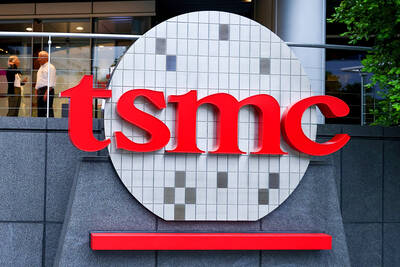
Taiwan Semiconductor Manufacturing Co (TSMC, 台積電) is now ranked ninth among the world’s 100 most valuable companies after its market capitalization more than doubled over the past year, PricewaterhouseCoopers (PwC) Taiwan said in a report last month. TSMC’s market capitalization surged 101 percent year-on-year to US$1.427 trillion as of March 31, the accounting and consulting firm’s 2026 Global Top 100 Companies by Market Capitalization report said. The gain catapulted the world’s largest contract chipmaker from 12th place to ninth in the rankings, and it was the fastest-growing among the global top 10, it said. TSMC was the only Taiwanese company among the top
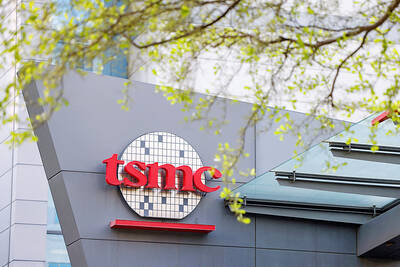
Taiwan Semiconductor Manufacturing Co (TSMC, 台積電) yesterday reported record revenue of NT$416.975 billion (US$13.17 billion) for last month, putting the world’s largest contract chipmaker on track to set a record for quarterly revenue. Last month’s figure surpassed March’s record NT$415.19 billion and represented increases of 1.5 percent from April and 30.1 percent from a year earlier. For the first five months of the year, TSMC generated NT$1.96 trillion in revenue, up 30 percent year-on-year, it said in a statement. TSMC has forecast second-quarter revenue of between US$39 billion and US$40.2 billion, representing sequential growth of about 10 percent and year-on-year growth of about


 RSS
RSS