

Minister-designate of the Council of Agriculture Chen Wu-hsiung (陳武雄) said yesterday that the incoming Chinese Nationalist Party (KMT) administration would maintain the restrictions on the import of 830 agricultural products from China, including garlic and peanuts, in order to protect local farmers’ interests.
Chen made the remarks in an interview with the Central News Agency, during which he said both sides of the Taiwan Strait should seek to promote bilateral economic and trade exchanges under the so-called “1992 consensus.”
The “1992 consensus” was a term coined by former KMT Mainland Affairs Council chairman Su Chi (蘇起) in 2000 to describe a tacit understanding reportedly reached in Hong Kong in 1992 between Taiwan and China to skirt sovereignty issues in cross-strait talks.
Taiwan currently allows imports of 1,467 farm products from China, but the new KMT government will not lift the restrictions on the importation of another 830 products, such as garlic, peanuts, dried mushrooms and rice, Chen said.
He suggested that the best way to protect farmers’ interests is for Taiwan and China to open up their markets to each other’s products based upon their respective market demands, instead of filing complaints against each other at the WTO.
Touching on his work agenda after he assumes his post on May 20, Chen said spiraling international food prices have brought about social instability in many countries, therefore he will give top priority to stabilizing food supplies and to ensuring food safety, so as to take care of local consumers and farmers.
He said should domestic fuel prices be raised after the inauguration of the new government on May 20, the council would earmark funds to subsidize fuel for fishermen so that they can continue to operate their fishing boats.
He also promised to push for the early passage of a draft rural community renovation bill and an amendment to the National Pension Act (國民年金法) to protect farmer’s rights and interests.
“As the National Pension Act will go into effect on Oct. 1, the council will ask all legislative caucuses to support an amendment aimed at preventing an increase in the insurance premiums paid by local farmers,” Chen said.
Under the new pension system, which will replace the farmers’ insurance program, farmers under the age of 65 will see their government-run farmers health insurance plan transferred to the national insurance system and they will have to pay more in premiums, while the birth subsidy will be canceled and the death subsidy reduced.
Describing a draft statute for rural community renovation as part of a third-stage farmland reform project, Chen said that the incoming administration would invest a total of NT$150 billion (US$4.6 billion) over the next 10 years.
Chen said the council would help local farmers to effectively use 22 hectares of fallow farmland, replenish 60,000 hectares of forests over the next eight years and set up three large forest amusement parks.


INFRINGEMENT: The investigation comes after a complaint from Vicor Corp, with the company seeking a limited exclusion order as well as cease-and-desist orders, the ITA said The US International Trade Commission (USITC) has launched a Section 337 investigation naming Taiwanese technology companies, including Hon Hai Precision Industry Co (鴻海), Delta Electronics Inc (台達電) and Quanta Computer Inc (廣達), as respondents. The Ministry of Economic Affairs (MOEA) pledged assistance if needed. The USITC said on Friday in a statement that it had voted to institute an investigation under Section 337 of the US Tariff Act of 1930 into certain vertical power delivery systems, related components and computing devices incorporating such systems. The investigation covers 20 companies from Taiwan, China, Germany and the US, the commission said, adding that it
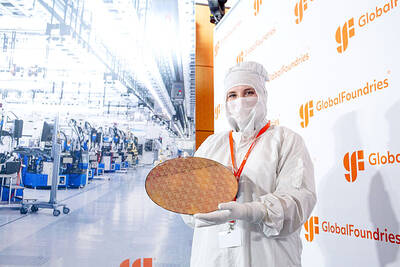
PACKAGING PUSH: The chipmaker said that it would begin ramping up silicon interposer production in New York in the first half of 2028 to support AI systems GlobalFoundries Inc shares gained as much as 7 percent after the chip manufacturer announced a five-year, US$2 billion deal to provide US production capacity to Taiwan Semiconductor Manufacturing Co (TSMC, 台積電). Under the agreement, announced on Thursday, GlobalFoundries is to help supply components known as silicon interposers. The US company is to rely on manufacturing at its facility in Malta, New York, and said it has the option to expand capacity “as customer demand grows.” An interposer is a small layer of silicon that sits between a chip and its packaging. It is home to the wires that carry electronic signals and
A man charged along with Super Micro Computer Inc co-founder Yih-Shyan “Wally” Liaw (廖益賢) of conspiring to send cutting-edge chips to China in violation of US export controls pleaded guilty, court documents said. Ting-Wei “Willy” Sun (孫廷瑋), a former outside contractor described by US authorities as a “fixer” who allegedly aided in the sales, pleaded guilty on Thursday at a hearing in federal court in New York as part of an agreement with prosecutors, court filings showed. Prosecutors claimed the men were part of a scheme to send Nvidia Corp-powered servers to an unnamed Southeast Asian company and then divert them to
SECOND-TOP MONTH: September revenue was 0.6 percent lower month-on-month, but despite the drop, it was the firm’s highest-ever sales report for the month Taiwan Semiconductor Manufacturing Co (TSMC, 台積電) yesterday reported record quarterly revenue for last quarter, after sales last month hit the second-highest monthly level in the company’s history. Revenue in the quarter ended last month was NT$1.49 trillion (US$46.75 billion), up 17 percent from NT$1.27 trillion in the second quarter and exceeding the combined prediction of 19 LSEG SmartEstimate analysts of NT$1.46 trillion. Last quarter’s figure — which was up 12 percent from the midpoint of last year — also surpassed the company’s July estimates of US$44.6 billion to US$45.8 billion amid surging demand for the ramp-up of its advanced 2-nanometer technology, artificial


 RSS
RSS