


The Council for Economic Planning says Nangang Software Park’s (南港軟體園區) performance in a recent survey by the Economist Intelligence Unit (EIU) shows that the government’s efforts to promote innovation and the development of knowledge-economy clusters has borne fruit.
The survey looked at the effectiveness of four software parks in Asia — Cyberjaya in Malaysia, Dalian Software Park in China, Quang Trung Software City in Vietnam and Nangang — in promoting start-ups and domestic software firms, and the extent to which they foster innovation.
In last month’s survey, Nangang Software Park was found to have the highest survival rate for start-up businesses more than two years old, at 80 percent.
The council said that promoting “knowledge clustering” was key to the success of industries. It said Taiwan ranked first in the world in terms of the state of cluster development in the World Economic Forum’s global competitiveness report for 2006 and last year
The performance of companies that have set up shop in the Hsinchu Science Park, Central Taiwan Science Park and Southern Taiwan Science Park provide more proof that the government’s policy has been successful, the council said.
It said the total turnover of businesses located in the three parks was NT$1.9664 trillion (US$64.69 billion) last year, up 12.3 percent over the previous year.
Meanwhile, exports from the three parks amounted to NT$1.2376 trillion last year, a 15.6 percent increase year-on-year, the council said. Such exports represented a 15.3 percent of the nation’s total exports last year, it said
The EIU survey also noted that the Nangang park’s occupancy rate was “an enviable 98 percent.”
The park is the nation’s largest software park.
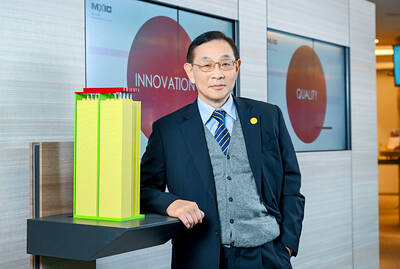
Macronix International Co (旺宏), the world’s biggest NOR flash memory supplier, yesterday said it would spend NT$22 billion (US$699.1 million) on capacity expansion this year to increase its production of mid-to-low-density memory chips as the world’s major memorychip suppliers are phasing out the market. The company said its planned capital expenditures are about 11 times higher than the NT$1.8 billion it spent on new facilities and equipment last year. A majority of this year’s outlay would be allocated to step up capacity of multi-level cell (MLC) NAND flash memory chips, which are used in embedded multimedia cards (eMMC), a managed
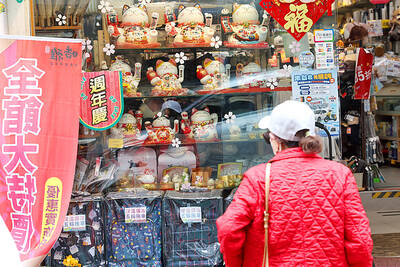
CULPRITS: Factors that affected the slip included falling global crude oil prices, wait-and-see consumer attitudes due to US tariffs and a different Lunar New Year holiday schedule Taiwan’s retail sales ended a nine-year growth streak last year, slipping 0.2 percent from a year earlier as uncertainty over US tariff policies affected demand for durable goods, data released on Friday by the Ministry of Economic Affairs showed. Last year’s retail sales totaled NT$4.84 trillion (US$153.27 billion), down about NT$9.5 billion, or 0.2 percent, from 2024. Despite the decline, the figure was still the second-highest annual sales total on record. Ministry statistics department deputy head Chen Yu-fang (陳玉芳) said sales of cars, motorcycles and related products, which accounted for 17.4 percent of total retail rales last year, fell NT$68.1 billion, or

In the wake of strong global demand for AI applications, Taiwan’s export-oriented economy accelerated with the composite index of economic indicators flashing the first “red” light in December for one year, indicating the economy is in booming mode, the National Development Council (NDC) said yesterday. Moreover, the index of leading indicators, which gauges the potential state of the economy over the next six months, also moved higher in December amid growing optimism over the outlook, the NDC said. In December, the index of economic indicators rose one point from a month earlier to 38, at the lower end of the “red” light.
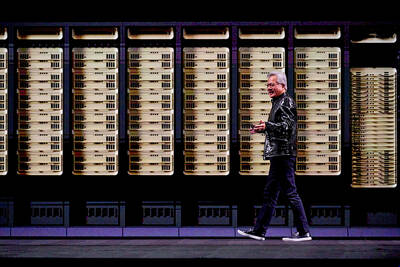
The global server market is expected to grow 12.8 percent annually this year, with artificial intelligence (AI) servers projected to account for 16.5 percent, driven by continued investment in AI infrastructure by major cloud service providers (CSPs), market researcher TrendForce Corp (集邦科技) said yesterday. Global AI server shipments this year are expected to increase 28 percent year-on-year to more than 2.7 million units, driven by sustained demand from CSPs and government sovereign cloud projects, TrendForce analyst Frank Kung (龔明德) told the Taipei Times. Demand for GPU-based AI servers, including Nvidia Corp’s GB and Vera Rubin rack systems, is expected to remain high,


 RSS
RSS