


The US dollar was under pressure on Friday after the US government reported consumer spending, the main driver of the world's biggest economy, stalled last month.
The euro was at US$1.5799 around 9pm GMT, down from US$1.5778 in New York late on Thursday.
The greenback was at ?99.16, down from ?99.59 on Thursday.
Dealers said the euro was boosted early by comments from European Central Bank (ECB) policymaker Axel Weber that reinforced the view the ECB will not cut interest rates soon.
The greenback, meanwhile, was weighed down by a series of mostly weak US economic figures this week that have bolstered expectations of further US interest rate cuts.
The US Federal Reserve has slashed its base federal funds rate to 2.25 percent from 5.25 percent since September to stimulate growth and ease a global credit crunch.
In fresh dismal news about the US economy, the US Commerce Department reported Friday flat consumer spending in February after price rises were adjusted for inflation.
"Mixed data for the US continues to hamper the outlook for the economy, but falling inflationary pressures increased bearish sentiment for the US dollar as market participants increase bets of another rate cut," Terri Belkas and David Song, analysts at Forex Capital Markets, wrote in a client note.
Meanwhile, the euro found support after reported comments by Weber reiterating that the ECB would focus on inflation risks, signaling it would refrain from cutting interest rates.
He said inflation was "alarmingly high" and suggested interest rates would not come down as long as price pressures continued.
A dramatic appreciation of the euro in recent weeks has caused concern in the eurozone that it could curb economic growth in the bloc.
Major European nations, led by France, argue that the soaring euro is hurting eurozone companies by making their exports more expensive.
The euro is "too strong" in light of the eurozone's lackluster economic growth, French President Nicolas Sarkozy said in a speech in London on Thursday.
"The dollar has never been weaker ... and the euro, which is based on too-low growth rates, is too strong," Sarkozy said.
The euro hit a record high of US$1.5905 on March 17 as the dollar was hit by a run of negative data and ongoing credit market turmoil.
In late New York trading on Friday, the dollar was at 0.9948 Swiss francs, compared with SF0.9940 late on Thursday.
The pound was at US$1.9948, down from US$2.0071.

To many, Tatu City on the outskirts of Nairobi looks like a success. The first city entirely built by a private company to be operational in east Africa, with about 25,000 people living and working there, it accounts for about two-thirds of all foreign investment in Kenya. Its low-tax status has attracted more than 100 businesses including Heineken, coffee brand Dormans, and the biggest call-center and cold-chain transport firms in the region. However, to some local politicians, Tatu City has looked more like a target for extortion. A parade of governors have demanded land worth millions of dollars in exchange
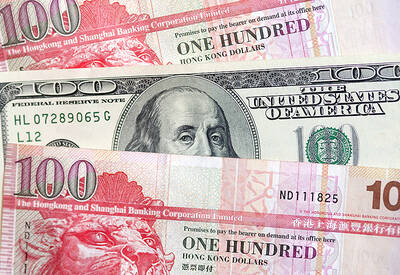
Hong Kong authorities ramped up sales of the local dollar as the greenback’s slide threatened the foreign-exchange peg. The Hong Kong Monetary Authority (HKMA) sold a record HK$60.5 billion (US$7.8 billion) of the city’s currency, according to an alert sent on its Bloomberg page yesterday in Asia, after it tested the upper end of its trading band. That added to the HK$56.1 billion of sales versus the greenback since Friday. The rapid intervention signals efforts from the city’s authorities to limit the local currency’s moves within its HK$7.75 to HK$7.85 per US dollar trading band. Heavy sales of the local dollar by

Taiwan Semiconductor Manufacturing Co’s (TSMC, 台積電) revenue jumped 48 percent last month, underscoring how electronics firms scrambled to acquire essential components before global tariffs took effect. The main chipmaker for Apple Inc and Nvidia Corp reported monthly sales of NT$349.6 billion (US$11.6 billion). That compares with the average analysts’ estimate for a 38 percent rise in second-quarter revenue. US President Donald Trump’s trade war is prompting economists to retool GDP forecasts worldwide, casting doubt over the outlook for everything from iPhone demand to computing and datacenter construction. However, TSMC — a barometer for global tech spending given its central role in the

An Indonesian animated movie is smashing regional box office records and could be set for wider success as it prepares to open beyond the Southeast Asian archipelago’s silver screens. Jumbo — a film based on the adventures of main character, Don, a large orphaned Indonesian boy facing bullying at school — last month became the highest-grossing Southeast Asian animated film, raking in more than US$8 million. Released at the end of March to coincide with the Eid holidays after the Islamic fasting month of Ramadan, the movie has hit 8 million ticket sales, the third-highest in Indonesian cinema history, Film


 RSS
RSS