


The US dollar's depreciation is "negative" for the Chinese economy, China's top currency regulator said yesterday.
China will manage its foreign-exchange reserves "according to set guidelines," Hu Xiaolian (胡曉煉) told reporters in Beijing, where she was attending the annual meeting of the National People's Congress. "To the extent that dollar depreciation is negative for the global economy, the Chinese economy will definitely be affected."
A record trade surplus has flooded the Chinese economy with cash and drove the world's largest foreign currency reserves to US$1.5 trillion by the end of last year.

PHOTO: AFP
Chinese Premier Wen Jiabao (
"It's the frying pan or the fire for China," said Stephen Green, senior economist at Standard Chartered Bank PLC in Shanghai. "If they stop buying US dollars or diversify, this will only do further damage to their existing holdings."
Chinese Commerce Minister Chen Deming (
The surplus is"hard to predict," he said.
In December, Chen said the declining dollar is a bigger concern for the economy than the yuan's gains.
The US dollar's depreciation makes major commodities, such as gold and oil more expensive, and reduces the wealth of countries and companies that hold US dollar assets, Chen said at the time.
China's economy, the world's fourth-largest, may grow 10 percent this year, the IMF predicted, down from 11.4 percent last year.
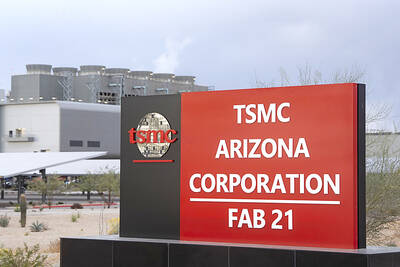
Taiwan Semiconductor Manufacturing Co (TSMC, 台積電), the world’s biggest contract chipmaker, booked its first-ever profit from its Arizona subsidiary in the first half of this year, four years after operations began, a company financial statement showed. Wholly owned by TSMC, the Arizona unit contributed NT$4.52 billion (US$150.1 million) in net profit, compared with a loss of NT$4.34 billion a year earlier, the statement showed. The company attributed the turnaround to strong market demand and high factory utilization. The Arizona unit counts Apple Inc, Nvidia Corp and Advanced Micro Devices Inc among its major customers. The firm’s first fab in Arizona began high-volume production
VOTE OF CONFIDENCE: The Japanese company is adding Intel to an investment portfolio that includes artificial intelligence linchpins Nvidia Corp and TSMC Softbank Group Corp agreed to buy US$2 billion of Intel Corp stock, a surprise deal to shore up a struggling US name while boosting its own chip ambitions. The Japanese company, which is adding Intel to an investment portfolio that includes artificial intelligence (AI) linchpins Nvidia Corp and Taiwan Semiconductor Manufacturing Co (TSMC, 台積電), is to pay US$23 a share — a small discount to Intel’s last close. Shares of the US chipmaker, which would issue new stock to Softbank, surged more than 5 percent in after-hours trading. Softbank’s stock fell as much as 5.4 percent on Tuesday in Tokyo, its
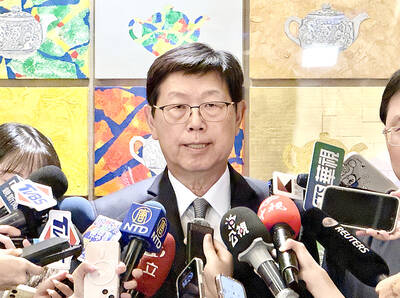
COLLABORATION: Softbank would supply manufacturing gear to the factory, and a joint venture would make AI data center equipment, Young Liu said Hon Hai Precision Industry Co (鴻海精密) would operate a US factory owned by Softbank Group Corp, setting up what is in the running to be the first manufacturing site in the Japanese company’s US$500 billion Stargate venture with OpenAI and Oracle Corp. Softbank is acquiring Hon Hai’s electric-vehicle plant in Ohio, but the Taiwanese company would continue to run the complex after turning it into an artificial intelligence (AI) server production plant, Hon Hai chairman Young Liu (劉揚偉) said yesterday. Softbank would supply manufacturing gear to the factory, and a joint venture between the two companies would make AI data
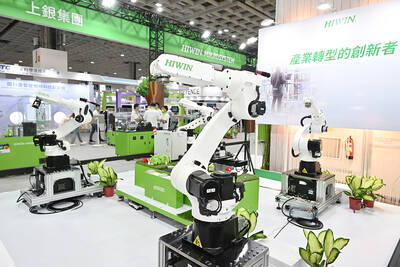
The Taiwan Automation Intelligence and Robot Show, which is to be held from Wednesday to Saturday at the Taipei Nangang Exhibition Center, would showcase the latest in artificial intelligence (AI)-driven robotics and automation technologies, the organizer said yesterday. The event would highlight applications in smart manufacturing, as well as information and communications technology, the Taiwan Automation Intelligence and Robotics Association said. More than 1,000 companies are to display innovations in semiconductors, electromechanics, industrial automation and intelligent manufacturing, it said in a news release. Visitors can explore automated guided vehicles, 3D machine vision systems and AI-powered applications at the show, along


 RSS
RSS