


While the Lunar New Year holiday is traditionally a peak time for travel, domestic airlines struggled this year amid tough competition from the high speed railway and soaring fuel costs.
"All four domestic airlines suffered losses last year," said Hanson Chang (
Aside from FAT, the other three airlines that focus on domestic flights are TransAsia Airways (復興航空), Mandarin Airlines (華信航空) and Uni Airways (立榮航空).
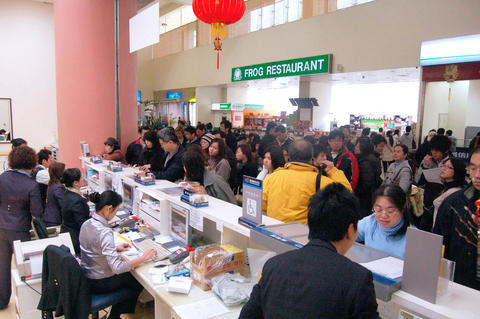
PHOTO: TSAI CHIH-MING, TAIPEI TIMES
Deregulation is the key to domestic airline companies' survival, especially in this "gloomiest winter," TransAsia chairman Fan Chih-chiang (
"There is a myriad of regulations and restrictions that tie the hands of domestic airlines, which are already at a disadvantage compared to China Airlines Ltd (CAL,
FAT, the only listed company among the four, saw its losses expand to NT$3.91 per share in the first three quarters of last year, compared with a loss of NT$0.66 per share from a year ago.
TransAsia and Uni Air also reported net losses of NT$0.19 and NT$0.79 respectively in the first half of last year.
Seven months after the launch of the high-speed railway service in January last year, airline services on two routes were halted given heavy losses, and two more will be suspended next month.
Uni Air, a subsidiary of the Evergreen Group (長榮集團), will stop flying between Taipei and Kaohsiung, while FAT will halt its Taipei to Tainan service.
While some industry observers have suggested that mergers or joint operations could relieve the oversupply, Fan disagreed.
He said a merger would only work if the airlines' routes were complementary and they operate the same type of aircraft.
But since the four domestic airlines own eight different types of aircraft and compete on more or less the same routes, a merger would not be a solution as it would not cut maintenance costs nor expand the airlines' operations network, he said.
Those are the same reasons why the four can't operate joint services, said Irving Hsu (
Hsu said the Civil Aeronautics Administration's (CAA) demand that each route be serviced by two competing airlines also made a contingency plan difficult.
"Besides, even if one company drops out of a route, the other one would still struggle to make ends meet" because of the sharp decline in customers, Fan said.
Competing with CAL and EVA's near duopoly of international routes is difficult given government restrictions, although that did not stop the four from trying.
Anticipating the blow from the operation of the high-speed railway, FAT, Uni Air, Mandarin and TransAsia began to operate regular or charter flights to Vietnam, Cambodia, Thailand, Malaysia, the Philippines, Japan and South Korea.
However, these efforts have yet to drag them out of the red, as outbound flights contribute only a minor share to revenues.
Seeing strong demand for services that can help fliers save time and money, the four companies are exploring new transfer routes.
Chang said that although FAT's fast-growing service that transfers passengers through South Korea's Cheju Island to cities in the eastern and northern parts of China, including Shanghai, Beijing, Dalian and Shenyang, has helped to narrow losses, "nothing compares to direct flights when talking about a real boost in business."
Uni Air said even if direct flights could not be implemented in the short term, turning cross-strait charter flights into a regular service during weekends would significantly benefit all domestic airlines.
"We have waited too long. But if the restrictions are eased or lifted overnight, we can immediately meet the surging demand," Hsu said.
"Easing restrictions on the small three links (
Currently, only Kinmen residents or Taiwanese businesspeople in China are allowed take advantage of direct travel between Taiwan and Xiamen via Kinmen.
"We are desperate for spring after this long, cruel winter," Fan said.
"If we [four domestic airlines] had one unequivocal wish for this Lunar New Year, that would be a full-scale direct transportation link between Taiwan and China," Fan said.

HSBC Holdings PLC is deepening its commitment to Taiwan as the economy emerges as one of the bank’s fastest-growing markets globally, driven by an artificial intelligence (AI) investment boom, expanding cross-border trade, and rising wealth creation. “The advantage that Taiwan has is a growth story linked to the semiconductor and broader AI industries, strong underlying corporate performance, and wealth creation,” said Surendra Rosha, HSBC’s co-chief executive for Asia and the Middle East, in an exclusive interview with the Taipei Times on June 2, during this year’s HSBC Taiwan Conference. That combination has helped HSBC cement its position as the most profitable international
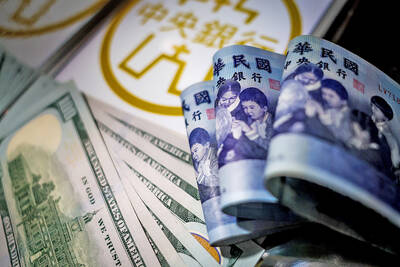
The New Taiwan dollar yesterday fell sharply against the US dollar to close at its lowest level since May 22 amid a massive outflow of funds from the country because of investors panicking over global equity markets. The NT dollar ended at NT$31.580 against the US dollar, slightly lower than its close of NT$31.568 on May 22, after moving between NT$31.5 and NT$31.648 on combined turnover of US$3.062 billion on the Taipei Foreign Exchange and the Cosmos Foreign Exchange. The NT dollar received a significant hit in the morning session, slumping as much as NT$0.173 at a time when other Asian currencies

Taiwan Semiconductor Manufacturing Co (TSMC, 台積電) is now ranked ninth among the world’s 100 most valuable companies after its market capitalization more than doubled over the past year, PricewaterhouseCoopers (PwC) Taiwan said in a report last month. TSMC’s market capitalization surged 101 percent year-on-year to US$1.427 trillion as of March 31, the accounting and consulting firm’s 2026 Global Top 100 Companies by Market Capitalization report said. The gain catapulted the world’s largest contract chipmaker from 12th place to ninth in the rankings, and it was the fastest-growing among the global top 10, it said. TSMC was the only Taiwanese company among the top
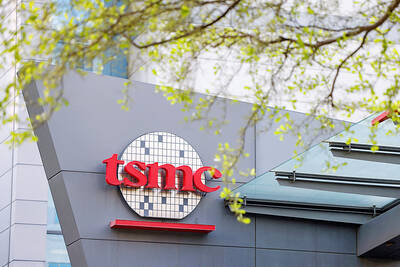
Taiwan Semiconductor Manufacturing Co (TSMC, 台積電) yesterday reported record revenue of NT$416.975 billion (US$13.17 billion) for last month, putting the world’s largest contract chipmaker on track to set a record for quarterly revenue. Last month’s figure surpassed March’s record NT$415.19 billion and represented increases of 1.5 percent from April and 30.1 percent from a year earlier. For the first five months of the year, TSMC generated NT$1.96 trillion in revenue, up 30 percent year-on-year, it said in a statement. TSMC has forecast second-quarter revenue of between US$39 billion and US$40.2 billion, representing sequential growth of about 10 percent and year-on-year growth of about


 RSS
RSS