


Of all the cronies of the late Philippine dictator Ferdinand Marcos, Chinese-born tycoon Lucio Tan stands out as one of the most durable -- and for that reason remarkable.
In the two decades since Marcos fled into exile following the so-called People Power revolt in 1986, Tan has expanded a formidable empire in tobacco, beer, aviation and banking.
This makes Tan different from many associated with the Marcos era, whose empires faded away while his flourished.
And this despite losing some of his shareholdings to the government following the collapse of the Marcos regime.
Despite allegations of being given favorable treatment by Marcos, Tan has managed to get back most of what he lost in court battles spanning nearly two decades.
The 71-year-old businessman, who was born in Fujian Province, saw his latest victory on Dec. 7 when the Supreme Court lifted the government's sequestration of Allied Bank, which is controlled by Tan.
The Court declared null and void an order by the Presidential Commission on Good Government (PCGG) for the sequestration of Tan's shares in Allied Bank, Fortune Tobacco and Foremost Farms and Shareholdings Inc.
The commission is a government body tasked with recovering the allegedly ill-gotten wealth of the late president Marcos and his cronies.
Analysts and bank officials say the court's ruling now paves the way for a merger between Allied Bank and another Tan-controlled bank, Philippine National Bank (PNB).
"The merger will probably happen next year," PNB president Omar Tyrone Mier said, although he would not give any details or dates.
Tan set up Allied Bank in 1977 and while he only owns 13 percent personally, most of the remaining shares are held by close Tan allies. It has a market capitalization of 10 billion pesos (US$243 million).
PNB, once a government bank and formerly the country's largest commercial bank, was set up 91 years ago and privatized in 1989.
Tan now owns 67 percent of the bank, with the remainder largely held by foreign fund managers.
It has a market capitalization of approximately 30 billion pesos, Mier said.
The PCGG says it will file a motion for reconsideration of the Supreme Court's decision, but Mier said it was a "long shot" that the ruling would be reversed.
"Even with a motion for reconsideration, the merger will still take place next year," Mier said.
"We will not give up Allied Bank," said PCGG commissioner Narciso Nario.
Even when PNB and Allied Bank are merged, the bank would still be only the fourth largest in the Philippines, but Mier said increasing the bank's size was necessary.
"In the banking industry, size matters. It means you have more muscle to expand your portfolio, your branches, your borrowing limit goes higher," he said.
PNB and Allied Bank bring different qualities to the merger, said James Lago, research chief of Westlink Global Equities Inc.
PNB has a recognizable brand name and an extensive network and background with the millions of Filipinos working overseas who use it to remit billions of dollars to their families back home.
Allied Bank, meanwhile, has the accounts of Tan's companies as well as extensive contacts with the Filipino-Chinese business community, who are a major player in the nation's retail, food processing and manufacturing sectors, Lago said.
But he said that "the merger of the different cultures of the two banks will take at least two years. There are two entrenched cultures there, especially at PNB."
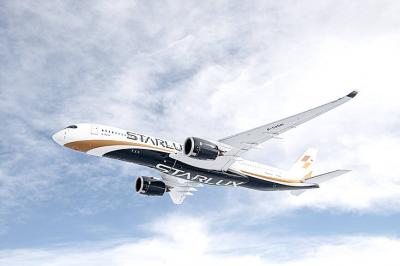
Starlux Airlines Co (星宇航空) today unveiled a long-haul network expansion plan at a shareholders’ meeting in Taipei, including direct flights to Barcelona, Spain, and Zurich, Switzerland, as well as a service connecting Taipei, Sydney and New Zealand. Starlux is to become the first Taiwanese carrier to offer non-stop services to the two European cities, while the inaugural oceanic route is expected to expand transit opportunities within the Australia-New Zealand market, Starlux said. Flight services to Chicago, Dallas, Washington and New York are under evaluation, the airline added. Prior to the shareholders’ meeting, the airline earlier this year announced that it would be

Netherlands-based semiconductor equipment supplier ASML Holding NV yesterday said that it is planning to hire an additional 1,000 people in Taiwan this year in response to growing demand from clients. ASML had previously planned to recruit 600 people this year, but that the plan has been adjusted upward, ASML vice president and ASML Taiwan general manager Grace Wang (汪佳慧) told reporters. ASML has a workforce of more than 4,500 in Taiwan, accounting for about 10 percent of its global total, Wang said. This year’s recruitment campaign would focus on adding people in the customer support, manufacturing and supply chain domains to assist ASML

UNDER MICROSCOPE: Taiwan detained three people who allegedly conspired to buy servers in Taiwan and export them using fraudulent documentation, prosecutors said Nvidia Corp chief executive officer Jensen Huang (黃仁勳) on Saturday urged Super Micro Computer Inc to tighten up on compliance after Taiwan detained three people this week for allegedly making fraudulent declarations about artificial intelligence (AI) servers made by its US partner. The development marked the nation’s first crackdown on semiconductor smuggling, which grew after the US slapped restrictions on exports of high-end chips such as Nvidia AI accelerators to China. Nvidia is “rigorous” in explaining regulations to all of its partners, Huang told reporters after arriving in Taipei. “Ultimately Super Micro has to run their own company,” he said in response to

Nvidia Corp yesterday announced that CEO Jensen Huang (黃仁勳) would attend an employee meeting in Taipei tomorrow to celebrate the launch of the company’s Taiwan headquarters project. Huang would attend a gathering at the site of Nvidia’s planned headquarters in Beitou Shilin Technology Park (北投士林科技園區), the company said in a statement. After arriving in Taiwan on Saturday last week, Huang told reporters that he plans to meet with Quanta Computer Inc (廣達) chairman Barry Lam (林百里) and Taiwan Semiconductor Manufacturing Co (TSMC, 台積電) chairman C.C. Wei (魏哲家), and would attend the groundbreaking ceremony for Nvidia’s Taiwan headquarters tomorrow. Nvidia has not yet applied


 RSS
RSS