


Oil futures retreated on Friday, giving back much of the previous session's big gain after the US government's jobs report last month was not as robust as some traders had hoped.
The Labor Department report "wasn't a blockbuster number that would keep feeding the oil bull," said Phil Flynn, an analyst at Alaron Trading Corp, in Chicago.
The report showed employers added 94,000 jobs to their payrolls last month following October's 170,000 gain. The data quashed the hopes of oil investors that the Federal Reserve would cut interest rates by a half percent instead of the more widely expected quarter percent when it meets on Tuesday, Flynn said.
Interest rate cuts tend to weaken the dollar against other currencies. Oil futures offer a hedge against a weak US dollar and oil futures bought and sold in dollars are more attractive to foreign investors when the greenback is falling.
Light, sweet crude for January delivery fell US$1.95 to settle at US$88.28 a barrel on the New York Mercantile Exchange after rising US$2.74 on Thursday.
Some analysts think volatility is becoming a central feature of a market, whose sentiment seems to be changing from bullish to bearish.
Several analysts said it was difficult to find reasons to explain Thursday's price run-up and Friday's declines.
"In the last hour of [Thursday's] session, in the wake of nothing, [Nymex crude] spiked more than US$1.25," Stephen Schork, a trader and analyst in Villanova, Pennsylvania, said.
Some analysts pegged Thursday's price surge on tough talk by the administration of US President George W. Bush on Iran, while others cited the administration's announcement of a plan to deal with the subprime crisis or an Organization for Economic Cooperation and Development estimate that China's economy is growing faster than expected.
Other energy futures also fell on Friday. Next month's heating oil futures fell US$0.0403 to settle at US$2.5047 a gallon on the Nymex, while next month's gasoline futures fell US$0.0323 to settle at US$2.269 a gallon.
In London, next month's Brent crude fell US$1.54 to settle at US$88.64 a barrel on the ICE Futures exchange.
Meanwhile, commodities surged on supply concerns.
Soybeans rose to the highest price since July 1973 and corn climbed to a five-month high on speculation the dry weather threatening young plants in Argentina would spread to Brazil.
Less than 1.3cm of rain will fall in the next five days in Argentina at the same time as temperatures are rising, increasing crop stress, said Drew Lerner, president of World Weather Inc in Overland Park, Kansas.
Dry weather will prevail into next month, when crops are reproducing, he said.
"Fears of weather losses are growing," said Gregg Hunt, a market analyst and broker for MF Global Inc in Chicago. "No one wants to be short if a full-fledged drought is developing."
Soybean futures for delivery next month rose US$0.21, or 1.9 percent, to US$11.1975 a bushel on the Chicago Board of Trade.
Corn futures for March delivery rose US$0.0525, or 1.3 percent, to US$4.1725 a bushel. The price earlier reached US$4.18, the highest since June 19.
Wheat rose to a two-month high after Canada, the second-largest exporter of the grain, cut its production estimate.
Canada may harvest 20.1 million tonnes in the year ending July 31, down from an Oct. 4 estimate of 20.6 million tonnes, Statistics Canada said yesterday. Drought in the southern prairies and excessive rain in the north hurt crops, the agency said. Global supplies may fall to 109.8 million tonnes by May 31, the lowest since 1978, the US government has said.
"What's pushing it over the edge was Canada coming out with lower numbers," said Jason Britt, an analyst at Central States Commodities Inc in Kansas City, Missouri.
Stockpiles "are tight and people are hypersensitive," he said.

HSBC Holdings PLC is deepening its commitment to Taiwan as the economy emerges as one of the bank’s fastest-growing markets globally, driven by an artificial intelligence (AI) investment boom, expanding cross-border trade, and rising wealth creation. “The advantage that Taiwan has is a growth story linked to the semiconductor and broader AI industries, strong underlying corporate performance, and wealth creation,” said Surendra Rosha, HSBC’s co-chief executive for Asia and the Middle East, in an exclusive interview with the Taipei Times on June 2, during this year’s HSBC Taiwan Conference. That combination has helped HSBC cement its position as the most profitable international

The New Taiwan dollar yesterday fell sharply against the US dollar to close at its lowest level since May 22 amid a massive outflow of funds from the country because of investors panicking over global equity markets. The NT dollar ended at NT$31.580 against the US dollar, slightly lower than its close of NT$31.568 on May 22, after moving between NT$31.5 and NT$31.648 on combined turnover of US$3.062 billion on the Taipei Foreign Exchange and the Cosmos Foreign Exchange. The NT dollar received a significant hit in the morning session, slumping as much as NT$0.173 at a time when other Asian currencies

Taiwan Semiconductor Manufacturing Co (TSMC, 台積電) is now ranked ninth among the world’s 100 most valuable companies after its market capitalization more than doubled over the past year, PricewaterhouseCoopers (PwC) Taiwan said in a report last month. TSMC’s market capitalization surged 101 percent year-on-year to US$1.427 trillion as of March 31, the accounting and consulting firm’s 2026 Global Top 100 Companies by Market Capitalization report said. The gain catapulted the world’s largest contract chipmaker from 12th place to ninth in the rankings, and it was the fastest-growing among the global top 10, it said. TSMC was the only Taiwanese company among the top
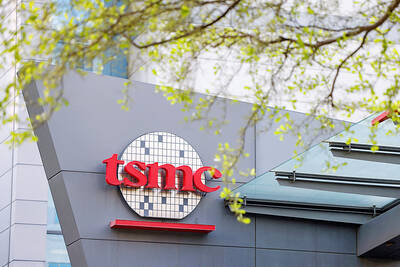
Taiwan Semiconductor Manufacturing Co (TSMC, 台積電) yesterday reported record revenue of NT$416.975 billion (US$13.17 billion) for last month, putting the world’s largest contract chipmaker on track to set a record for quarterly revenue. Last month’s figure surpassed March’s record NT$415.19 billion and represented increases of 1.5 percent from April and 30.1 percent from a year earlier. For the first five months of the year, TSMC generated NT$1.96 trillion in revenue, up 30 percent year-on-year, it said in a statement. TSMC has forecast second-quarter revenue of between US$39 billion and US$40.2 billion, representing sequential growth of about 10 percent and year-on-year growth of about


 RSS
RSS