


With the Nangang Software Park (南港軟體園區) and exhibition hall near completion, along with transportation facilities at the Nangang train station, property prices in the district are set to rally, market watchers said.
Over the past four years, housing prices in Nankang have surged approximately 76 percent from NT$250,000 per ping (3m2) to NT$440,000 per ping, said Wang Tsai-wang, (王財旺), an associate manager at Evertrust Rehouse Co (永慶房屋).
With construction of the third phase of the Nangang Software Park expected to be completed by the end of this year and a larger exhibition hall complementing the Taipei World Trade Center Exhibition Hall set to open next year, the property market in Nangang should experience further growth, he said.
Betting on the uptrend, Huaku Construction Corp (
By floor area, the selling price was NT$471,700 per ping, a record-high in the district, Wang said.
Another 328.5-ping piece of land in Nangang put on sale by the Taipei City Government on Friday sold for NT$335.17 million, or NT$1.03 million per ping, to three individual buyers.
Both bids attracted about 60 tenders, including submissions by major constructors such as Cathay Real Estate Development Co (國泰建設), Shining Group (鄉林集團) and Hung Sheng Construction Ltd (宏盛建設).
Huaku intends to build high-end residential complexes of 50 ping to 70 ping per unit, with presales scheduled to begin in the second half of next year, company chairman Chung Jung-chang (鍾榮昌) said.
Given the market potential, the construction company envisions setting the price at NT$600,000 per ping, or NT$1.7 billion for the whole project, Chung said.
"The property market in Nangang District took off last year and will sustain that momentum even when the overall market sees a correction in the near future," Su Chi-jung (
A report by the Ministry of the Interior's Architecture and Building Research Institute released last month showed that the composite index of the nation's property market in the second quarter of this year had declined one point from the first quarter to 11 points, showing signs of cooling off after two years of prosperity.
Oversupply is the main reason behind the overall market downturn, Su said. But housing prices in Nangang will remain stable, or even rise moderately, because of several factors, he said.
In addition to the exhibition hall and software park infrastructures, ongoing construction at the Nangang train station -- a hub for railways, the high-speed rail and MRT by 2009 -- accompanied by a shopping center, hotels and office buildings, should attract home buyers, Su said.
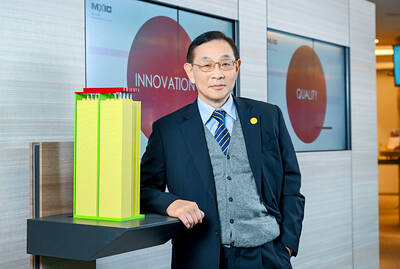
Macronix International Co (旺宏), the world’s biggest NOR flash memory supplier, yesterday said it would spend NT$22 billion (US$699.1 million) on capacity expansion this year to increase its production of mid-to-low-density memory chips as the world’s major memorychip suppliers are phasing out the market. The company said its planned capital expenditures are about 11 times higher than the NT$1.8 billion it spent on new facilities and equipment last year. A majority of this year’s outlay would be allocated to step up capacity of multi-level cell (MLC) NAND flash memory chips, which are used in embedded multimedia cards (eMMC), a managed

CULPRITS: Factors that affected the slip included falling global crude oil prices, wait-and-see consumer attitudes due to US tariffs and a different Lunar New Year holiday schedule Taiwan’s retail sales ended a nine-year growth streak last year, slipping 0.2 percent from a year earlier as uncertainty over US tariff policies affected demand for durable goods, data released on Friday by the Ministry of Economic Affairs showed. Last year’s retail sales totaled NT$4.84 trillion (US$153.27 billion), down about NT$9.5 billion, or 0.2 percent, from 2024. Despite the decline, the figure was still the second-highest annual sales total on record. Ministry statistics department deputy head Chen Yu-fang (陳玉芳) said sales of cars, motorcycles and related products, which accounted for 17.4 percent of total retail rales last year, fell NT$68.1 billion, or

In the wake of strong global demand for AI applications, Taiwan’s export-oriented economy accelerated with the composite index of economic indicators flashing the first “red” light in December for one year, indicating the economy is in booming mode, the National Development Council (NDC) said yesterday. Moreover, the index of leading indicators, which gauges the potential state of the economy over the next six months, also moved higher in December amid growing optimism over the outlook, the NDC said. In December, the index of economic indicators rose one point from a month earlier to 38, at the lower end of the “red” light.
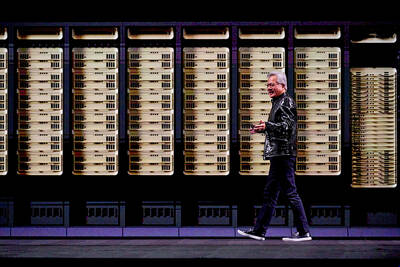
The global server market is expected to grow 12.8 percent annually this year, with artificial intelligence (AI) servers projected to account for 16.5 percent, driven by continued investment in AI infrastructure by major cloud service providers (CSPs), market researcher TrendForce Corp (集邦科技) said yesterday. Global AI server shipments this year are expected to increase 28 percent year-on-year to more than 2.7 million units, driven by sustained demand from CSPs and government sovereign cloud projects, TrendForce analyst Frank Kung (龔明德) told the Taipei Times. Demand for GPU-based AI servers, including Nvidia Corp’s GB and Vera Rubin rack systems, is expected to remain high,


 RSS
RSS