


Chang Chieh-wen (張潔文), a commissioner at the National Civil Service Institute's Mid-Island Campus, yesterday became the 10 millionth passenger to use the high speed rail, Taiwan High Speed Rail Corp (THSRC, 台灣高鐵) said.
Chang, 50, who makes her home in Chung Hsing New Village, Nantou County, said she only learned the news after boarding a high speed train at Taichung bound for Taipei at 7:38am.
She said she had asked others to book three tickets for herself and two colleagues on Sept. 18, adding that she was surprised to hear that she was the 10 millionth passenger.
Chang said that when she arrived at the Taichung station, she saw a lot of vehicles from TV stations around and thought that she was going to travel with some important figures.
She said she never expected to be the star attraction herself.
"I'm so happy. I feel like I've won the lottery," Chang said.
THSRC vice president Ted Chia (
The other passengers traveling in Chang's carriage received a 10 millionth passenger memorial key ring, Chia said.
He said that after selling the 10 millionth ticket on Sept. 18, the THSRC had set up life-size human figures at both the Taichung and Taipei stations with information to notify the holder of the ticket that they were the 10 millionth passenger, adding that the company did not find out who the 10 millionth passenger was until yesterday morning.
The high speed railway was formally inaugurated on Jan. 5. It reached the 5-million-passenger mark on May 28. The company had originally estimated that the 10 million mark would not be reached until the latter half of next month.
Chia said that the high speed railway currently carried around 1.5 million people per month, adding that in order to enhance its services, the THSRC has increased the number of trains from 38 per day to 91 per day.
The company is considering further increasing the number of trains from November, he said.
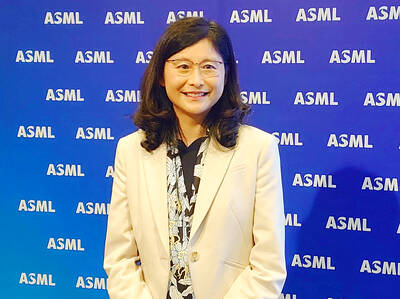
Netherlands-based semiconductor equipment supplier ASML Holding NV yesterday said that it is planning to hire an additional 1,000 people in Taiwan this year in response to growing demand from clients. ASML had previously planned to recruit 600 people this year, but that the plan has been adjusted upward, ASML vice president and ASML Taiwan general manager Grace Wang (汪佳慧) told reporters. ASML has a workforce of more than 4,500 in Taiwan, accounting for about 10 percent of its global total, Wang said. This year’s recruitment campaign would focus on adding people in the customer support, manufacturing and supply chain domains to assist ASML
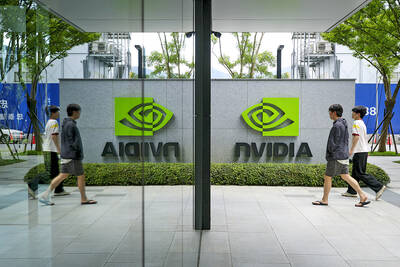
UNDER MICROSCOPE: Taiwan detained three people who allegedly conspired to buy servers in Taiwan and export them using fraudulent documentation, prosecutors said Nvidia Corp chief executive officer Jensen Huang (黃仁勳) on Saturday urged Super Micro Computer Inc to tighten up on compliance after Taiwan detained three people this week for allegedly making fraudulent declarations about artificial intelligence (AI) servers made by its US partner. The development marked the nation’s first crackdown on semiconductor smuggling, which grew after the US slapped restrictions on exports of high-end chips such as Nvidia AI accelerators to China. Nvidia is “rigorous” in explaining regulations to all of its partners, Huang told reporters after arriving in Taipei. “Ultimately Super Micro has to run their own company,” he said in response to

Nvidia Corp yesterday announced that CEO Jensen Huang (黃仁勳) would attend an employee meeting in Taipei tomorrow to celebrate the launch of the company’s Taiwan headquarters project. Huang would attend a gathering at the site of Nvidia’s planned headquarters in Beitou Shilin Technology Park (北投士林科技園區), the company said in a statement. After arriving in Taiwan on Saturday last week, Huang told reporters that he plans to meet with Quanta Computer Inc (廣達) chairman Barry Lam (林百里) and Taiwan Semiconductor Manufacturing Co (TSMC, 台積電) chairman C.C. Wei (魏哲家), and would attend the groundbreaking ceremony for Nvidia’s Taiwan headquarters tomorrow. Nvidia has not yet applied

Huawei Technologies Co (華為) said it has come up with a new pathway to shorten its gap with industry leader Taiwan Semiconductor Manufacturing Co (TSMC, 台積電), potentially achieving a breakthrough in making advanced semiconductors without cutting-edge equipment. Right now there is about a five-year gap between what TSMC is capable of and what Huawei, together with its manufacturing partner Semiconductor Manufacturing International Corp (中芯), can produce. Huawei is to start making 1.4-nanometer chips by 2031 with its own “LogicFolding” technology, Huawei semiconductor chief He Tingbo (何庭波) said in a rare public appearance during a chip conference yesterday, while TSMC has


 RSS
RSS