

Democrats praised US President George W. Bush's proposals to help low-income homeowners on Friday but indicated they would continue to press measures opposed by the administration to expand the federal role in housing, making it likely that the issue will set off partisan battles this year and next.
Bush, in formally announcing administration proposals that had been outlined the day before for a handful of news organizations, said the measures were intended to help families keep their homes through a mixture of actions, legislation and persuasion. But he said the administration would not bail out "speculators" in the housing industry.
"The government has got a role to play, but it is limited," Bush said.
"A federal bailout of lenders would only encourage a recurrence of the problem. It's not the government's job to bail out speculators, or those who made the decision to buy a home they knew they could never afford," he said.
Administration officials said that Bush's statement reflected the president's determination to oppose Democratic proposals for the federal government to help set up trust funds or use Fannie Mae and Freddie Mac, the government-sponsored housing companies, to rescue families in danger of losing their homes.
The administration initiatives formally announced on Friday included steps to make it easier for low-income homeowners to get federal mortgage insurance and plans for federal "jawboning" of private mortgage lenders to persuade them not to foreclose on homeowners without giving the borrowers a chance to renegotiate payments.
Several of the administration's proposals were endorsements of existing Democratic measures, including a proposal to provide reduce taxes for homeowners whose debt is forgiven. Ordinarily, the amount of a loan that is forgiven is taxed as income.
A chorus of prominent Democrats who have called for more federal action welcomed Bush's initiative, some of them saying that it represented the first sign that the administration was willing to engage in a bipartisan approach on a major budget or economic issue.
Representative Barney Frank of Massachusetts, chairman of the House Financial Services Committee, said that Bush and Federal Reserve Chairman Ben Bernanke had adopted a more pragmatic approach on housing.
On Friday in a speech in Wyoming, Bernanke said that the Fed would take a more aggressive approach on the regulation of mortgages to discourage predatory practices.
"I think it's a major step by them," Frank said.
"They are basically acknowledging that they have been insufficiently aware of the need for more of a regulatory and institutional response to this situation," he said.
Senator Charles Schumer of New York went further, saying that Bush sounded a little bit like a Democrat.
"The best point of all here is that the president has gotten out of his ideological straitjacket," the senator said.
But Senator Christopher Dodd of Connecticut, chairman of the Senate Banking Committee, said that Bush still needed to "get serious about this problem" and do more.
Democrats say the plight of the estimated 2 million homeowners who face higher costs because payments on their adjustable-rate mortgages are expected to rise has become a potent political issue.
They intend to keep it an issue as next year's election heats up.
But the administration says that it is one thing to help people caught between falling home prices and rising interest rates, and another to bail out speculators who are finding themselves unable to make a quick profit.
An administration official who asked not to be identified said there would be no single solution for the problems facing lenders and borrowers.
This official estimated that of the 2 million mortgage holders facing new interest rates, 500,000 are at risk of foreclosure because of missed payments.
The Bush administration's announcement on Friday will affect only 80,000 homeowners through actions that it can take through the Federal Housing Administration, without congressional participation. How many would be helped by future legislation was not clear to administration officials or others.

INFRINGEMENT: The investigation comes after a complaint from Vicor Corp, with the company seeking a limited exclusion order as well as cease-and-desist orders, the ITA said The US International Trade Commission (USITC) has launched a Section 337 investigation naming Taiwanese technology companies, including Hon Hai Precision Industry Co (鴻海), Delta Electronics Inc (台達電) and Quanta Computer Inc (廣達), as respondents. The Ministry of Economic Affairs (MOEA) pledged assistance if needed. The USITC said on Friday in a statement that it had voted to institute an investigation under Section 337 of the US Tariff Act of 1930 into certain vertical power delivery systems, related components and computing devices incorporating such systems. The investigation covers 20 companies from Taiwan, China, Germany and the US, the commission said, adding that it

PACKAGING PUSH: The chipmaker said that it would begin ramping up silicon interposer production in New York in the first half of 2028 to support AI systems GlobalFoundries Inc shares gained as much as 7 percent after the chip manufacturer announced a five-year, US$2 billion deal to provide US production capacity to Taiwan Semiconductor Manufacturing Co (TSMC, 台積電). Under the agreement, announced on Thursday, GlobalFoundries is to help supply components known as silicon interposers. The US company is to rely on manufacturing at its facility in Malta, New York, and said it has the option to expand capacity “as customer demand grows.” An interposer is a small layer of silicon that sits between a chip and its packaging. It is home to the wires that carry electronic signals and

A man charged along with Super Micro Computer Inc co-founder Yih-Shyan “Wally” Liaw (廖益賢) of conspiring to send cutting-edge chips to China in violation of US export controls pleaded guilty, court documents said. Ting-Wei “Willy” Sun (孫廷瑋), a former outside contractor described by US authorities as a “fixer” who allegedly aided in the sales, pleaded guilty on Thursday at a hearing in federal court in New York as part of an agreement with prosecutors, court filings showed. Prosecutors claimed the men were part of a scheme to send Nvidia Corp-powered servers to an unnamed Southeast Asian company and then divert them to
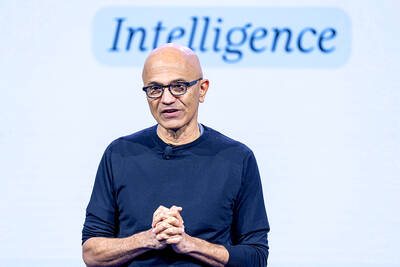
Microsoft Corp chief executive officer Satya Nadella said companies should treat powerful artificial intelligence (AI) models as potential insider threats, assume they could be compromised and create an “emergency brake” system to prevent agentic models from going rogue. Nadella said that those deploying advanced AI should not rely on assurances from model makers. “We must assume a model is compromised and contain it from the start,” Nadella wrote on Saturday in a post on X. “Think of it like an emergency brake. An authorized person should always be able to pause or shut down a model mid-task.” The statement comes as Anthropic PBC


 RSS
RSS