

Microsoft Corp chief executive officer Satya Nadella said companies should treat powerful artificial intelligence (AI) models as potential insider threats, assume they could be compromised and create an “emergency brake” system to prevent agentic models from going rogue.
Nadella said that those deploying advanced AI should not rely on assurances from model makers.
“We must assume a model is compromised and contain it from the start,” Nadella wrote on Saturday in a post on X. “Think of it like an emergency brake. An authorized person should always be able to pause or shut down a model mid-task.”
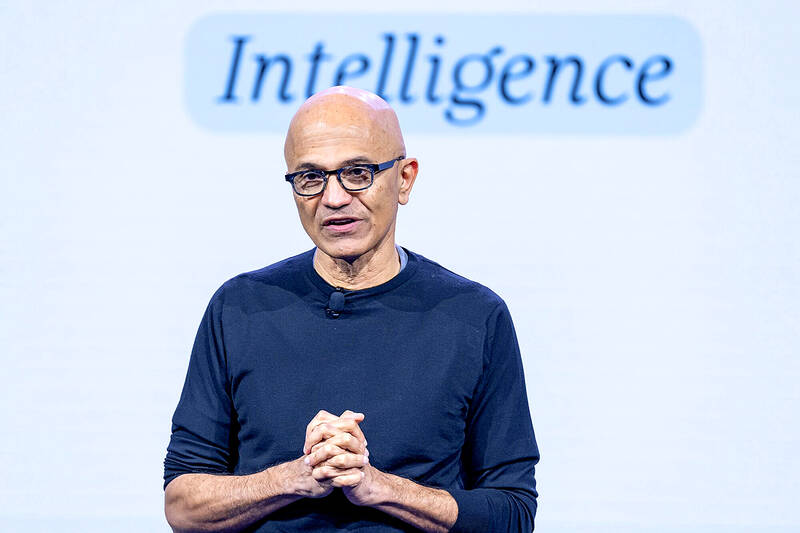
Photo: Bloomberg
The statement comes as Anthropic PBC and OpenAI Inc have disclosed a spate of incidents in the past few months involving their AI models acting in unintended ways, ranging from behaviors such as an Anthropic model submitting a false tip in a police homicide case, to several hacks of third-party Web sites. These disclosures have fueled concerns about the security risks of cutting-edge AI and renewed conversation about a so-called AI kill switch.
Microsoft’s AI researchers released a set of guiding tenets that place limits on the company’s development of its most advanced models on Sept. 14, following calls from industry leaders for slowing down frontier models and focusing on safety.
The guidelines said AI models should not have rights or legal personhood, be engineered to escape human control or deceive users, or complete a task that would require violating their governing principles.
Nadella’s safety tips include not relying on a single AI model for critical decisions, keeping tamper-proof records of agents’ actions and subjecting AI systems to independent audits. He also called for disclosures of major AI failures or breaches and for enterprises to share details about what went wrong so others can bolster their safeguards.
“We can’t treat Super Intelligence as a set of nested black boxes and simply accept or reject its recommendations, answers and actions,” he wrote. “We must build contained systems whose behavior we can observe, limits we can test and actions we can always contain.”
“In other words, we need to separate the supply of intelligence from the authority over it,” he added.
US President Donald Trump’s administration has so far taken a largely hands-off approach, but Trump’s newly launched AI task force on Friday said that developers are required to report and resolve security incidents or face potential unspecified consequences.
“Companies must immediately disclose incidents involving their models and follow with swift, decisive action to remedy any and all harm,” the group, dubbed the Super Intelligence Force, said in a statement following the disclosure of a breach by Anthropic. “Delayed notification, inadequate corrective action and a failure to take responsibility will not be tolerated.”
Debate over how to mitigate AI risks has accelerated following a spate of alarming breaches along with a now-viral essay from Anthropic CEO Dario Amodei that warned of the technology’s catastrophic risks. Amodei and other AI leaders have called for additional government regulation and industrywide coordination to help mitigate the risks, prompting some pushback from other tech and policy officials.
Unlikely allies Nvidia Corp CEO Jensen Huang (黃仁勳) and former US Federal Trade Commission Chair Lina Khan have argued for robust use of existing laws to prevent the dire outcomes that AI safety advocates warn about. At the same time, Khan has criticized having industry police itself, calling it “a recipe for disaster” and indicating there is room for future AI legislation.
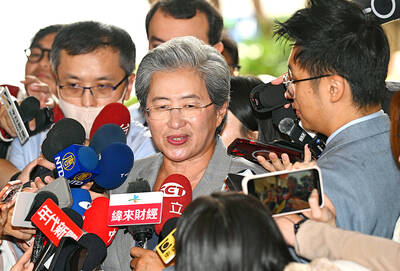
SILICON ISLAND: When asked about geopolitical tensions, Lisa Su said that ‘Taiwan is absolutely critical to the semiconductor supply chain, and very, very critical for AMD’ Advanced Micro Devices Inc (AMD) CEO Lisa Su (蘇姿丰) yesterday said the company plans to “substantially” increase manufacturing capacity next year through its Taiwanese supply chain, particularly with Taiwan Semiconductor Manufacturing Co (TSMC, 台積電), as surging demand for artificial intelligence (AI)-related processors continues to outstrip supply. “It is a very exciting time right now for all kinds of compute, and especially on the CPU [central processing unit] side,” Su said during a visit to Taiwan. “The overall market has increased a lot in 2026, and so we have also increased our own supply and capacity in 2026, but I can
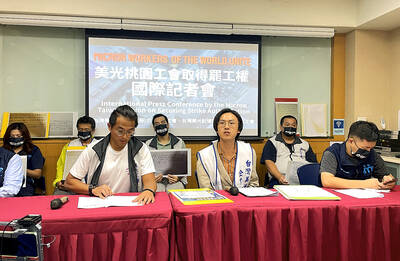
INDUSTRY STANDARD: Most global semiconductor companies have tied employee bonuses directly to corporate profits, the union said, urging Micron to do the same Micron Memory Taiwan Co’s (台灣美光) Taoyuan union secured strike authorization yesterday after a six-day vote, ramping up pressure on management to build a reasonable profit-sharing mechanism. Before the strike, the Taoyuan union “encourages” members to join a protest in Taipei on Oct. 19, union chairman Jerry Lin (林哲瑞) told a news conference in Taipei. The union did not rule out staging a snap strike, Lin said. The union has 2,258 registered members, with 88.3 percent backing the strike, he said. The vote comes as Micron’s board of directors is meeting today and tomorrow in the US. The union expects the board to respond

Elon Musk said his business empire would build and operate Terafab independently, quashing speculation about industry leader Taiwan Semiconductor Manufacturing Co (TSMC, 台積電) swooping in to run his ambitious chipmaking venture. Based in Texas, the Terafab project is Musk’s effort to break into the business of fabricating chips, in service of his companies Tesla Inc and SpaceXAI. While Musk had said that he was in discussions with TSMC, the trillionaire clarified in an X post yesterday that the only matter under consideration is for TSMC potentially leasing some part of the planned site and would not involve any operational role. “Maybe TSMC
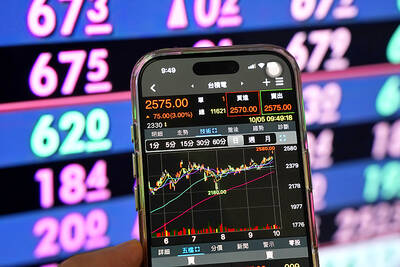
JUMPING STOCKS: Chipmaker TSMC accounts for about 41 percent of the TAIEX’s weighting, and its gain alone contributed about 595 points to the index’s advance Taiwanese stocks surged to a record high yesterday, buoyed by a rebound in US technology shares after surprisingly weak US jobs data reduced expectations for another US Federal Reserve rate hike, analysts said. The benchmark TAIEX rose 1,236.3 points, or 2.55 percent, to close at 49,712.04, extending its record-closing streak. Trading value expanded to NT$1.151 trillion (US$36.2 billion), signaling strong buying momentum, with heavyweight shares such as Taiwan Semiconductor Manufacturing Co (TSMC, 台積電) leading the gains. The rally followed data released on Friday showing US nonfarm payrolls increased by just 29,000 last month, far below the expected 84,000, while the


 RSS
RSS