

The Tibet Autonomous Region vowed to place the protection of its glaciers, wetlands and grasslands ahead of the development of industries such as tourism and manufacturing in its economic planning.
Tibet will reject investment from industries such as mining, should they result in the erosion of land or pollution of natural reserves, Huang Yutian, head of the Lhasa economic and development zone, told reporters on Friday in the Tibetan capital.
The development of Tibet is part of the government's 5.77 trillion yuan (US$720 billion) investment in western China to boost the poorest regions, the National Bureau of Statistics said. The spending is also aimed at reducing dissent among ethnic Tibetans, many of whom resent Beijing's approach in quashing dissidents, analysts said.
"We support the development of Tibet's industries, but not at the expense of environmental erosion," Huang said. "For now, we don't have any serious cases of environmental pollution. We don't use coal. We rely on clean energy resources, solar and hydropower."
The local government will also limit tourism because Tibet's ecology couldn't sustain increased human activities, Zhang Tianhua (
Tourists arriving in Tibet will exceed 3 million next year on increased interest in China as Beijing hosts the Olympic Games, Ta Ji, vice mayor of Lhasa, said on Friday.
A 33 billion yuan railway link between Tibet and neighboring Qinghai Province, which started operating a year ago, has brought increased numbers of visitors to the region, Ta said. Four trains come to Lhasa daily, each carrying about 700 people.
The autonomous region is able to support tourism activities for 3 million people, Zhang said.
Tibet's government has put on hold for now a plan to pave an existing dirt road linking Lhasa and Nepal, Zhang said, without giving a specific reason. The local government will instead work on minor repairs, he said.
"It's pretty much like fixing a leak in the roof of your house," Zhang said. "We'll be improving the condition of the road, which is sand and stone, not paving it with tar."

Federal Reserve Bank of Philadelphia President Anna Paulson on Thursday joined the chorus of policymakers saying additional interest-rate increases may be needed to ensure inflation returns to the central bank’s 2 percent goal. “Looking ahead, if conditions evolve as I expect, some modest further tightening may be warranted,” Paulson said on Thursday at an event in Philadelphia. Earlier on Thursday, New York Fed President John Williams said he and his colleagues “still have a lot of work to do” in dealing with lingering inflation risks. Several other officials have aired similar comments, in line with the signal given last week when policymakers voted
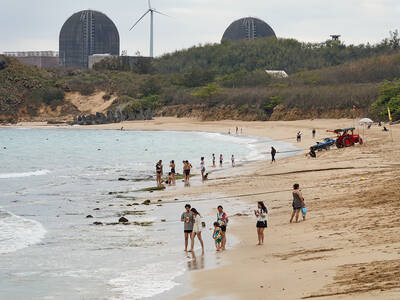
COURSE CHANGE: The shift comes amid pressure from chipmakers for stable, low-carbon electricity. Officials said Ma-anshan could be restarted as early as 2028 Taiwan has approved a preliminary plan to restart an idled atomic power plant, marking a reversal of the ruling party’s anti-nuclear stance as the nation pursues greater energy security. The Nuclear Safety Commission has cleared its review of an initial proposal to restart the Ma-anshan Nuclear Power Plant, it said in a statement on Thursday. Taiwan Power Co (台電) will still need to carry out follow-up work including safety inspections, before submitting another report on implementation for review, the commission said. The earliest the plant could resume operations is 2028, according to previous reports in local media, citing Minister of Economic Affairs

GlobalFoundries Inc yesterday said it plans to accelerate global capacity optimization and expansion to accommodate exponential growth in radio frequency (RF) and other chips driven by the artificial intelligence (AI) boom. Singapore will pay a vital role in the company’s capacity expansion, alongside production line optimizations across its manufacturing sites, GlobalFoundries Asia Pacific head Vincent Feng (范曾文) told a news conference in Hsinchu City. “Many might be surprised to hear that the RF market is thriving now. We are gearing up for a massive capacity expansion, and it is all being driven by AI,” Feng said. He declined to disclose details of the

MORE DATA CENTERS: Microsoft’s Taiwan-area general manager said the corporation is looking to add two more data centers in northern Taiwan over the next few years Microsoft Corp plans to double its data centers in Taiwan from two facilities to four, Microsoft Taiwan general manager Sean Pien (卞志祥) said yesterday. “Over the past two to three years, we have consistently seen demand outstrip supply, and we expect that situation to continue over the next two to three years,” Pien said on the sidelines of a news conference in Taipei. The data center sites would mainly be in northern Taiwan to meet customer demand and reduce the risk of operational disruptions caused by a single event, he said, without saying their exact locations. Microsoft enabled the first phase of


 RSS
RSS