


The New Taiwan dollar yesterday saw its strongest close in nearly three weeks against its US counterpart amid speculation that the central bank had intervened to stop the currency's decline.
The local currency gained NT$0.059 to close at NT$33.239, on a combined turnover of US$1.839 billion on the Taipei foreign exchange market and the smaller Yuantai foreign exchange market.
Yesterday's close was the strongest since May 7 when it was NT$33.22 against the greenback.
The NT dollar gained ground two days in a row after it looked like breaking the NT$33.4 mark in the middle of the morning session on Wednesday. Rumors were rife that the central bank had intervened to pull it back to a close of NT$33.398 that day.
Commenting on the local currency's regained strength in the past two days, the nation's monetary policymaker reiterated that the currency's exchange rate is determined by supply and demand.
"The central bank will only step in to maintain order when the market sees abnormal trading caused by seasonal or irregular psychological effects," Duann Jin-sheng (段金生), director-general of the central bank's foreign exchange department, told the Taipei Times yesterday.
He said analysts might have different interpretations of the NT dollar's movements, but there was no definite answer that was correct.
The NT dollar is expected to remain stable this year and fluctuate within a small range, the Taiwan Institute of Economic Research (TIER, 台經院) said yesterday.
The NT dollar started to depreciate against the greenback in December, but is very likely to rebound on demand for Asian currencies this year and on the down trend of the US dollar, TIER's monthly economic report said.
The expected gradual rise of the yuan on pressure from the US will also help to lift the NT dollar, the report said.
TIER forecast last month the NT dollar would rise to NT$32.75 against the US dollar by the end of the year.
But Peter Kurz, head of Taiwan equity research at Citigroup Global Markets, is not so optimistic about local currency, which has since 2000 been the weakest currency in Asia, excluding Japan.
"We see no signs that the NT dollar's relative weakness will reverse anytime soon," Kurz said in a report released yesterday, adding that the currency may continue its weakness for the next few quarters.
Kurz, dubbed "Mr Taiwan," attributed the weak local currency to three reasons: political uncertainty, low interest rates and soft export growth.
"Politics hurts the currency because of sentiment-driven capital flight and falling investment returns because of anti-China policies," Kurz said.
The widening real interest rate gap with the US dollar remains a draw for capital outflow and the nation's central bank appeared comfortable with the new low NT dollar that could help slackening exports, which result in downward pressure on the currency, he said.
However, Citigroup Global Markets said the weak NT dollar was expected to benefit three classes of equities: flat-panel display, life insurance and property stocks.
As most exporters have moved their production bases to China, whose currency is rising sharply against the NT dollar, manufacturers left behind in Taiwan are gaining an advantage brought by the weaker currency, especially those with lower operating leverage such as the flat-panel display sector, Kurz said.
Also, a depreciating NT dollar could mean rising property prices, which would benefit life insurance firms that hold significant real estate in their portfolios and considerable US dollar assets that they are no longer directly hedging, he said.
Citigroup named six investment picks: AU Optronics Co (
But investors should avoid banking stocks that the US investment advisory agency said are big losers from NT dollar exposure and low interest rates.
Accordingly, some banking-centric financial groups topped the net sales list for foreign investors on the local bourse yesterday, including SinoPac Holding (永豐金控) and Chinatrust Financial Holding Co (中信金控), according to the Taiwan Stock Exchange's data.

HSBC Holdings PLC is deepening its commitment to Taiwan as the economy emerges as one of the bank’s fastest-growing markets globally, driven by an artificial intelligence (AI) investment boom, expanding cross-border trade, and rising wealth creation. “The advantage that Taiwan has is a growth story linked to the semiconductor and broader AI industries, strong underlying corporate performance, and wealth creation,” said Surendra Rosha, HSBC’s co-chief executive for Asia and the Middle East, in an exclusive interview with the Taipei Times on June 2, during this year’s HSBC Taiwan Conference. That combination has helped HSBC cement its position as the most profitable international
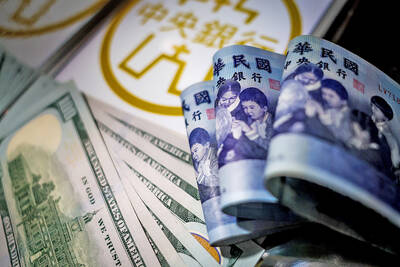
The New Taiwan dollar yesterday fell sharply against the US dollar to close at its lowest level since May 22 amid a massive outflow of funds from the country because of investors panicking over global equity markets. The NT dollar ended at NT$31.580 against the US dollar, slightly lower than its close of NT$31.568 on May 22, after moving between NT$31.5 and NT$31.648 on combined turnover of US$3.062 billion on the Taipei Foreign Exchange and the Cosmos Foreign Exchange. The NT dollar received a significant hit in the morning session, slumping as much as NT$0.173 at a time when other Asian currencies
Taiwan Semiconductor Manufacturing Co (TSMC, 台積電) is now ranked ninth among the world’s 100 most valuable companies after its market capitalization more than doubled over the past year, PricewaterhouseCoopers (PwC) Taiwan said in a report last month. TSMC’s market capitalization surged 101 percent year-on-year to US$1.427 trillion as of March 31, the accounting and consulting firm’s 2026 Global Top 100 Companies by Market Capitalization report said. The gain catapulted the world’s largest contract chipmaker from 12th place to ninth in the rankings, and it was the fastest-growing among the global top 10, it said. TSMC was the only Taiwanese company among the top
Taiwan Semiconductor Manufacturing Co (TSMC, 台積電) yesterday reported record revenue of NT$416.975 billion (US$13.17 billion) for last month, putting the world’s largest contract chipmaker on track to set a record for quarterly revenue. Last month’s figure surpassed March’s record NT$415.19 billion and represented increases of 1.5 percent from April and 30.1 percent from a year earlier. For the first five months of the year, TSMC generated NT$1.96 trillion in revenue, up 30 percent year-on-year, it said in a statement. TSMC has forecast second-quarter revenue of between US$39 billion and US$40.2 billion, representing sequential growth of about 10 percent and year-on-year growth of about


 RSS
RSS