


On a cool Monday evening, students hurried across Shinchon, a university district in western Seoul.
At the district's Anycall Studio, three schoolgirls were giggling while snapping pictures with a 10-megapixel camera phone, and having them printed on the spot.
A young man examined a play station and tested a few handset games shown on a liquid-crystal-display television.
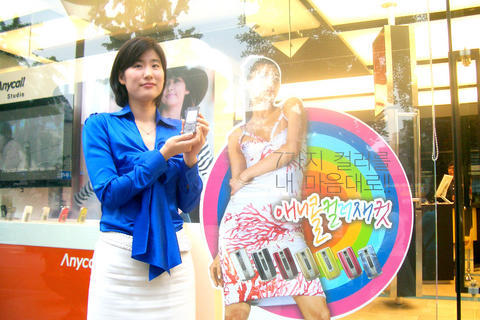
PHOTO: JASON TAN, TAIPEI TIMES
With a price tag of US$2 million, the two-story studio is Samsung Electronics Co's one-and-only handset brand store in South Korea, showcasing the latest mobile phones, including award-winning handsets and overseas models.
The second studio is located in Shanghai. In addition, Samsung Galleries in Moscow and New York showcase Samsung's complete lineup, including Anycall branded phones.
"Selling phones isn't the showrooms' purpose. We want to offer convenience to consumers, letting them know how mobile phones can interact with their daily lives," Ryu Jae-hyun, Samsung Taiwan's director of mobile communication, told the Taipei Times during a media trip to Seoul last week.
By the second half of the year, the Seoul store will be copied in Taipei's bustling commercial Xinyi District.
The Taipei store will be on a smaller scale, but the presence is definitely important to prove Samsung's commitment to the local market, said Ryu, who has been posted in Taipei for more than two years.
Despite being a late entrant into Taiwan's market, Samsung has managed to clinch the No. 4 position after Nokia Oyj, Motorola Inc and Sony Ericsson.
The South Korean chaebol broke the 10 percent mark by securing a 11. 3 percent share in March, up from 8.1 percent last October.
"We came to Taiwan later than others, that's why awareness of the Anycall brand is slightly lagging," said Roh Ki-hak, Samsung's senior vice president of mobile communication.
But it is setting an ambitious goal to secure a 15 percent share by the end of the year by selling a total of 1 million phones in Taiwan, he said.
Thanks to the high-end Ultra edition phones launched last year, Samsung sold 34.8 million worldwide in the first three months of this year, a quarterly record for the company -- despite an overall seasonal market shrinkage.
Riding on the successful Ultra edition series, Samsung will debut the F308, a new mobile phone model its says is the first to offer both a phone and portable music player in a dual-faced design.
The combination of phone and music player is a desirable but complicated function, which meant that the design team had to create a simple, clear cut interface for users, Lee Kyung-jin, a designer at Samsung's mobile communication division, said during a phone launch in the company's Seoul office last week.
The F308 is a cellphone on one side, but flip it over and the user has a music player at their fingertips.
Samsung, the world's third-largest handset brand, sold 118 million handsets worldwide last year, up from 103 million in 2005 and 86.5 million units in 2004, the company's statistics showed.
"We aim to sell 135 million units this year and chances are high that we will surpass that number," Roh said.
Phone makers including Samsung are trying to cash in at the expense of Motorola, as the No. 2 maker undergoes restructuring to recover from sagging sales after the glory of its hit Razr line of phones faded.
To cope with the increase in demand, Samsung said last Tuesday it would invest 200 billion won (US$216.4 million) into increasing output at its Gumi plant -- Samsung's only domestic handset facility approximately 260km southeast of Seoul.
The output from Gumi will rise to 75 million units this year from 69 million last year.
It is also considering several locations, including Vietnam, for its next overseas handset plant, adding to the current facilities in China, India and Brazil.
The next growth momentum will come from emerging markets, including China, India and Africa, Roh said.
"Users in these markets need lower-end phones. When we launch such products, we will add differentiation to our low-end phones to make them stand out," he said.
But industry watchers said competition is fierce.
"Samsung's Ultra edition phones are well received but rivals like LG or Motorola also focus on slim phones," Fox Su (
However, Lee is convinced that Samsung phones will continue to enjoy high popularity.
"Handsets are no longer merely a communication item. We create brand originality in our phones by adding the element of sensibility'," Lee said.
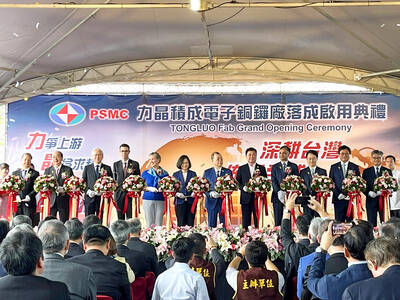
ARTIFICIAL INTELLIGENCE: The chipmaker last month raised its capital spending by 28 percent for this year to NT$32 billion from a previous estimate of NT$25 billion Contract chipmaker Powerchip Semiconductor Manufacturing Corp (力積電子) yesterday launched a new 12-inch fab, tapping into advanced chip-on-wafer-on-substrate (CoWoS) packaging technology to support rising demand for artificial intelligence (AI) devices. Powerchip is to offer interposers, one of three parts in CoWoS packaging technology, with shipments scheduled for the second half of this year, Powerchip chairman Frank Huang (黃崇仁) told reporters on the sidelines of a fab inauguration ceremony in the Tongluo Science Park (銅鑼科學園區) in Miaoli County yesterday. “We are working with customers to supply CoWoS-related business, utilizing part of this new fab’s capacity,” Huang said, adding that Powerchip intended to bridge

purpose: Tesla’s CEO sought to meet senior Chinese officials to discuss the rollout of its ‘full self-driving’ software in China and approval to transfer data they had collected Tesla Inc CEO Elon Musk arrived in Beijing yesterday on an unannounced visit, where he is expected to meet senior officials to discuss the rollout of "full self-driving" (FSD) software and permission to transfer data overseas, according to a person with knowledge of the matter. Chinese state media reported that he met Premier Li Qiang (李強) in Beijing, during which Li told Musk that Tesla's development in China could be regarded as a successful example of US-China economic and trade cooperation. Musk confirmed his meeting with the premier yesterday with a post on social media platform X. "Honored to meet with Premier Li
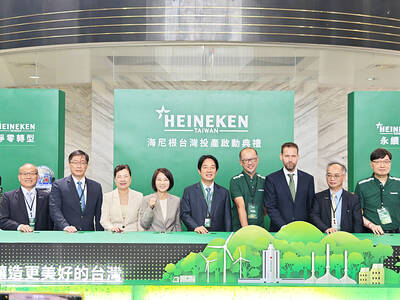
Dutch brewing company Heineken NV on Friday announced an investment of NT$13.5 billion (US$414.62 million) over the next five years in Taiwan. The first multinational brewing company to operate in Taiwan, Heineken made the statement at a ceremony held at its brewery in Pingtung County. It also outlined its efforts to make the brewery “net zero” by 2030. Heineken has been in the Taiwanese market for 20 years, Heineken Taiwan managing director Jeff Wu (吳建甫) said. With strong support from local consumers, the Dutch brewery decided to transition from sales to manufacturing in the country, Wu said. Heineken assumed majority ownership and management rights

Microsoft Corp yesterday said that it would create Thailand’s first data center region to boost cloud and artificial intelligence (AI) infrastructure, promising AI training to more than 100,000 people to develop tech. Bangkok is a key economic player in Southeast Asia, but it has lagged behind Indonesia and Singapore when it comes to the tech industry. Thailand has an “incredible opportunity to build a digital-first, AI-powered future,” Microsoft chairman and chief executive officer Satya Nadella said at an event in Bangkok. Data center regions are physical locations that store computing infrastructure, allowing secure and reliable access to cloud platforms. The global embrace of AI


 RSS
RSS