


Wall Street ended a winning, holiday-shortened week with a quiet advance on Thursday as investors awaited the release of employment figures for last month and remained cautiously optimistic after their recent buying streak. For the week, the major indexes showed gains each day and returned to positive territory for the year.
There was a subdued tone to trading on Thursday as investors adjusted portfolios ahead of a three-day weekend; the stock market was closed for Good Friday. Investors were particularly careful because they won't be able to trade on Friday's US Labor Department's employment report until the stock market reopens tomorrow morning.
There was little reaction to the department's report that first-time claims for unemployment benefits rose to their highest weekly level since March 3, which indicated companies might be struggling to cope with sluggish growth in the national economy.
Thursday marked the Dow's sixth straight session of gains, its biggest streak of advances since November. The blue-chip average spent the first half of Thursday's session in negative territory before moving higher at about midday.
"The market went up on fumes this week," said Philip Dow, managing director of equity strategy at RBC Dain Rauscher.
"Nobody has any wild expectations to the positive for the jobs report. But, barring some kind of negative report, I still think we'll see the market tread water," he said.
The Dow rose 30.15, or 0.24 percent, to 12,560.20.
Broader stock indicators also made gains. The Standard & Poor's 500 index rose 4.39, or 0.31 percent, to 1,443.76, and the NASDAQ composite index advanced 12.65, or 0.51 percent, to 2,471.34.
For the week, the Dow rose 0.78 percent, the S&P 500 gained 1.8 percent and the NASDAQ composite index advanced 2.3 percent. The Dow added more than 100 points on Tuesday after a stronger-than-expected report on sales of existing homes helped shore up investors' confidence in the economy.
US Treasury bond prices tumbled and stock futures rose in holiday-shortened trading on Friday after the unemployment rate fell to a five-month low, signaling that the economy could be stronger than expected.
The yield on the benchmark 10-year Treasury note surged to 4.75 percent -- its highest level since mid-February -- from 4.68 percent late on Thursday. Yields move in the opposite direction of bond prices.
The bond market closed at 11am EDT for Good Friday; stock and many other financial markets were closed on Friday.
Stock futures trading pits were closed on Friday, but electronically traded Standard & Poor's 500 index futures expiring in June rose 5.3 points, or 0.36 percent, to 1,458.00, while NASDAQ 100 index futures advanced 10.5 points, or 0.57 percent, to 1,838.75.
Oil prices settled down slightly a day after a modest ease in global political tensions. Prices had advanced in recent weeks in part amid unease over Iran's now-ended detention of British sailors and marines. Investors are now focused on energy inventories and demand, and sent a barrel of light, sweet crude down US$0.10 to US$64.28 on the New York Mercantile Exchange.
Some order was restored to the market this week after a series of volatile sessions last week.
"The market continues to fluctuate in a narrow range. I don't expect a big move in either direction because I think the economy has slowed but the slowdown is proving very mild," said Stuart Schweitzer, global markets strategist for JPMorgan Private Bank. He said that inflation remained higher than the Federal Reserve would like, likely keeping the central bank from lowering short-term interest rates.
"I think the movie will end well and we'll be smiling but there may be some scenes where we just have to take our eyes away from the screen," he said.
DaimlerChrysler AG shares surged US$3.81, or 4.7 percent, to US$84.80 after billionaire investor Kirk Kerkorian's Tracinda Corp approached the German automaker's board about acquiring its US-based Chrysler division.
He has held stakes in Chrysler since the 1990s, a decade after he lost out on a deal to acquire the full company. Kerkorian said he would offer Chrysler a stake in the company.
Micron Technology Inc pressured technology stocks after the flash memory maker posted disappointing second-quarter results late Wednesday.
The company swung to a loss as costs swelled and prices weakened. Shares fell US$0.56, or 4.6 percent, to US$11.51.
Advancing issues on Thursday outnumbered decliners by about 5 to 3 on the New York Stock Exchange, where consolidated volume came to 2.31 billion shares, compared with 2.61 billion shares traded on Wednesday.
The Russell 2000 index of smaller companies rose 2.56, or 0.32 percent, to 813.35.

HSBC Holdings PLC is deepening its commitment to Taiwan as the economy emerges as one of the bank’s fastest-growing markets globally, driven by an artificial intelligence (AI) investment boom, expanding cross-border trade, and rising wealth creation. “The advantage that Taiwan has is a growth story linked to the semiconductor and broader AI industries, strong underlying corporate performance, and wealth creation,” said Surendra Rosha, HSBC’s co-chief executive for Asia and the Middle East, in an exclusive interview with the Taipei Times on June 2, during this year’s HSBC Taiwan Conference. That combination has helped HSBC cement its position as the most profitable international
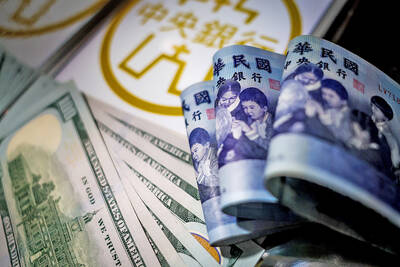
The New Taiwan dollar yesterday fell sharply against the US dollar to close at its lowest level since May 22 amid a massive outflow of funds from the country because of investors panicking over global equity markets. The NT dollar ended at NT$31.580 against the US dollar, slightly lower than its close of NT$31.568 on May 22, after moving between NT$31.5 and NT$31.648 on combined turnover of US$3.062 billion on the Taipei Foreign Exchange and the Cosmos Foreign Exchange. The NT dollar received a significant hit in the morning session, slumping as much as NT$0.173 at a time when other Asian currencies
Taiwan Semiconductor Manufacturing Co (TSMC, 台積電) is now ranked ninth among the world’s 100 most valuable companies after its market capitalization more than doubled over the past year, PricewaterhouseCoopers (PwC) Taiwan said in a report last month. TSMC’s market capitalization surged 101 percent year-on-year to US$1.427 trillion as of March 31, the accounting and consulting firm’s 2026 Global Top 100 Companies by Market Capitalization report said. The gain catapulted the world’s largest contract chipmaker from 12th place to ninth in the rankings, and it was the fastest-growing among the global top 10, it said. TSMC was the only Taiwanese company among the top
Taiwan Semiconductor Manufacturing Co (TSMC, 台積電) yesterday reported record revenue of NT$416.975 billion (US$13.17 billion) for last month, putting the world’s largest contract chipmaker on track to set a record for quarterly revenue. Last month’s figure surpassed March’s record NT$415.19 billion and represented increases of 1.5 percent from April and 30.1 percent from a year earlier. For the first five months of the year, TSMC generated NT$1.96 trillion in revenue, up 30 percent year-on-year, it said in a statement. TSMC has forecast second-quarter revenue of between US$39 billion and US$40.2 billion, representing sequential growth of about 10 percent and year-on-year growth of about


 RSS
RSS