


The nation's real estate market has shown only a mild price increase over the past decade compared with other nations, although the transaction volume last year broke a 1998 record high, central bank Governor Perng Fai-nan (
Perng's comment was made in response to Chinese Nationalist Party (KMT) Legislator Lai Shyh-bao (
Citing a report published in the Economist in December last year, Perng said among 17 nations surveyed between 1997 and last year, 10 saw their housing prices shoot up by more than 100 percent and four up by more than 60 percent.

PHOTO: CNA
Only three markets -- Hong Kong, Japan and Germany -- reported declines.
"Taiwan was not included in the survey but based on Cathay [Real Estate Development Co's,
Meanwhile, the nation saw 450,000 housing projects change hands last year, including newly-built and second-hand houses -- the highest level recorded since 1998 -- the Ministry of the Interior's tallies showed.
The central bank attributed the sizzling transactions to low interest rates that have fueled a steady growth in market demand; sky-high prices of state-owned land during auctions; and the government's plan to allow more Chinese tourists to visit Taiwan.
These factors have driven demand for real estate investments, the monetary policymaker wrote in a report released in the finance committee.
In the press conference following the central bank's last quarterly meeting in December, Perng for the first time said the bank would keep a close eye on the housing market, hinting that it had started paying attention to whether the sector was overheating.
The policymaker is scheduled to hold its next board meeting on March 29 to discuss its monetary policy.
Since October 2004, the central bank has raised the benchmark interest rate 10 times for a total of 1.375 percentage points.
The current rediscount rate charged to commercial lenders is 2.75 percent.
People First Party Legislator Christina Liu (
Among 43 nations, Taiwan's short-term rate at 1.82 percent is only higher than that of Japan and its long-term rate at 2.05 percent is also among the lowest.
Since 2000, Taiwanese have wired NT$5.7 trillion (US$172.7 billion), or NT$800 billion per annum on average, overseas in pursuit of better investment returns, she said.
In response, Perng said that capital had also been flowing into the nation, and argued that monetary policy must take Taiwan's overall economic structure into consideration.
The central bank's data showed the nation had foreign exchange reserves of US$266.1 billion last year, up by US$12.8 billion from 2005. Foreign capital investing in Taiwan's stock market accounted for more than 50 percent of the figure, or US$150 billion, Perng said.
The governor also dismissed legislators' comments that the government might request that the central bank relocate to the south.
He said it was not possible for the government to make the request without moving the capital first because Taipei is the nation's financial center.
Legislators also questioned whether images of Sun Yat-sen (
Perng said the central bank would only launch new versions of bills when bill counterfeiting made it necessary.

BUSINESS UPDATE: The iPhone assembler said operations outlook is expected to show quarter-on-quarter and year-on-year growth for the second quarter Hon Hai Precision Industry Co (鴻海精密) yesterday reported strong growth in sales last month, potentially raising expectations for iPhone sales while artificial intelligence (AI)-related business booms. The company, which assembles the majority of Apple Inc’s smartphones, reported a 19.03 percent rise in monthly sales to NT$510.9 billion (US$15.78 billion), from NT$429.22 billion in the same period last year. On a monthly basis, sales rose 14.16 percent, it said. The company in a statement said that last month’s revenue was a record-breaking April performance. Hon Hai, known also as Foxconn Technology Group (富士康科技集團), assembles most iPhones, but the company is diversifying its business to
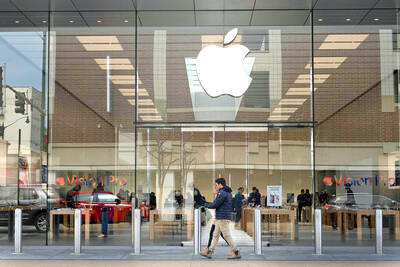
Apple Inc has been developing a homegrown chip to run artificial intelligence (AI) tools in data centers, although it is unclear if the semiconductor would ever be deployed, the Wall Street Journal reported on Monday. The effort would build on Apple’s previous efforts to make in-house chips, which run in its iPhones, Macs and other devices, according to the Journal, which cited unidentified people familiar with the matter. The server project is code-named ACDC (Apple Chips in Data Center) within the company, aiming to utilize Apple’s expertise in chip design for the company’s server infrastructure, the newspaper said. While this initiative has been

GlobalWafers Co (環球晶圓), the world’s No. 3 silicon wafer supplier, yesterday said that revenue would rise moderately in the second half of this year, driven primarily by robust demand for advanced wafers used in high-bandwidth memory (HBM) chips, a key component of artificial intelligence (AI) technology. “The first quarter is the lowest point of this cycle. The second half will be better than the first for the whole semiconductor industry and for GlobalWafers,” chairwoman Doris Hsu (徐秀蘭) said during an online investors’ conference. “HBM would definitely be the key growth driver in the second half,” Hsu said. “That is our big hope

The consumer price index (CPI) last month eased to 1.95 percent, below the central bank’s 2 percent target, as food and entertainment cost increases decelerated, helped by stable egg prices, the Directorate-General of Budget, Accounting and Statistics (DGBAS) said yesterday. The slowdown bucked predictions by policymakers and academics that inflationary pressures would build up following double-digit electricity rate hikes on April 1. “The latest CPI data came after the cost of eating out and rent grew moderately amid mixed international raw material prices,” DGBAS official Tsao Chih-hung (曹志弘) told a news conference in Taipei. The central bank in March raised interest rates by


 RSS
RSS