


Dunkin' Donuts, the 10th-biggest US chain, will open its first store in Taiwan today, providing a wide variety of donuts, beverages and sandwiches to compete head-on with its Japanese counterpart Mister Donut.
Relying on its local partner Mercuries and Associates Ltd's (
The US firm runs over 1,400 Dunkin' Donuts in Asia, including 500 in the Philippines, 400 in Korea, 250 in Indonesia and close to 200 in Thailand. It expressed optimism that the famous brand will soon have a strong presence in the local market.
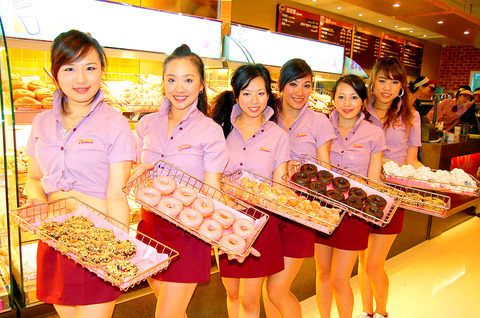
PHOTO: YANG YA-MIN, TAIPEI TIMES
"Taiwan is a great target market for our Greater China strategy. People here are good at accepting Western brands," Pavese said following a press conference in Taipei yesterday.
Following only six months of negotiations, Mercuries and Associates -- which also owns the beef noodle chain Sanshang Chiaofu (三商巧福), Napoli pizza and Japanese restaurant Tonkatsu (福勝亭) -- secured a 20-year franchise right, including expansion in China.
Andrew Chang (
"With different combinations of coffee, donuts, bagels, croissants and bread, we aim to snatch a market share in the leisure food and beverage market, including breakfast," Chang said, adding that most of its branches will operate between 7am and 10pm.
Different from Mister Donut, which has kitchens in every store, Dunkin' Donuts cuts production costs through regional factories, allowing it to offer products at a lower price than its competitors.
Its first factory in Shenkeng (
The nation's coffee and bakery market has become extremely competitive, with leading players like Starbucks, Mister Donut and the cafe and bakery chain 85°C (美食達人) battling for market dominance.
Mister Donut, which entered the local market in October 2004, has expanded to 16 stores and plans to have 40 stores by the end of this year.
"What differentiates us from the competition is that donuts are the major focus in our shops and we prioritize sophisticated flavors and high-quality products," said Ting Hui-ling (丁慧玲), a public relations specialist for Mister Donut Taiwan Co (統一多拿滋), which offers as many as 50 donut flavors.
Mister Donut sold 18.78 million donuts last year, with total revenues expected to reach NT$595 million, statistics showed.
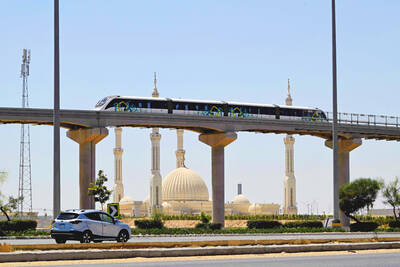
Cairo’s new monorail slices across the city skyline, running above the familiar chaos of blaring horns and aging buses’ exhaust fumes that mark rush hour below. The US$4.5 billion monorail, opened this month, is among Egypt’s most prominent new transport projects, part of a debt-funded infrastructure drive criticized for sapping state finances while bringing limited benefits to most of the country’s 109 million people. “It feels like you’re in a different country,” said Ramy Sayed, a restaurant manager, aboard a driverless Innovia 300 train. “No noise, no traffic, we’re not used to this.” The eastern line runs 56km from the bustling middle-class

Taiwanese firms have increased investment in the Philippines in recent years as Manila’s ties with Washington deepen and global supply chains continue to shift away from China, an expert at the Chung-Hua Institution for Economic Research (CIER, 中華經濟研究院) said yesterday. The Philippines had not been among Taiwanese investors’ top choices in Southeast Asia, CIER Taiwan ASEAN Studies Center director Kristy Hsu (徐遵慈) said at a seminar in Taipei. However, Taiwan’s investment in the country has grown significantly since the COVID-19 pandemic, reaching US $257 million last year, a high in recent years, she said. Although Taiwan’s total investment in the Philippines still lags

Intel Corp regards Taiwan Semiconductor Manufacturing Co (TSMC, 台積電) as a longstanding partner, as the US chipmaker would continue outsourcing production of advanced chips to TSMC, Intel chief executive officer Lip-Bu Tan (陳立武) said yesterday. “I don’t look at people as competitors. I look at the collaboration... Nvidia is also, you know, a good friend,” Tan told a news conference following his keynote speech at the Computex trade show in Taipei. “It’s a very trusted partnership for us... We are a big, top customer for them, and we’re going to continue doing that,” he said, referring to TSMC, the world’s largest foundry
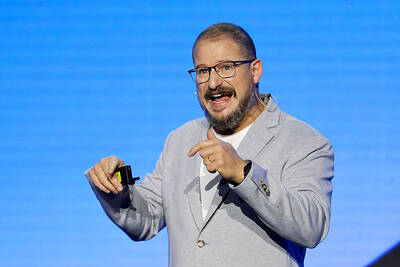
Artificial intelligence (AI) agents would supplant smartphones as the center of people’s digital lives, fundamentally reshaping personal devices and driving a major computing upgrade cycle, Qualcomm Inc CEO Cristiano Amon said yesterday. In his keynote speech for this year’s Computex trade show in Taipei, Amon said that the rise of "agentic AI" — AI systems capable of reasoning, planning and carrying out tasks autonomously — would transform how people interact with technology across phones, PCs, vehicles and wearable devices. Describing the technology as the next major evolution in computing, Amon said that "2026 is the year of agents.” For decades, smartphones have sat


 RSS
RSS