


Hewlett-Packard (HP) is looking for a second act. Several of them, actually.
Its turnaround was confirmed this year when profits from PCs, corporate servers and storage devices nearly doubled from a year earlier. It sold more PCs than any other maker and claimed the title of the world's largest technology company.
Goal
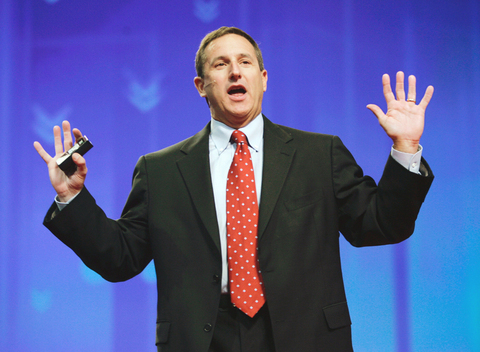
PHOTO: AP
Now it has to sustain those gains. The US$92 billion company has set a goal of growing 6 percent next year and the year after. That means it must add about US$5.5 billion a year in new revenue, or about what Yahoo produces each year in total revenue.
"Scale has enormous advantages," Mark Hurd, HP's chairman and chief executive, said in a recent interview.
"One disadvantage is that billions of dollars of annual revenue growth may appear underwhelming expressed as a simple percentage figure," he said.
The Law of Big Numbers is the bane of any giant company. It decrees that a behemoth has a harder time growing as quickly as a small and nimble company.
Hewlett-Packard is no exception. It has cut 15,000 employees and plans to trim more of its US$84 billion in expenses to become more efficient and deploy the savings for growth, but cost-cutting improves the bottom line faster than it does the top line.
A debt-free company with an US$11 billion cash hoard, HP could acquire other companies, but it has said it prefers not to make any major acquisitions. It still needs to add revenue by growing from within, and that will not be easy.
"HP could do both," said Benjamin Reitzes, an analyst with UBS Investment Research.
"A company with almost US$100 billion in revenue should be doing both," he said.
It has some ideas. It is moving quickly to build printers for almost any application in which ink hits paper. Analysts say that is a slam dunk. Two other areas it has identified for growth, selling cost-efficient corporate data centers and consumer electronics, pose considerably more risk. Reitzes is confident that Hurd can succeed.
"He's worked some magic before," he said.
Printers are HP's sure thing. It makes nearly half the printers sold across the globe. The printer unit contributes half the company's profits, with enviable profit margins of 15 percent because of the ink and toner it sells for the printers.
So far, the company has avoided becoming complacent. It dominates the market for home printing, where 55 percent of all digital photographs are printed.
As consumers have begun shifting to printing digital photographs at stores, it is following them to wherever they choose to print. It builds in-store printing kiosks, sells digital prints online through its Snapfish.com service and runs the online or back shop photo-printing operations for major retailers like Wal-Mart Stores and Costco.
Shift
It is part of a shift in emphasis from printers to printing.
"Anything that is printed is an opportunity for HP," Vyomesh Joshi, the executive vice president for the imaging and printing group, said.
So the company is now selling large digital presses to commercial printers who make billboards or in-store marketing materials. It recently sold color digital presses to Amazon.com, the online retailer, which uses them to print books on demand.
The payoff is obvious.
"When you talk about liters of ink rather than milliliters of ink, that is exciting for us," Joshi said.
HP's move to sell the data center of the future stems from its perpetual drive to cut its overhead. As it consolidates its 85 US data centers into six, it is creating a showcase that its sales team can point to -- a computer room that would cost significantly less to run because it would be energy efficient and run with few technicians.
"What we are recommending to our customers is huge," Hurd said.
"Every company wants to do what we are doing. We believe everyone has to do it sooner or later," he said.
Air-conditioning units at its data center in its Palo Alto, California, headquarters used to blow out air at 14.5oC to cool the racks of servers and storage devices. Now, because of sensors that monitor the temperature of the air circulating next to the devices, cooling can be achieved with a 19oC setting. The result is a 30 percent reduction in energy consumption, the company says, representing enough electricity in that 100-server room to cool 116 homes.
The room is also quieter -- not that it matters, because the company's plan is to automate every process so a technician need visit only when there is an error that software managing the center cannot solve.
"We are about halfway to a 24/7 lights-out data center," said Chandrakant Patel, an HP fellow and the research scientist with HP Labs who helped design the Dynamic Cooling software.
The technology is there. Whether it will succeed depends on how convincing the hundreds of sales representatives the company is now hiring can be.
The third goal is to move beyond the traditional PC. HP is clearly benefiting from the shift in consumer preferences toward notebook PCs. As the entertainment-obsessed consumer shifts toward ever more mobile devices like hand-held video players and phones that can function as mini-PCs, the company wants to be ready with always-connected devices that may blur the differences between a standard PC and consumer electronic devices.
"It is an important part of the vision we have," said Shane Robinson, the chief technology officer at HP.
These "managed home" products may be the toughest part of the company's growth strategy to execute.
HP has been selling TVs for several years, even in Best Buy, the US' largest consumer electronics retailer. But it has not broken into the upper ranks of TV makers, where Sony, Samsung and Sharp hold court.
The company's products are in 28,000 stores, but it has been unable to use the considerable clout it has with retailers who sell its notebooks and printers to push its TVs and other consumer products, A.M. Sacconaghi, a securities analyst with Sanford Bernstein, said.
HP's hand-held devices are aimed at corporate users, a market that is collapsing, and most of the products are considered flops. The entire iPaq line of HP hand-helds is being overhauled this year to focus on wireless connectivity, said Todd Bradley, the executive vice president of the PC unit.
Stephen Baker, a technology analyst with the market consulting firm NPD, which sells data to HP, said it was still too early to judge the company's progress.
"They haven't had high expectations and went about it slowly and deliberately. They don't have the high numbers because they haven't been ready," he said.
For his part, Hurd said: "The managed home will happen, but it may evolve at a slower pace than in enterprise. You can spend a lot on the managed home and not get a return."
That time may be near. The company has three new but as yet unheralded products that point in the direction it is headed. The Media Smart TV is a flat-panel 37-inch liquid-crystal-display TV that automatically pulls in content stored on a PC or other networked devices with a hard drive. It costs US$2,000, a 50 percent premium over its regular 37-inch LCD set.
The US$570 iPaq Travel Companion is a hand-held device that lets users watch videos through a wireless connection to the Internet. And the Media Vault, a storage device, is attached to the home network to store music, movies and photos. It is priced at US$350 to US$500 depending on how much data it stores.
Ahead
"We are about a year ahead of anyone else," Bradley said.
But the products are hard to find in the stores -- in part, company executives concede, because they are pioneering a new category.
"The retailers are adjusting to how to sell the products," Satjiv Chahil, the senior vice president for the PC division's marketing, said.
"When you are doing breakthrough products, the normal distribution doesn't pick it up all the way," he said.
That may change as Apple Computer pushes forward with its own connected TV, the iTV, and as other companies announce similar strategies at next month's Consumer Electronics Show in Las Vegas.
"The Apple iTV? It's a Media Smart wannabe," Chahil said.
"Steve Jobs is validating a behavioral change and an industry direction. The good news is that we were there a year in advance," he said.
"Consumers keep telling us they want something that is insanely simple," Hurd said, adding that the company believes the new Media Smart TV to be "insanely simple."
The problem for HP is that to keep pace with market changes, the company that Hurd describes as "the world's leading IT infrastructure company" may have to recast the PC part of itself as a consumer electronics company like Sony, Samsung or that other computer maker that has made the shift, Apple. And that will not be an easy thing to do.
"If we want to be a great company, we can't do one thing," Hurd said.
"We need to do multiple things at all times," he said.
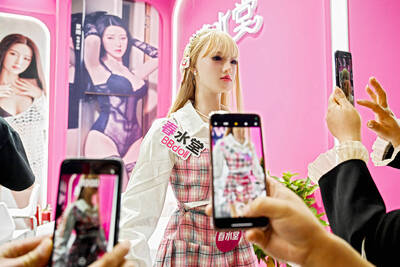
Among the rows of vibrators, rubber torsos and leather harnesses at a Chinese sex toys exhibition in Shanghai this weekend, the beginnings of an artificial intelligence (AI)-driven shift in the industry quietly pulsed. China manufactures about 70 percent of the world’s sex toys, most of it the “hardware” on display at the fair — whether that be technicolor tentacled dildos or hyper-realistic personalized silicone dolls. Yet smart toys have been rising in popularity for some time. Many major European and US brands already offer tech-enhanced products that can enable long-distance love, monitor well-being and even bring people one step closer to

Malaysia’s leader yesterday announced plans to build a massive semiconductor design park, aiming to boost the Southeast Asian nation’s role in the global chip industry. A prominent player in the semiconductor industry for decades, Malaysia accounts for an estimated 13 percent of global back-end manufacturing, according to German tech giant Bosch. Now it wants to go beyond production and emerge as a chip design powerhouse too, Malaysian Prime Minister Anwar Ibrahim said. “I am pleased to announce the largest IC (integrated circuit) Design Park in Southeast Asia, that will house world-class anchor tenants and collaborate with global companies such as Arm [Holdings PLC],”

Sales in the retail, and food and beverage sectors last month continued to rise, increasing 0.7 percent and 13.6 percent respectively from a year earlier, setting record highs for the month of March, the Ministry of Economic Affairs said yesterday. Sales in the wholesale sector also grew last month by 4.6 annually, mainly due to the business opportunities for emerging applications related to artificial intelligence (AI) and high-performance computing technologies, the ministry said in a report. The ministry forecast that retail, and food and beverage sales this month would retain their growth momentum as the former would benefit from Tomb Sweeping Day
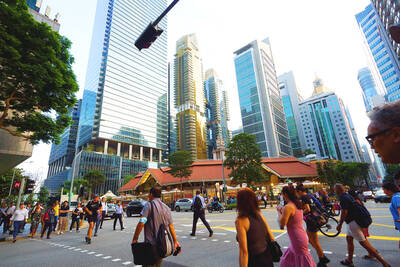
Thousands of parents in Singapore are furious after a Cordlife Group Ltd (康盛人生集團), a major operator of cord blood banks in Asia, irreparably damaged their children’s samples through improper handling, with some now pursuing legal action. The ongoing case, one of the worst to hit the largely untested industry, has renewed concerns over companies marketing themselves to anxious parents with mostly unproven assurances. This has implications across the region, given Cordlife’s operations in Hong Kong, Macau, Indonesia, the Philippines and India. The parents paid for years to have their infants’ cord blood stored, with the understanding that the stem cells they contained


 RSS
RSS