


Asian stocks closed mainly higher on Friday in lackluster trading as investors squared off their positions ahead of the Christmas holidays.
Singapore provided the highlight of the day with a 0.74 gain which delivered the benchmark back into record territory while Tokyo was up 0.34 percent after a late rally in market leaders.
Modest gains were also notched up in Hong Kong, Taipei, Sydney, Kuala Lumpur and Bangkok where anxiety appears to have abated after the government's attempt to introduce currency controls earlier in the week.
Slight losses were registered in Jakarta, Manila and Wellington while Shanghai and Seoul were flat.
TAIPEI
Share prices closed 0.41 percent higher as fund mangers spruced up portfolios ahead of the year-end, with expectations of increased foreign capital inflows also providing support.
However, volume was light as many market players were away on holiday.
The weighted index rose 31.53 points at 7,652.47 on turnover of NT$86.97 billion (US$2.68 billion).
"Stocks found support from window-dressing activity in the run-up to the end of the year," said Michael On, president of Beyond Asset Management Co Ltd.
He said some investors are pinning hopes that foreign funds will allocate more money to Taiwan amid expected reduction of exposure to Thailand following the recent financial turbulence in that country.
Rotational activity seen on Friday is an indication of such hopes, the analyst said, but added that trade was relatively thin due to the holiday mood. The Taiwan stock market will remain open tomorrow but trade is expected to be sluggish as most overseas bourses will be shut for the Christmas holiday.
TOKYO
Share prices rose 0.34 percent, reaching a new seven-month high, in a late-day rally as interest in blue chips and upbeat corporate news offset end of the year profit-taking.
Dealers said figures released by Toyota Motor Corp showing it was on course to become the world's biggest automaker helped lift the mood of the market, which was in negative territory in the morning session.
The Nikkei-225 gained 57.13 points to close at 17,104.96, its highest close since May 9. But the broader TOPIX index of all first-section companies eked out gains of only 0.80 points to end at 1,672.10.
Volume fell to 1.71 billion shares from 2.07 billion on Thursday.
HONG KONG
Share prices closed 0.51 percent higher as China Mobile and select blue chips attracted interest ahead of the expiry of December futures contracts next week.
Dealers said Hutchison Telecom was in focus on expectations of a bidding war for the company's Indian unit.
They said Chinese insurers picked up after reports China issued draft rules allowing the firms to invest in a wider range of overseas stocks and fixed-income products.
The Hang Seng Index closed up 97.68 points at 19,320.52.
Hutchison Telecommunication was in focus amid expectations of a bidding war for its Indian unit.
UK's Vodafone Group confirmed that it is considering buying Hutchison's 67 percent-owned unit Hutchison Essar, pitting it in a likely bidding war with India's Reliance Communications and others.
SEOUL
Share prices closed little changed as many investors took to the sidelines ahead of the holiday weekend and the release of key economic data in the coming week.
The market started off on a weak note due to a decline on Wall Street and downbeat US economic data, moved in a tight range throughout the session and ended with slight gains on foreign investor interest in banks and retailers.
The KOSPI index inched up 1.02 points at 1,437.49.
SHANGHAI
Although Chinese markets are up 100 percent, making them the world's best performing major exchange this year, investors may be in for a bumpier ride ahead as investors pocket profits prior to new share offerings.
The Shanghai A-share Index rose 0.87 points to 2,464.21 and the Shenzhen A-share Index was down 5.10 points or 0.91 percent at 554.28.
The Shanghai Composite Index, which covers A and B-shares on the Shanghai Stock Exchange, rose 0.73 points at 2,343.67.
SYDNEY
Share prices closed 0.36 percent higher as gains in banking stocks offset a slump in resources.
Dealers said the Australian market had taken a slightly defensive position, with financial stocks up and resources shares down on the back of lower prices on the London Metal Exchange and an overnight retreat in the oil price.
The S and P/ASX 200 climbed 20.2 points to 5,603.7. A total of 1.30 billion shares were traded.
SINGAPORE
Share prices powered to a new record high, boosted by gains in banking and property stocks.
The Straits Times Index rose 21.55 points to 2,942.39. Volume totalled 1.05 billion shares worth S$893 million (US$580 million).
"Volumes are quite thin, we saw some light interest today but nothing too strong," a dealer from a European brokerage said.
Banks and property stocks garnered the most interest as traders looked for some last minute opportunities with the year-end holidays looming, dealers said.
KUALA LUMPUR
Share prices closed 0.28 percent higher as blue chips attracted interest in late trade.
The composite index gained 3.04 points to 1,079.72 on turnover of 733.34 million shares.
BANGKOK
Share prices rose 0.62 percent after days of volatile trading, set off by panic selling on the government's draconian currency measures aimed at curbing the baht's rise.
Dealers said investors bought energy-linked shares but overall gains were limited as investors were cautious following the army-installed government's abrupt U-turn on the capital rules in the wake of a 15-percent plunge.
The composite index gained 4.21 points to 680.31 on turnover of 3.1 billion shares.
MUMBAI
Share prices closed higher led by cement companies as investors expect strong demand for building materials despite the prospect of higher lending rates for home loans.
Dealers said cement companies would continue to benefit from demand for new homes and office space and that an expected hike in interest rates by the central bank next month will have a marginal impact.
The 30-share Mumbai stock exchange Sensex index ended up 86.88 points or 0.65 percent to 13,471.74.
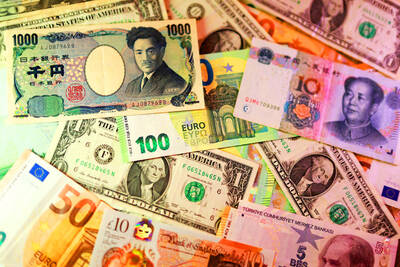
Taiwan’s foreign exchange reserves fell below the US$600 billion mark at the end of last month, with the central bank reporting a total of US$596.89 billion — a decline of US$8.6 billion from February — ending a three-month streak of increases. The central bank attributed the drop to a combination of factors such as outflows by foreign institutional investors, currency fluctuations and its own market interventions. “The large-scale outflows disrupted the balance of supply and demand in the foreign exchange market, prompting the central bank to intervene repeatedly by selling US dollars to stabilize the local currency,” Department of Foreign

ENERGY ISSUES: The TSIA urged the government to increase natural gas and helium reserves to reduce the impact of the Middle East war on semiconductor supply stability Chip testing and packaging service provider ASE Technology Holding Co (日月光投控) yesterday said it planned to invest more than NT$100 billion (US$3.15 billion) in building a new advanced chip testing facility in Kaohsiung to keep up with customer demand driven by the artificial intelligence (AI) boom. That would be included in the company’s capital expenditure budget next year, ASE said. There is also room to raise this year’s capital spending budget from a record-high US$7 billion estimated three months ago, it added. ASE would have six factories under construction this year, another record-breaking number, ASE chief operating officer Tien Wu

The EU and US are nearing an agreement to coordinate on producing and securing critical minerals, part of a push to break reliance on Chinese supplies. The potential deal would create incentives, such as minimum prices, that could advantage non-Chinese suppliers, according to a draft of an “action plan” seen by Bloomberg. The EU and US would also cooperate on standards, investments and joint projects, as well as coordinate on any supply disruptions by countries like China. The two sides are additionally seeking other “like-minded partners” to join a multicountry accord to help create these new critical mineral supply chains, which feed into

For weeks now, the global tech industry has been waiting for a major artificial intelligence (AI) launch from DeepSeek (深度求索), seen as a benchmark for China’s progress in the fast-moving field. More than a year has passed since the start-up put Chinese AI on the map in early last year with a low-cost chatbot that performed at a similar level to US rivals. However, despite reports and rumors about its imminent release, DeepSeek’s next-generation “V4” model is nowhere in sight. Speculation is also swirling over the geopolitical implications of which computer chips were chosen to train and power the new


 RSS
RSS