


Soon after Hiwin Technologies Corp (
Hiwin's Japanese rivals joined hands to block sales of precision machinery from Japan to Hiwin, afraid of the growing threat posed by the small Taiwanese firm.
It left the components manufacturer -- with a speciality in ballscrews, aircraft parts and linear bearings for use in precision machinery -- little choice but to turn to German vendors to purchase the necessary production equipment. The move would cost an additional NT$30 million (US$0.9 million) over its old suppliers.
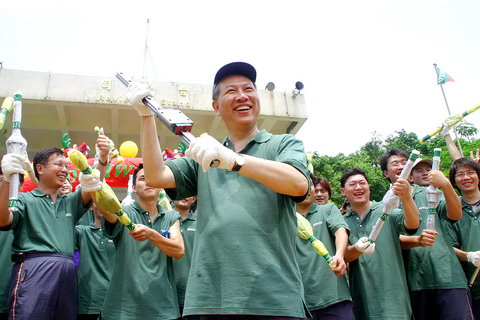
PHOTO: TSENG HUI-WEN, TAIPEI TIMES
Faced with this increase cost, Chuo decided to master the capability to manufacture the precision equipment himself.
After more than six years of countless attempts and failures, the company managed to lift the machinery quality to international standards -- a process that cost some NT$4 million.
"Without the capability to manufacture production equipment, a company's competitiveness will lag," Chuo said.
Chuo, who is a highly motivated individual, is representative of the entrepreneurial spirit of Taiwan's small and medium-sized businesses (SMEs).
Instead of pursuing contract manufacturing, where margins are forever shrinking, Chuo decided to make a bold attempt at branding.
But "branding is a long and windy road," he said.
Hostility from Chou's original Japanese suppliers was one of the early challenges he faced.
To ensure an edge in a highly competitive business, Hiwin has pumped more than 5 percent of total revenues into research and development (R&D) over the past five years.
This year's estimated R&D amount will hit NT$170 million, up from last year's NT$128.6 million, the company's statistics showed.
The R&D percentage will rise to 10 percent when total sales reach NT$10 billion in 2008, Chuo said.
Facing strong demand, Hiwin has set its sights on becoming the world's largest ballscrew maker and the No. 3 linear guideway maker in 2010.
While R&D is a key ingredient to ensure brand success, mergers and acquisitions (M&As) are another shortcut to fame.
BenQ Corp (
Heavy losses, however, forced BenQ to stop financing BenQ Mobile in Germany in October, causing the latter to file for bankruptcy protection and leaving 3,000 staff out of work.
While large companies such as BenQ have not fared well with M&As, homegrown SMEs have their own experiences -- some good, some bad.
"Merging with someone too much larger in size may not help. Companies should not merge just for the sake of it," said Peter Lo (
Buying out a foreign firm is a viable strategy as companies might not be well versed in overseas markets, but the option does not guarantee instant success, he said.
Lo, who hails from Chiayi County, never knew that his purchase of a US fitness enterprise in 1996 would later pave the way for the world's fifth-largest fitness equipment corporation.
Lo decided to take over the fitness division of US-based Trek Bicycle Corp in order to make inroads into US market, and in the end the move paid off.
He surmised at the time that nobody would sell fitness machines in the US better than domestic professionals, and he paid only a small sum -- US$100,000 -- for the takeover. The professional managers he recruited not only understood product development, but also how to manage a brand by roping in successful channel partners.
The US$100,000 investment opened the doors to JHT in the US market and later gave birth to the "Vision Fitness" -- the company's first brandname.
"We shouldn't just marry anyone and hold a big scale, flashy wedding. We need to think of the possible impact before tying the knot," Lo said.
In his case, making use of domestic professionals and channels to manage a brand is a more efficient strategy, he said.
Dick Hsieh (
When he decided to venture into business in 1979, he wanted to incorporate his artistic interests into luggage production.
He had big ambitions -- he wanted people all over the world to equate the "Eminent" logo with international travel.
When he decided to set a foothold in Europe, he opted to join hands with Galeria Kaufhof, the largest department store in Germany with 142 outlets in Germany and Belgium.
That strategy worked. Eminent luggage is showcased prominently at highlighted sections of the stores and has since become the leading brand in Germany, even beating larger rival US-based Samsonite Corp.
"Without brand and channels, a firm will not go far." Hsieh said.

Among the rows of vibrators, rubber torsos and leather harnesses at a Chinese sex toys exhibition in Shanghai this weekend, the beginnings of an artificial intelligence (AI)-driven shift in the industry quietly pulsed. China manufactures about 70 percent of the world’s sex toys, most of it the “hardware” on display at the fair — whether that be technicolor tentacled dildos or hyper-realistic personalized silicone dolls. Yet smart toys have been rising in popularity for some time. Many major European and US brands already offer tech-enhanced products that can enable long-distance love, monitor well-being and even bring people one step closer to

Malaysia’s leader yesterday announced plans to build a massive semiconductor design park, aiming to boost the Southeast Asian nation’s role in the global chip industry. A prominent player in the semiconductor industry for decades, Malaysia accounts for an estimated 13 percent of global back-end manufacturing, according to German tech giant Bosch. Now it wants to go beyond production and emerge as a chip design powerhouse too, Malaysian Prime Minister Anwar Ibrahim said. “I am pleased to announce the largest IC (integrated circuit) Design Park in Southeast Asia, that will house world-class anchor tenants and collaborate with global companies such as Arm [Holdings PLC],”

TRANSFORMATION: Taiwan is now home to the largest Google hardware research and development center outside of the US, thanks to the nation’s economic policies President Tsai Ing-wen (蔡英文) yesterday attended an event marking the opening of Google’s second hardware research and development (R&D) office in Taiwan, which was held at New Taipei City’s Banciao District (板橋). This signals Taiwan’s transformation into the world’s largest Google hardware research and development center outside of the US, validating the nation’s economic policy in the past eight years, she said. The “five plus two” innovative industries policy, “six core strategic industries” initiative and infrastructure projects have grown the national industry and established resilient supply chains that withstood the COVID-19 pandemic, Tsai said. Taiwan has improved investment conditions of the domestic economy

MAJOR BENEFICIARY: The company benefits from TSMC’s advanced packaging scarcity, given robust demand for Nvidia AI chips, analysts said ASE Technology Holding Co (ASE, 日月光投控), the world’s biggest chip packaging and testing service provider, yesterday said it is raising its equipment capital expenditure budget by 10 percent this year to expand leading-edge and advanced packing and testing capacity amid strong artificial intelligence (AI) and high-performance computing chip demand. This is on top of the 40 to 50 percent annual increase in its capital spending budget to more than the US$1.7 billion to announced in February. About half of the equipment capital expenditure would be spent on leading-edge and advanced packaging and testing technology, the company said. ASE is considered by analysts


 RSS
RSS