


After embarking on a buying spree of overseas companies over the past year, emerging countries such as China and Dubai are poised to be stronger players in the world economy and see their competitiveness leap ahead next year, the Switzerland-based business school Institute for Management Devel-opment (IMD) said yesterday.
Thanks to the huge and rapid accumulation of foreign currency reserves, emerging nations have been actively buying industrial assets abroad and become new, vital players in the global market, IMD said in a press release.
Companies that have amply demonstrated such ambition include Chinese home appliance giant Haier Group (
"They have the skills, the connections and huge amounts of money ... new players are blossoming everywhere, and Western countries are in the hot seat," IMD said in the release.
With foreign currency reserves of more than US$1 trillion, China is now buying industrial assets, especially all the energy assets it can get its hands on. India is playing the IT card with its strong software and service companies, while Dubai is diversifying in everything from shipping to finance, IMD said.
The buying frenzy and emerging power will be the focus of the 2007 IMD World Competitiveness Yearbook, which is scheduled to be released in March, it said.
China ranked as the 19th most competitive country in this year's competitiveness report, up sharply from 31st place last year. India was ranked No. 29 and Singapore was in third position last year.
The consequence is "a new world of competitors, essentially from Asia, Russia and the Gulf countries, [that] is learning to stand on its own feet and to operate within its own borders," IMD said.
The buying spree will not stop next year and large competitive superpowers will want to use their economic muscle on the political scene, IMD said.
China's move in extending its relations in Africa and Russia, which is using its energy supplies as a lever in Europe, are an example, it said.
While these emerging countries have significantly strengthened their competitiveness, Taiwan appears to be lagging behind.
Taiwan ranked No. 18 in the IMD's competitiveness report this year, down from No. 11 last year, as its rating in four major areas -- economic performance, government efficiency, business efficiency and infrastructure -- all fell.
"Half of the reason for the drop is that other countries are moving ahead much faster," Suzanne Rosselet, deputy director of the IMD World Competitiveness Center that publishes the report, told the Taipei Times in October in Geneva.
To address the problem, the Taiwanese government should be consistent in policymaking and make sure that the policies are executed, as a negative conception of the government's volatile policies was a major reason for the fall in Taiwan's ranking, she said.
Political instability and overregulation in the field of business also need to be addressed, she said.
Rosselet warned though that over-dependence on China could present a risk. Taiwan and China are intertwined economically, which poses both opportunities and challenges. It is up to the government to decide which comes first to benefit the country, Rosselet said.

Among the rows of vibrators, rubber torsos and leather harnesses at a Chinese sex toys exhibition in Shanghai this weekend, the beginnings of an artificial intelligence (AI)-driven shift in the industry quietly pulsed. China manufactures about 70 percent of the world’s sex toys, most of it the “hardware” on display at the fair — whether that be technicolor tentacled dildos or hyper-realistic personalized silicone dolls. Yet smart toys have been rising in popularity for some time. Many major European and US brands already offer tech-enhanced products that can enable long-distance love, monitor well-being and even bring people one step closer to

Malaysia’s leader yesterday announced plans to build a massive semiconductor design park, aiming to boost the Southeast Asian nation’s role in the global chip industry. A prominent player in the semiconductor industry for decades, Malaysia accounts for an estimated 13 percent of global back-end manufacturing, according to German tech giant Bosch. Now it wants to go beyond production and emerge as a chip design powerhouse too, Malaysian Prime Minister Anwar Ibrahim said. “I am pleased to announce the largest IC (integrated circuit) Design Park in Southeast Asia, that will house world-class anchor tenants and collaborate with global companies such as Arm [Holdings PLC],”

TRANSFORMATION: Taiwan is now home to the largest Google hardware research and development center outside of the US, thanks to the nation’s economic policies President Tsai Ing-wen (蔡英文) yesterday attended an event marking the opening of Google’s second hardware research and development (R&D) office in Taiwan, which was held at New Taipei City’s Banciao District (板橋). This signals Taiwan’s transformation into the world’s largest Google hardware research and development center outside of the US, validating the nation’s economic policy in the past eight years, she said. The “five plus two” innovative industries policy, “six core strategic industries” initiative and infrastructure projects have grown the national industry and established resilient supply chains that withstood the COVID-19 pandemic, Tsai said. Taiwan has improved investment conditions of the domestic economy
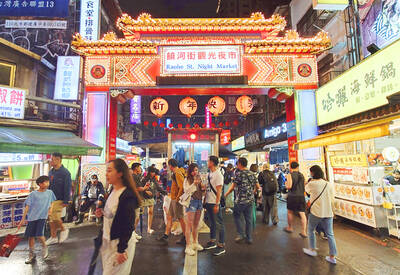
Sales in the retail, and food and beverage sectors last month continued to rise, increasing 0.7 percent and 13.6 percent respectively from a year earlier, setting record highs for the month of March, the Ministry of Economic Affairs said yesterday. Sales in the wholesale sector also grew last month by 4.6 annually, mainly due to the business opportunities for emerging applications related to artificial intelligence (AI) and high-performance computing technologies, the ministry said in a report. The ministry forecast that retail, and food and beverage sales this month would retain their growth momentum as the former would benefit from Tomb Sweeping Day


 RSS
RSS